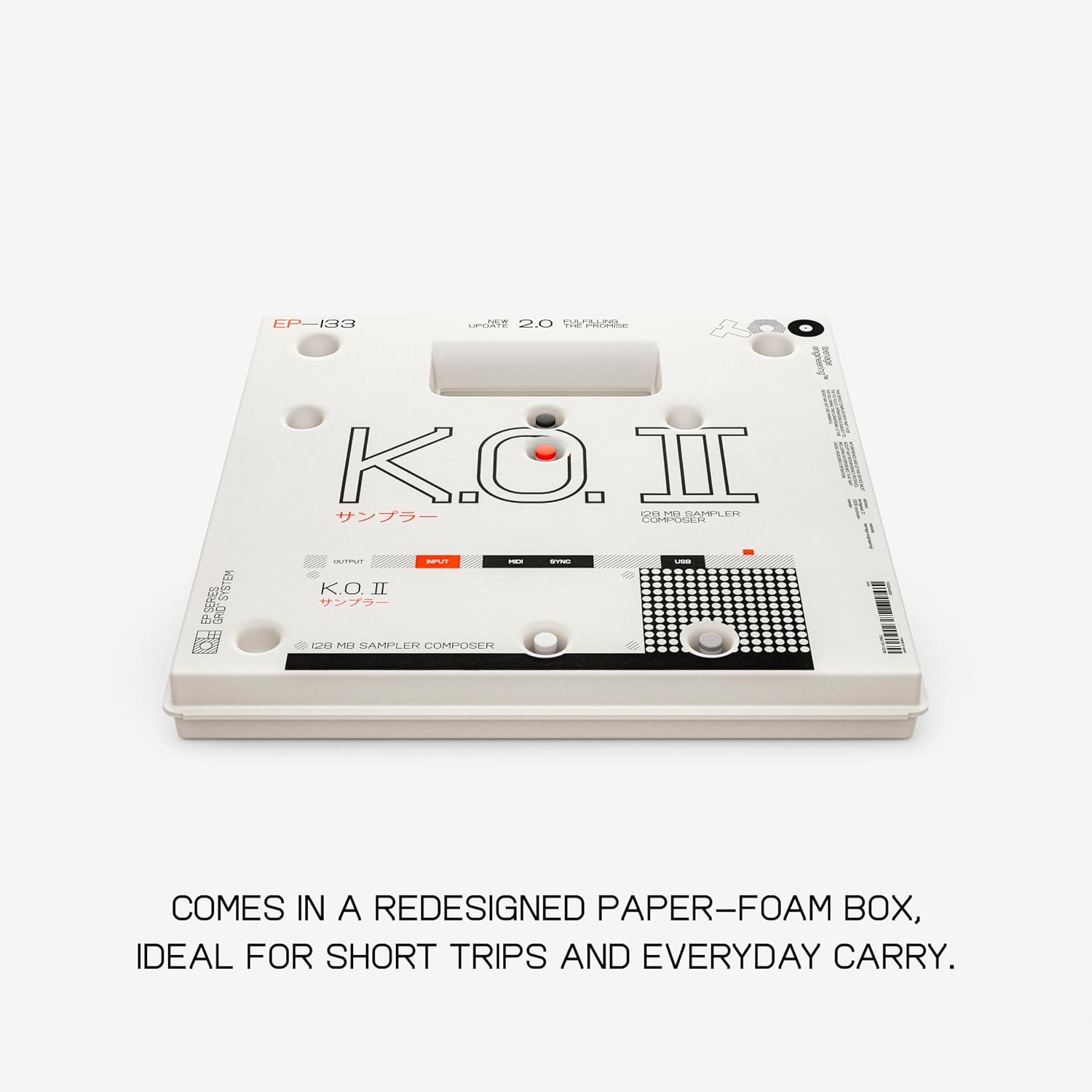
Teenage Engineering makes some of the most talked-about and most misunderstood drum instruments on the market. If you’re new to the brand, here’s the quick context: TE builds small, opinionated hardware devices—drum machines, synthesizers, and sequencers—that prioritize a distinct design philosophy over feature-count. They’re not trying to out-spec Roland. The three instruments in this guide span a wide range: the EP-133 K.O. II is a sampler and sequencer built around chopping and performing audio; the EP-1320 Medieval is a newer, stranger instrument with a themed interface and an unorthodox approach to sound layering; and the PO-32 Tonic is part of TE’s credit-card-sized Pocket Operator series—tiny, battery-powered devices where the PO-32 stands apart as a genuine drum synthesizer (meaning it generates sounds from scratch using math and algorithms, rather than playing back recordings). Choosing between them isn’t about which one is best. It’s about which one fits what you’re trying to do right now.
| EDITOR'S PICKteenage engineering EP–133 K.O.… | Mid-tierteenage engineering pocket oper… | Budget pickTeenage Engineering EP-1320 Med… | |
|---|---|---|---|
| Built-in mic | ✓ | — | ✓ |
| Parameter locks | — | ✓ | — |
| Punch-in FX | — | ✓ | — |
| Memory | 128MB | — | — |
| Price | $329.00 | $59.00 | |
| See on Amazon → | See on Amazon → | See on Amazon → |
What Each Instrument Actually Is (And Isn’t)
Getting this wrong is the most expensive mistake in the TE ecosystem. Let’s be direct.
The PO-32 Tonic is a synthesis engine disguised as a toy. The community consensus—consistent across Synthtopia’s PO-32 Tonic overview and aggregated owner commentary—is that it’s closer to a stripped-down analog-style drum synthesizer than a sample player. The key differentiator: the PO-32 integrates with Microtonic, a drum synthesis plug-in from Sonic Charge. You can design patches in Microtonic on your computer and transfer them to the Tonic via audio cable. That one feature separates the PO-32 from every other Pocket Operator. Owners who use it this way describe it as genuinely expressive—a way to build completely custom drum voices that no other unit in the PO line can match. The trade-off is a 23-step learning curve that catches a lot of buyers off guard.
The EP-133 K.O. II is the most DAW-like instrument TE has ever shipped in a standalone form. CDM’s 2024 workflow feature describes it as a sampler-sequencer that has genuinely reinvigorated musicians’ relationships with physical hardware—specifically because it forces you away from a screen. Owners report that sampling directly into the unit, chopping, and building a beat in one session feels radically different from dragging clips in Ableton. It has 16 pads, effects, a mixer section, and full standalone operation. No computer required after initial setup. That’s the positioning.
The EP-1320 Medieval is the hardest instrument in this group to characterize—because it generates the most polarized owner responses of any recent TE product. MusicRadar’s 2025 hands-on describes it as deeply clever once the logic clicks, but the community pattern is clear: a significant number of owners report 15 or more hours of use still feeling genuinely confused. The specific limitation that generates the most friction: all samples must share a single key. That compositional constraint isn’t a bug—it’s an architectural decision—but it fundamentally changes how you can arrange sounds, and many buyers don’t realize it until they’re already in.
The Tradeoffs, Named Explicitly
Here’s where the decision actually lives.
Synthesis vs. Sampling: The Core Split
If you want to design drum sounds from parameters—envelope, oscillator character, noise floor, transient shape—the PO-32 Tonic is the only instrument in this group that does that natively. The EP-133 and EP-1320 are both sample-based: you load audio in, and the instrument manipulates it. That’s not a criticism; it’s a workflow question. Synthesized drums behave differently under pitch shift, time compression, and modulation. If you’re building a kit that needs to feel cohesive in a specific way—and if you’re willing to invest time in Microtonic—the PO-32’s synthesis path is genuinely distinctive.
If your priority is working with your own sounds—field recordings, vinyl chops, synth hits you’ve already designed—the EP-133 is the right architecture. Sound On Sound’s 2024 EP-133 review notes the sampling and performance workflow as the unit’s clearest strength.
Interface Depth vs. Approachability
The PO-12 Rhythm (not the focus of this guide, but worth naming for context) is consistently described by the community as approachable enough for children with adult help—and complex enough to reward adults who want to go deeper. It’s the genuine entry point. The PO-32 Tonic is harder—the Microtonic integration alone requires a computer, an audio cable, and patience. The EP-133 sits in the middle for initial setup, but its depth is real and documented. The EP-1320 Medieval is the steepest curve in this entire lineup.
Standalone vs. Ecosystem Tool
| Instrument | Standalone? | Pairs well with… |
|---|---|---|
| PO-32 Tonic | Yes (standalone playback) | Microtonic, other Pocket Operators |
| EP-133 K.O. II | Yes (fully standalone) | Pocket Operators, DAW for sample prep |
| EP-1320 Medieval | Yes | Other EP-series hardware (limited sync options) |
The EP-133’s sync capability is worth calling out specifically. Owners who chain it with Pocket Operators via the 3.5mm sync pulse system describe creative lo-fi beat workflows that feel genuinely different from anything a DAW can replicate—the slight analog drift and the physical interaction are part of the aesthetic. Perfect Circuit’s editorial notes on the EP-133 describe this chaining behavior as one of its more compelling live-use cases.
By the Numbers
Street price range (May 2026 market):
- PO-32 Tonic: ~$89–$99
- EP-133 K.O. II: ~$349–$399
- EP-1320 Medieval: ~$349–$399
Battery life (Pocket Operators): Manufacturer-rated at approximately 2 months of daily use on AAA batteries. Owner reports in live performance contexts suggest roughly 3–4 hours of continuous active use per charge cycle before output starts to vary.
Who Should Buy What
If you’re making this decision right now, here’s the clearest framework available based on aggregated community evidence and published reviews.
Buy the PO-32 Tonic if: You want a synthesis engine you can genuinely tweak at the parameter level, you’re willing to spend time in Microtonic designing patches, and you want something that fits in a jacket pocket for a performance rig. The caveat is honest: if you don’t engage with Microtonic, the PO-32 is a very capable but ordinary Pocket Operator. The synthesis access is behind that integration. Owners who use it without Microtonic consistently report feeling like they’re missing the point of the instrument.
Buy the EP-133 K.O. II if: You want a standalone sampler that rewards physical interaction, you’re building a workflow around your own sounds, and you want something that syncs with Pocket Operators without requiring a laptop open in your session. The EP-133 is the least “weird” TE product in this group—it does what it says, it does it well, and the community consensus is that it genuinely changes how people engage with beat-making. CDM’s 2024 feature on the EP-133 is the most useful long-form documentation for understanding its ceiling.
Buy the EP-1320 Medieval if: You have already explored at least one other TE instrument, you can tolerate a steep learning curve, and the instrument’s aesthetic and compositional constraints sound like a creative challenge rather than a limitation. The owners who push through report real satisfaction. But the single-key sample architecture is not a minor quirk—it’s a fundamental compositional trade-off, and if you need independent pitch control per sample slot, the EP-1320 will frustrate you in a way that’s hard to undo. Do not buy this as your first TE instrument.
A note on documentation: across all three instruments, a recurring community pattern is YouTube-dependency. Official manuals are consistently described as insufficient for intermediate users who want to understand why the instruments work the way they do, not just how to operate them. Budget extra time—and search specifically for creator workflows rather than official tutorials—regardless of which device you choose.
Frequently Asked Questions
What is the difference between the PO-32 Tonic and the PO-12 Rhythm in terms of sound generation? The PO-12 Rhythm is a sample-based Pocket Operator—it plays back preset sounds stored in the device. The PO-32 Tonic uses synthesis: it generates sounds algorithmically, and those algorithms can be customized via Microtonic patch transfer. Per Synthtopia’s overview of the PO-32, this makes the Tonic closer in character to a drum synthesizer than a rompler (a device that plays back recorded samples). The PO-12 is the more approachable entry point; the PO-32 is the more technically capable one.
Do Pocket Operators sync with each other and with the EP-133 K.O. II? Yes—Pocket Operators use a 3.5mm audio sync pulse system that chains units together in a master/slave arrangement. The EP-133 K.O. II outputs a compatible sync signal. Owner reports consistently describe multi-PO chains as reliable in controlled environments, though cable management and gain staging on the sync signal require attention in noisy live contexts.
Can you change the pitch of individual samples on the EP-1320 Medieval? This is the instrument’s most-reported limitation. The EP-1320’s architecture routes all samples through a single shared key, which means independent per-sample pitch control in the traditional sense isn’t available in the way most samplers offer it. Owners who find this limiting consistently describe it as a genuine compositional obstacle. Owners who accept it as a constraint describe building around it creatively. Know which camp you’re in before buying.
Does the EP-133 K.O. II require a computer to use fully, or is it truly standalone? The EP-133 is genuinely standalone for performance and composition—sampling, sequencing, effects, and mixing all operate without a computer. A computer is useful for loading samples quickly via USB, but it is not required. Sound On Sound’s 2024 review specifically notes standalone operation as one of its strengths for producers who want screen-free sessions.
How long do batteries last in the Pocket Operators during a live performance? Manufacturer specs rate Pocket Operators at approximately two months of regular use on a pair of AAA batteries. In continuous live performance use—lights on, audio output active, sequencer running—owner reports suggest 3–4 hours of reliable operation is a reasonable expectation. Carrying a spare set of batteries to any live set longer than two hours is the consistent community recommendation.
Is the EP-1320 Medieval’s medieval-themed interface a serious usability obstacle or just aesthetic? Based on aggregated owner reports and MusicRadar’s 2025 coverage, the theming is both. The visual language—iconography, terminology, and layout derived from a medieval aesthetic—is not purely decorative. It maps onto the instrument’s functional architecture in ways that require learning the internal logic on its own terms rather than mapping it to familiar sampler conventions. Owners who engage with that logic describe the interface as clever and consistent. Owners who try to map it onto prior sampler experience consistently report lasting confusion. It is a real learning investment, not a cosmetic quirk.