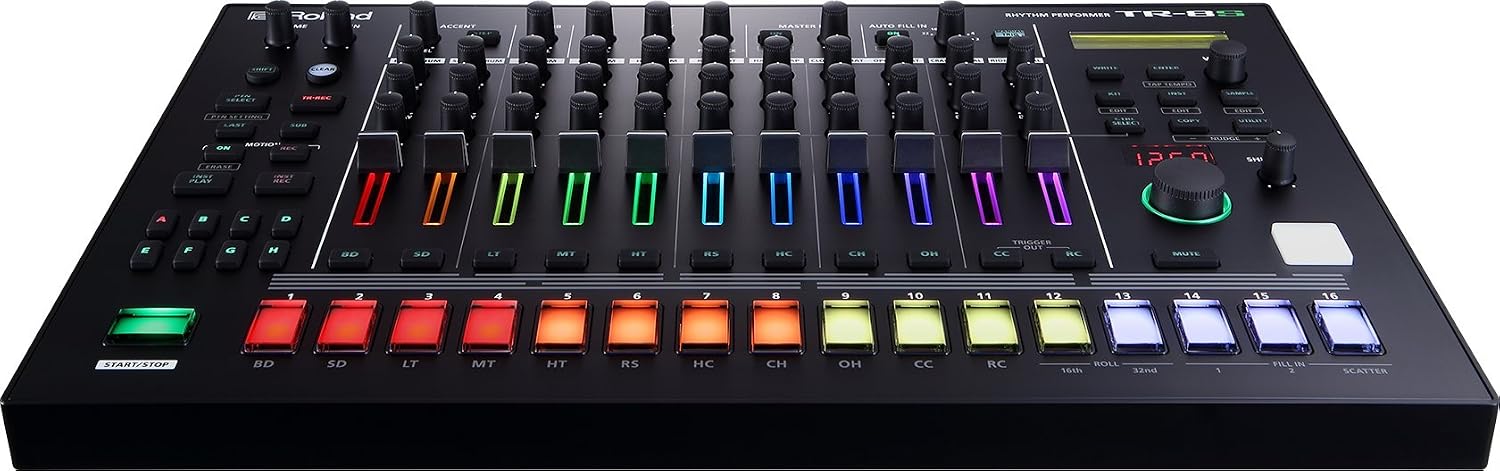
Roland makes a lot of drum machines, but two names keep appearing in the same breath whenever producers ask “which one should I actually buy?” The TR-8S and the TR-6S are both part of Roland’s modern TR (Transistor Rhythm) performance series—standalone hardware boxes designed to let you program, play, and perform drum and percussion patterns without needing a laptop. The “TR” name is a direct nod to Roland’s legendary vintage machines like the 808 and 909, whose electronic drum sounds defined entire genres of music. Both machines recreate those classic sounds using Roland’s ACB (Analog Circuit Behavior) modeling technology—a digital process designed to simulate the electrical characteristics of real analog circuits—plus they accept imported samples via SD card (more on that shortly). If you are relatively new to dedicated drum hardware but ready to spend seriously on a machine that will last, this guide is written for you. If you are further along—running an Elektron rig, a Eurorack case, or a DAW-centric hybrid setup—there is enough technical depth here to sharpen a purchasing decision you have probably been sitting on.
The short version: the TR-8S is the larger, more powerful sibling with individual outputs, USB audio capability, and deeper sample management. The TR-6S is the compact, battery-powered version that trades some connectivity for portability. But the full picture is more interesting—and more useful—than that summary.
| EDITOR'S PICKRoland TR-8S Rhythm Performer |… | Mid-tierRoland Rhythm Composer | Budget pickRoland AIRA Compact T-8 BEAT MA… | |
|---|---|---|---|
| Kits | 128 | — | — |
| Outputs | — | 10 | — |
| Rhythm tracks | — | — | 6 |
| Sequencer | — | — | TR-REC |
| Sound engine | ACB | — | — |
| Classic sounds | 808, 909, 707, 727, 606, CR-78 | — | — |
| Price | $899.99 | $494.99 | $249.99 |
| See on Amazon → | See on Amazon → | See on Amazon → |
By the Numbers
| Spec | TR-8S | TR-6S |
|---|---|---|
| Instrument Tracks | 11 | 6 |
| Individual Outputs | Yes (7 assignable) | No |
| USB Audio Interface | Yes (class-compliant) | No |
| Battery Operation | No (AC only) | Yes (AA batteries) |
| SD Card Sample Import | Yes | Yes |
| Approximate Street Price (May 2026) | ~$499 | ~$299–$349 |
What You Are Actually Comparing
Before diving into the tradeoffs, it helps to understand what both machines share. Roland’s Sound On Sound review from 2018 described the TR-8S as a “remarkably complete performance machine,” and that foundational architecture was later refined and miniaturized into the TR-6S. Both machines run ACB modeling of classic TR sounds—808 kick, snare, hi-hats, clap, the 909 kick and snare—alongside user-loadable samples stored on SD cards (formatted to FAT32). Both have Roland’s iconic step-sequencer interface, where 16 illuminated pads represent 16th-note steps across a pattern. Both offer real-time scatter effects, fill functions, and per-step parameter control. Both connect to a DAW over USB for MIDI sync and control.
That shared foundation is substantial. The machines are not as far apart as the price gap might suggest from a sound-design standpoint. Where they diverge is almost entirely in the categories that matter most for live performance infrastructure and studio integration: outputs, connectivity, power, and track count.
Owners consistently describe the TR-8S as a machine they almost didn’t buy—then found fully justified once they used it in context. One recurring note across aggregated owner reviews is the moment when the USB audio interface feature clicks: rather than a dedicated audio interface, the TR-8S streams all its audio directly into a DAW over a single USB cable, eliminating a piece of gear from the chain. Multiple owners specifically mention using this to sequence Reason and Ableton Live simultaneously, with the TR-8S functioning as clock master, MIDI controller, and audio interface in one device.
The TR-6S story is different. MusicRadar’s 2020 review praised its sound quality and build consistency, and owners who pair it with compact gear—the Arturia MicroFreak is a name that comes up repeatedly in buyer accounts—describe it as an ideal “second voice” in a portable rig. The battery operation is the headline feature and the headline disappointment simultaneously. Roland specs the TR-6S on AA batteries, but real-world owner reports consistently flag battery life as the primary frustration: the machine’s power draw means you cycle through batteries faster than expected in live-set conditions. Rechargeable AAs help but don’t eliminate the issue. This is not a dealbreaker for bedroom studio use, but it is a real operational variable for anyone building a stage rig around it.
The TR-8S Case: Why Eleven Tracks and Seven Outputs Change Everything
The TR-8S’s 11-instrument track count and seven assignable individual outputs are not just spec-sheet checkboxes. They represent a fundamentally different integration model with external gear.
Individual outputs mean your kick, snare, and hi-hats can each hit a separate channel on a hardware mixer or audio interface. That enables per-channel EQ, compression, reverb sends, and parallel processing chains—the same workflow a studio engineer uses with a full live drum kit. Without individual outputs, you are working with a stereo mix baked inside the machine, which limits post-processing granularity significantly.
For Eurorack users and modular enthusiasts, individual outputs also open CV/gate integration via external MIDI-to-CV converters: trigger the TR-8S via MIDI, route its individual outputs as audio sources, and you are building a hybrid analog-digital rhythm system. Sweetwater’s product overview notes that the TR-8S’s USB class-compliant audio interface streams eight channels into a DAW, meaning you can record each drum voice to its own DAW track without an additional interface. That’s a meaningful workflow advantage in a studio context.
The sample import capability on the TR-8S is also deeper than the TR-6S. While both accept SD card samples, the TR-8S provides more memory allocation per project and more flexible sample assignment per instrument track. Per Roland’s published documentation and Synthtopia’s firmware update coverage from 2022, later TR-8S firmware expanded the sample import workflow to allow per-step sample switching, meaning a single instrument track can cycle through different samples at different steps—a technique that dramatically expands sonic range beyond the preset TR voice palette.
If you are running an Elektron Digitakt or Analog Rytm MKII as your sequencer hub, the TR-8S integrates cleanly as a sound module via MIDI, with each track addressable on a separate MIDI channel. That is a setup where the TR-8S earns its keep in a working performance rig.
The TR-6S Case: When Portability Is the Primary Architecture
The TR-6S’s clearest use case is a compact, self-contained rhythm source that travels. Six tracks covers the essential drum kit vocabulary—kick, snare, open and closed hi-hat, clap, and one percussion or tom voice—without the overhead of the TR-8S’s larger chassis and AC power requirement.
Producers building small, battery-capable rigs for live improvisation, busking, or modular-adjacent portable setups consistently cite the TR-6S as the right tool. The Perfect Circuit editorial listing describes it as optimized for performers who “want the TR sound library in the smallest possible box.” That framing holds up in owner accounts: the TR-6S is praised for sounding genuinely good—not like a toy or a budget compromise—while fitting into a backpack alongside a synthesizer and an audio interface.
The tradeoff math here is explicit. You give up:
- Five instrument tracks (11 vs. 6)
- Seven individual outputs (TR-6S has a single stereo out and a headphone jack)
- USB audio interface functionality
- AC power reliability
You gain:
- Battery operation (however imperfect)
- Significantly smaller footprint
- A $150–$200 price difference that can go toward another piece of gear
If your rig already has a capable audio interface and a DAW handling your main recording chain, the TR-6S’s missing USB audio feature costs you nothing. If you are building a studio setup where the TR-8S would replace your interface, the calculus shifts hard toward the larger machine.
The TR-08 and T-8 in Context: A Quick Honest Note
Two machines frequently appear in the same search queries as the TR-8S and TR-6S: the Roland TR-08 (from the Boutique series) and the Roland T-8. These are not the same product family, and the distinctions matter.
The TR-08 is a miniaturized digital recreation of the original TR-808, packaged in Roland’s Boutique form factor. Owners who have played original 808 hardware—a population that produces strong opinions—consistently describe the TR-08 as a “well-rounded update” that captures the 808’s character faithfully, while being clear-eyed that it is digital modeling, not analog circuitry. The absence of a quarter-inch output on Boutique-series hardware is a recurring practical frustration cited in reviews: you are working with a mini-jack output, which requires adapters in most studio and live-performance contexts.
The T-8 is Roland’s budget-oriented hybrid that combines a TR-style step sequencer with a compressed TR sound library. Reviewers are honest that the T-8 is a “piecemeal” combination rather than a complete or definitive TR experience—it captures the interface concept and some of the sounds, but owners approaching it as a substitute for the TR-8S report a gap in depth and flexibility. For a first step into TR-style workflow at a lower entry price, it is a reasonable starting point; for anyone who will outgrow it in six months, the TR-8S’s additional investment is typically the better long-term call.
Frequently Asked Questions
Can the Roland TR-8S import your own samples via SD card? Yes. The TR-8S accepts user samples on an SD card (FAT32 formatted), and each instrument track can be assigned a custom sample alongside or in place of the ACB modeled sounds. Later firmware updates expanded this to allow per-step sample variation, making the sample import system genuinely flexible rather than cosmetic. Roland’s published documentation covers supported formats, which include standard WAV files.
Does the TR-8S work as a MIDI controller for Ableton and other DAWs? Yes. The TR-8S sends and receives MIDI over USB, and owners consistently report using it as a clock master and MIDI controller for Ableton Live, Reason, and other major DAWs. Its USB audio interface capability means it can simultaneously handle audio streaming and MIDI communication over a single cable—a workflow bonus multiple owners describe as genuinely reducing setup complexity.
Is the Roland TR-08 analog or digital? Digital. The TR-08 uses Roland’s ACB (Analog Circuit Behavior) modeling to simulate the analog circuits of the original TR-808. It does not contain analog audio circuitry. Owners who have played original hardware typically acknowledge this honestly: the TR-08 captures the 808’s character and behavior convincingly, but it is a digital recreation, not an analog instrument.
How long does the TR-6S battery last on a full charge? The TR-6S runs on AA batteries rather than an internal rechargeable cell. Roland’s spec sheet does not publish a precise hour rating, and real-world owner accounts vary based on volume and feature use—but the consistent pattern across reviews is that battery drain is faster than expected for live performance use. Rechargeable AAs are the practical workaround most owners land on.
What is the difference between the Roland TR-8S and TR-6S for live performance? The TR-8S gives you 11 instrument tracks, seven individual outputs for external mixing, USB audio interface capability, and AC power stability. The TR-6S gives you 6 tracks, a single stereo output, and battery operation in a smaller chassis. For a performer who needs each drum voice on its own mixer channel and wants to sync seamlessly with a DAW, the TR-8S is the live performance tool. For a performer who needs a compact, portable rhythm source that travels without a power adapter, the TR-6S fits that role—with the caveat that battery management becomes an active operational concern.
The Decision Rule
Here is the framework that resolves most of these decisions:
If you are building or already have a studio rig with a mixer, DAW, and audio interface: the TR-8S’s individual outputs and USB audio integration justify the price gap. Owners who made this purchase at the $499 price point consistently describe it as the right call in retrospect.
If portability is the primary architectural constraint—you are playing live sets from a backpack, pairing with a single synthesizer like the MicroFreak, or buying a second rhythm voice for a mobile rig that already has a capable main interface—the TR-6S is the right machine, with eyes open about battery management.
If you are drawn to the TR-08’s vintage-808 focus specifically: go in knowing it is digital, budget for a quarter-inch adapter, and understand that it is optimized for authentic 808 recreation rather than the broader TR-8S workflow.
The TR-8S is the machine that rewards being taken seriously. The TR-6S is the machine that rewards knowing exactly what you need it to do.