Roland has been making drum machines—dedicated hardware boxes that generate, sequence, and play back percussion sounds—since the early 1980s. Their TR series (TR stands for Transistor Rhythm, the name of Roland’s original circuit topology) became the backbone of house, techno, and hip-hop production. Today, three current machines carry that TR badge at very different price points and form factors: the flagship TR-8S, the compact TR-6S, and the miniature TR-08 from Roland’s Boutique line. If you’re trying to decide which one belongs in your setup, this article maps out exactly where each machine wins, where it compromises, and which one makes sense depending on what you’re actually trying to do. No hand-waving—just the tradeoffs laid out plainly so you can make the call.
| EDITOR'S PICKRoland TR-8S Rhythm Performer |… | Mid-tierRoland Rhythm Composer | Budget pickRoland TR-6S Rhythm Performer |… | |
|---|---|---|---|
| Type | Drum machine | Rhythm composer | Drum machine |
| Kits | 128 | — | — |
| Tracks | — | — | 6 |
| Outputs | — | 10 | — |
| FM engine | — | — | ✓ |
| Price | $899.99 | $494.99 | $453.99 |
| See on Amazon → | See on Amazon → | See on Amazon → |
The Lineup at a Glance
Before digging into the nuances, here’s the frame. All three machines share the TR lineage and Roland’s ACB (Analog Circuit Behavior) digital modeling technology—software that analyzes and reproduces the electrical behavior of original analog circuits. The differences come down to voice count, I/O, portability, and price.
| Model | Street price (mid-2026) | Voice count | Analog circuits | Sample import |
|---|---|---|---|---|
| TR-8S | ~$499 | 11 | Yes (select voices) | Yes |
| TR-6S | ~$299 | 6 | Yes (select voices) | Yes |
| TR-08 | ~$199 | 11 (TR-808 set) | No — ACB digital | No |
The three machines answer three meaningfully different briefs. The sections below work through each in detail before the decision frame pulls it together.
Machine-by-Machine Breakdown
TR-8S: The Machine That Keeps Surprising Its Owners
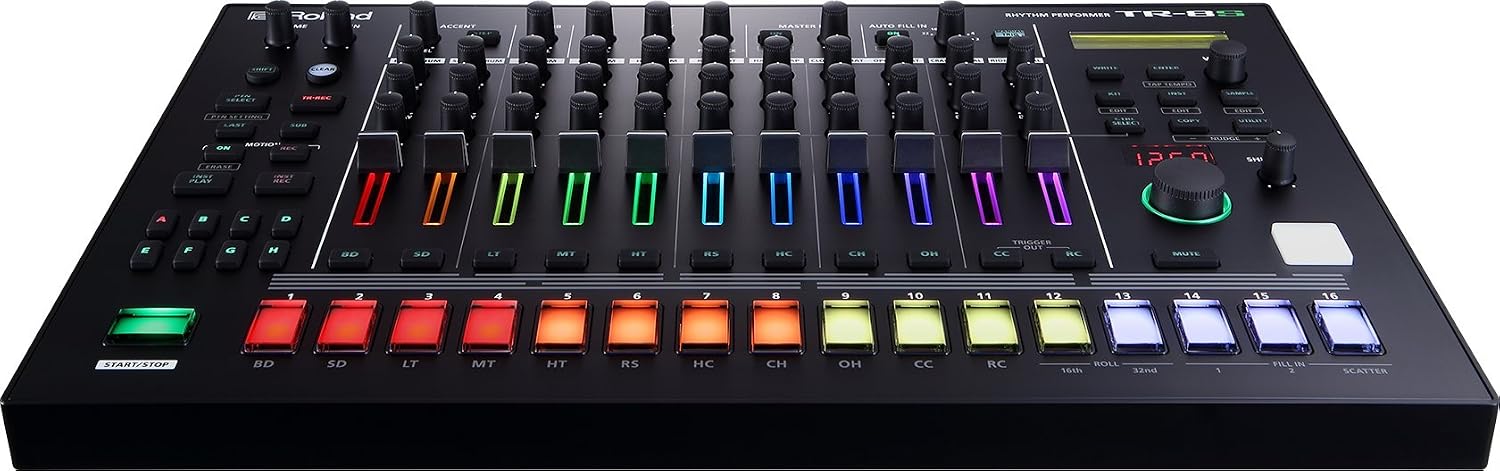
The TR-8S is the broadest instrument of the three. Sound On Sound’s 2018 review of the Roland TR-8S describes it as a remarkably complete performance and production tool for its price tier. The 11-voice sequencer covers classic TR-808 and TR-909 emulations simultaneously, plus TR-606, TR-707, CR-78, and TR-727 sound sets—all switchable per instrument track. That alone is a substantial library of rhythm machines that previously required owning multiple pieces of hardware or separate software licenses.
The TR-8S’s real differentiator is what owners consistently describe as its depth of customization. Per Sweetwater’s TR-8S product page and buyer Q&A, users who expected a straightforward pattern machine keep discovering new layers: per-step probability, sub-steps for shuffle and micro-timing, scatter effects, and a motion sequencing system that records real-time knob movements as automation. Sound On Sound’s review also flags the USB audio and USB MIDI dual functionality as a genuine workflow upgrade—you can use the TR-8S as a multi-channel audio interface simultaneously with using it as a sequencer, which means stems land in your DAW already separated by instrument without patch cables.
The sample import feature (loaded via SD card) is more than a checkbox. Owners report using it to slot custom one-shots directly into the pattern alongside the built-in ACB voices, so a 909 kick can share a sequence with a custom Foley hit or a sample from a hardware synthesizer. That flexibility is rare at this price.
The honest caveat: The TR-8S is the largest of the three—a proper desktop unit, not a grab-and-go box. Attack Magazine’s 2022 drum machine workflow feature notes that deep parameter access on machines like the TR-8S often requires button combinations that take genuine time to internalize. You’re getting a lot; be prepared to earn it.
A notable pattern in the owner community: multiple TR-8S buyers mention they originally considered simpler machines and are glad they stretched. The machine rewards patience in a way the more limited formats do not.
Roland
$899.99
In stock on Amazon
Check price on AmazonTR-6S: Maximum TR Heritage in Minimum Space
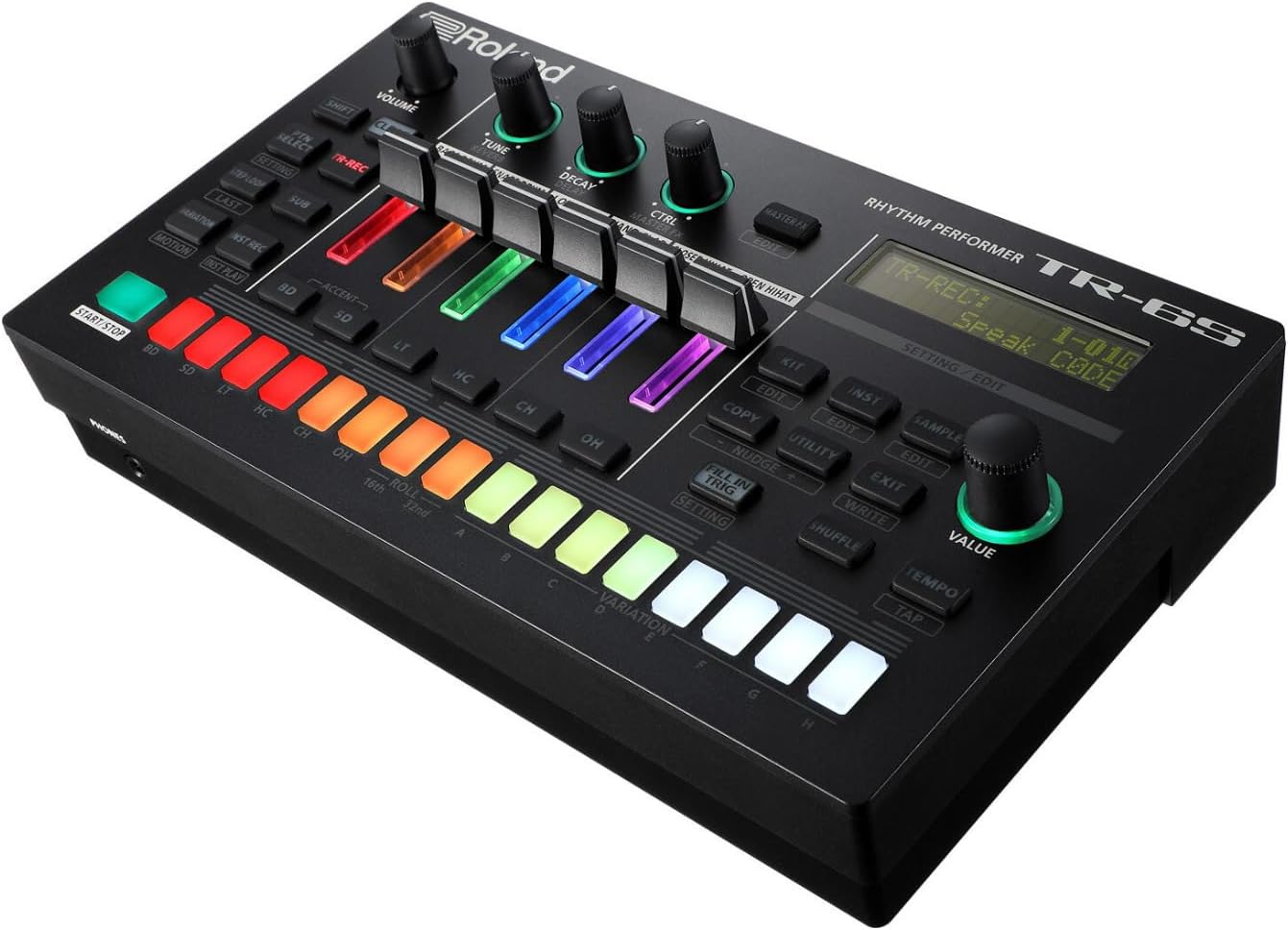
The TR-6S runs on the same ACB engine as the TR-8S and draws from the same deep catalog of classic TR sounds—808, 909, 606, 707, CR-78, 727—but compresses the instrument count to six tracks instead of eleven. For producers who primarily work with kick, snare, hi-hat (open and closed), clap, and one additional percussion voice, that’s frequently enough.
MusicRadar’s 2019 review of the Roland TR-6S praises the machine for how much TR heritage fits into the compact body. It genuinely sounds like its bigger sibling, and it supports the same sample import workflow via microSD card. The sequencer carries over the same step-programming logic, scatter effects, and motion sequencing. From a pure sound-engine standpoint, you are not buying a lesser instrument—you are buying a smaller one.
The battery situation is the flag that comes up consistently in TR-6S coverage. The machine runs on four AA batteries, which is useful for portable and off-grid contexts—busking, park sessions, travel setups—but battery life in practice sits around four to six hours of active use under moderate volume, based on aggregated owner accounts gathered in MusicRadar’s reader comments and Sweetwater’s buyer Q&A for the TR-6S product page. For a dedicated studio machine, that’s a non-issue since you’ll run it from the included adapter. For a performer who wants the portability to matter consistently, it’s worth building battery swaps into your workflow.
The honest tradeoff: The TR-6S saves approximately $200 over the TR-8S and takes up less desk space, but you’re trading five instrument tracks and some I/O flexibility to get there. The six voices are genuinely enough for a lot of music—four-on-the-floor techno, minimal house, stripped-back hip-hop—but if you’re layering complex multi-percussion patterns with separate outs for each voice, you will feel the ceiling.
Roland TR-08
$494.99
In stock on Amazon
Check price on AmazonTR-08: The 808 Specialist in a Boutique Shell
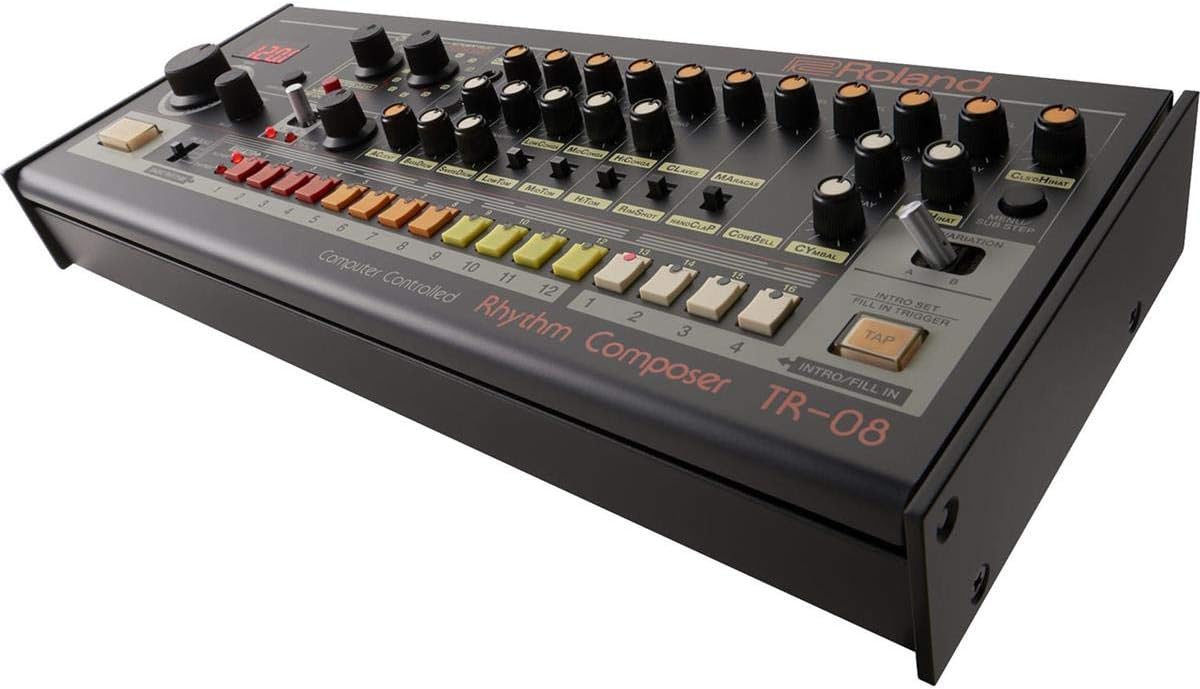
The TR-08 belongs to Roland’s Boutique series—small, bus-powered desktop units that faithfully reproduce specific classic instruments. This one recreates the TR-808, arguably the most influential drum machine ever made, in a chassis roughly the size of a hardcover book.
Synthtopia’s coverage of the Roland Boutique series at launch highlights that the TR-08 runs Roland’s ACB digital modeling rather than real analog circuitry. Reviewers almost universally note this distinction—sometimes with mild initial hesitation—but the consistent follow-up is that it delivers a sonically credible recreation. Side-by-side listening comparisons referenced in Synthtopia’s Boutique coverage and in Sound On Sound’s broader ACB series analysis suggest the differences between the TR-08 and an original TR-808 are subtle enough that most listeners will not identify them in a finished mix.
What the TR-08 does not do is give you flexibility beyond the 808 voice set. You get exactly the instruments the original 808 had: bass drum, snare drum, low, mid, and hi tom, rim shot, hand clap, maracas, cowbell, cymbal, open and closed hi-hat. No sample import. No switching to 909 or 606 sounds mid-performance. If the 808 sound set is your entire world, that focus is a feature rather than a limitation; if you want to branch into other TR eras, it’s a hard boundary.
The I/O situation is the practical concern that comes up repeatedly in live-use accounts. The Boutique form factor uses a stereo mini-jack (3.5mm) output instead of standard quarter-inch jacks. For studio use with a quarter-inch patch bay or mixing board, you need an adapter cable. On a live stage where cables get stepped on or yanked, that 3.5mm connection introduces a weak point that larger TR machines avoid. It’s a small thing until it becomes a problem mid-set.
The honest tradeoff: The TR-08 is the most affordable entry into real-hardware TR sequencing, and for 808-specific production or live performance it is genuinely capable. But the absence of sample import, the single-era sound set, and the Boutique I/O are real constraints that matter more as a setup grows in complexity.
Roland
$453.99
In stock on Amazon
Check price on AmazonThe Decision Frame: If X, Then Y
The patterns across published reviews—Sound On Sound’s TR-8S review, MusicRadar’s TR-6S review, Synthtopia’s Boutique series coverage, Sweetwater’s buyer Q&A pages, and Attack Magazine’s drum machine workflow feature—point toward consistent conclusions:
If you want one machine that can do everything TR-related and grow with you for years: the TR-8S is the answer. The breadth of sounds, the sample import, the USB audio interface functionality, and the deep motion sequencing make it the instrument that experienced owners consistently say they’re glad they invested in. The premium over the TR-6S pays for itself in versatility.
If portability is a genuine priority and six voices cover your compositions: the TR-6S is the smart call. Same sound engine, same heritage, same sample workflow, in a machine you can actually take off the desk. Battery life requires planning but isn’t a dealbreaker. Within its six tracks, the TR-6S is a full TR instrument—not a reduced one.
If you make 808-centric music and want the most affordable dedicated hardware path: the TR-08 earns its place. It is a specialist tool, not a generalist one. Know going in that ACB is digital modeling—excellent digital modeling, but digital—that you cannot import samples, and that the mini-jack output needs an adapter for most real-world rigs. Within those parameters, it is a focused, affordable, sonically credible 808 machine.
If you are a bedroom producer choosing between TR-6S and TR-8S: the consistent owner sentiment gathered across Sweetwater’s buyer Q&A for both machines is to stretch for the TR-8S if budget allows. The additional voices, the USB audio routing, and the full quarter-inch I/O pay off quickly once the machine connects to the rest of a studio rig.
Frequently Asked Questions
Is the TR-08 actually analog or digital modeling? It is digital modeling—specifically Roland’s ACB (Analog Circuit Behavior) technology. It is not an analog machine. Synthtopia’s Boutique series coverage confirms this consistently, as does Sound On Sound’s broader examination of Roland’s ACB platform. The recreation is widely considered sonically excellent and close to an original TR-808, but it is an important technical distinction if circuit authenticity matters to you.
Can the TR-6S run on batteries for portable use, and how long does the battery last? Yes. The TR-6S runs on four AA batteries. Based on owner accounts aggregated in MusicRadar’s TR-6S review comments and Sweetwater’s product Q&A, practical battery life falls in the four-to-six-hour range at moderate output levels. Runtime varies with volume and headphone versus line output use.
What classic drum machine sounds are included in the TR-8S versus the TR-6S? Both machines draw from the same Roland ACB library: TR-808, TR-909, TR-606, TR-707, CR-78, and TR-727 sound sets, as documented in Sound On Sound’s TR-8S review and MusicRadar’s TR-6S review. The TR-8S runs eleven instrument tracks and can combine sounds from multiple eras in a single pattern; the TR-6S runs six tracks from the same library.
Can all three sync with external gear or a DAW over USB? Yes, all three support USB MIDI sync. The TR-8S additionally functions as a USB audio interface—multiple channels of audio route directly into a DAW over a single USB cable, a point highlighted in Sweetwater’s TR-8S product page. The TR-6S and TR-08 support USB MIDI but not USB audio interface functionality. All three also carry standard MIDI DIN connections for hardware sync.
Can you import your own samples into the TR-6S or TR-8S? Yes to both. The TR-8S uses a standard SD card; the TR-6S uses a microSD card. Both allow you to load custom one-shot samples and assign them to instrument tracks alongside the built-in ACB voices, as confirmed in Sweetwater’s buyer Q&A for each machine. The TR-08 does not support sample import.