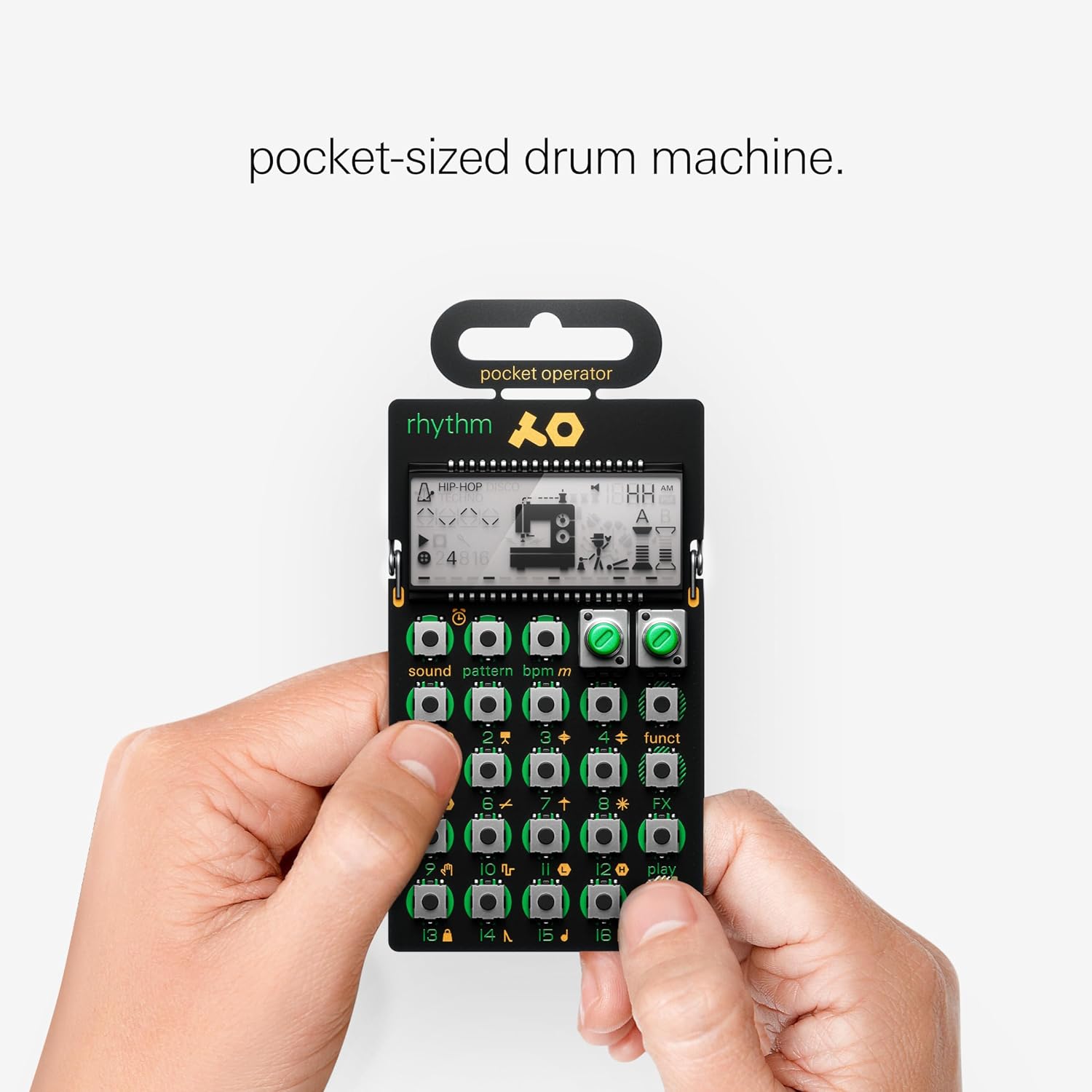
Teenage Engineering’s Pocket Operators—a series of palm-sized, bare-circuit synthesizers and sequencers—have spent the better part of a decade defying easy categorization. They look like toys. They cost less than a night out in most major cities. And yet producers at every level keep them in the rotation, not as novelties but as genuinely musical instruments. If you’re new to the concept: a Pocket Operator is a self-contained device with a built-in speaker, a small step sequencer (a tool for programming rhythmic patterns), and a bank of sounds or synthesis voices. You program beats by pressing buttons in sequence, chain effects, and sync multiple units together. The entire thing runs on two AAA batteries and fits in a jacket pocket without stretching the fabric.
This guide focuses on three specific models that come up repeatedly in producer conversations: the PO-12 Rhythm (the classic drum machine entry point), the PO-24 Office (a criminally overlooked unit built around industrial and office-machine sounds), and the PO-32 Tonic (the outlier—a genuine drum synthesizer that integrates with professional software). If you already own one PO and are weighing what comes next, or if you’re building a lo-fi production ecosystem from scratch, this is the decision map you need.
| EDITOR'S PICKteenage engineering EP–133 K.O.… | Mid-tierteenage engineering pocket oper… | Budget pickteenage engineering pocket oper… | |
|---|---|---|---|
| Memory | 128MB | — | — |
| Built-in mic | ✓ | — | — |
| Parameter locks | — | ✓ | ✓ |
| Solo function | — | ✓ | — |
| Punch-in effects | — | ✓ | ✓ |
| Price | $329.00 | $89.00 | $59.00 |
| See on Amazon → | See on Amazon → | See on Amazon → |
What Each Unit Actually Does: A Clear-Eyed Comparison
Before committing to any of these, it helps to understand what category each one lives in—because they are not interchangeable.
The PO-12 Rhythm is the straightforward drum machine of the three. Its sound palette covers kick, snare, hi-hat, and percussive hits that read immediately as rhythmic material. MusicRadar’s Pocket Operator buying guide describes it as the most intuitive entry point in the lineup, and owner accounts across aggregated reviews confirm that pattern: the PO-12 is the one people reach for when they want to sketch a beat on a train, loop alongside a guitar, or audition groove ideas without booting up a DAW (Digital Audio Workstation—software like Ableton Live or Logic Pro used to record and produce music). CDM has consistently positioned the PO-12 as proof that constraint-based instruments can generate ideas that polished tools miss.
The PO-24 Office operates in a different register entirely. Its sound sources include floppy disk drives, dot matrix printers, keyboard clicks, and other digital-industrial textures that were never designed to be musical. Owners who approach it expecting a conventional drum machine tend to be underwhelmed. Owners who approach it as a sequenced noise and rhythm tool describe it as one of the most surprising instruments in their collection. Perfect Circuit’s product listings flag it as a niche but devoted favorite, and the pattern in long-run reviews is consistent: the PO-24 rewards experimentation and pays off most for producers working in industrial, lo-fi, ambient, or experimental contexts. If your reference tracks involve any amount of texture, crunch, or found-sound rhythm, the PO-24 is less “criminally overlooked” and more “hidden gem that most buying guides undersell.”
The PO-32 Tonic is a genuinely different beast. Rather than playing back fixed samples, the PO-32 runs analog-modeled drum synthesis—meaning it generates sounds mathematically in the style of classic analog drum circuits rather than replaying recorded audio. Sound On Sound’s review of the PO-32 Tonic notes that this gives it a character that owners consistently describe as richer and more dynamic than the other POs. Crucially, the PO-32 also integrates with Microtonic, a professional drum synthesis plugin (software instrument) made by Sonic Charge. Through an audio transfer protocol—essentially encoding patch data as sound that the PO-32 receives through its audio input—you can load any Microtonic preset into the device. Synthtopia’s coverage of the Tonic at launch flagged this workflow as genuinely powerful rather than a marketing gimmick, and the producer community has validated that over several years of use.
By the Numbers
| Unit | Primary Sound Type | Synthesis Method | Microtonic Integration | Street Price Range (2026) |
|---|---|---|---|---|
| PO-12 Rhythm | Drums / percussion | Sample-based | No | ~$79–$99 |
| PO-24 Office | Industrial / noise textures | Sample-based | No | ~$79–$99 |
| PO-32 Tonic | Analog-modeled drums | Synthesis (not samples) | Yes | ~$89–$109 |
Prices sourced from current listings at Perfect Circuit and Sweetwater as of May 2026. Street prices fluctuate; check current retailer listings before purchasing.
Syncing, Stacking, and Building an Ecosystem
One of the Pocket Operator’s most underappreciated features is its sync system. Each unit has a 3.5mm audio input and output (standard headphone jacks), and it can pass a sync clock signal—a timing pulse that keeps multiple devices locked in tempo—from one PO to the next through a standard audio cable. This daisy-chain sync means you can run a PO-12, a PO-24, and a PO-32 all locked together in perfect time without any additional hardware. The master unit (the one you set the tempo on) sends clock to everything downstream.
This sync system also extends to external gear. Any device that can output a standard analog clock pulse—many Eurorack modules, the Korg Volca series, and certain MIDI-to-sync converters—can drive a Pocket Operator, or be driven by one. This opens the POs up as legitimate components in a larger modular or hybrid setup, not just standalone toys. CDM has covered this interoperability as one of the format’s underrated practical strengths.
One producer workflow that comes up repeatedly in aggregated community reviews: chaining one or more Pocket Operators with the Teenage Engineering EP-133 K.O. II (a sampler and beat-maker at a higher price tier) to build what owners describe as a lo-fi production ecosystem. The EP-133 can act as a sync master and recorder, capturing PO output while adding sampling and more sophisticated sequencing on top. It’s a combination that punches well above what each piece costs individually.
The bare-board form factor—Pocket Operators ship without a case or protective housing by default—does have a practical implication here: owners universally report that the built-in speaker is too quiet for any real-world use beyond private sketching, and that headphones or an amplifier are required for monitoring and performance. Teenage Engineering sells protective cases separately, and third-party options exist, but budget for that if you’re planning to use POs outside the house.
The PO-32 Tonic and the Microtonic Question
The integration between the PO-32 Tonic and Microtonic software is worth unpacking because it changes the instrument’s value proposition significantly depending on your situation.
If you already use Microtonic as a plugin in your DAW, the PO-32 becomes a hardware front-end for your existing sound library. The transfer workflow—playing a patch as audio into the PO-32’s input—takes under a minute per kit once you’ve done it a few times. Sound On Sound’s review describes the process as quick to learn and reliable in practice. You’re essentially taking the synthesis engine you already know and putting it in your pocket.
If you don’t own Microtonic, the PO-32 still ships with 16 factory sounds that cover a broad range of analog-modeled drum voices, and those sounds can be edited directly on the device using the parameter knobs. You are not locked out of useful functionality without the software—but you are locked out of the deepest level of customization and the ability to load specific patches. Microtonic is a paid plugin (Sonic Charge sells it via their website), so factor that into the total cost calculation if you’re planning to exploit the integration fully.
The honest decision frame: if you’re working primarily in the box (inside DAW software) and already have strong sample libraries, the PO-32’s synthesis character may not justify the extra steps. If you find yourself wanting more life and variation in your drum sounds—more the character of an analog circuit than the flatness of a sample—the PO-32 is the unit that delivers that in this format.
Frequently Asked Questions
Do you need to own Microtonic software to get the most out of the PO-32 Tonic? No, but it unlocks the instrument’s full potential. The factory sounds are genuinely usable and cover a wide range of drum voice characters. You can edit them with the onboard controls. Microtonic adds the ability to design patches from scratch in a visual interface and transfer them to the device—which owners who use both describe as transformative. If budget is the constraint, start with the PO-32 and add Microtonic later.
Can Pocket Operators sync to each other and to external gear? Yes. POs pass a sync clock signal through their 3.5mm audio connections, so you can chain multiple units in sequence. They also accept and output sync-compatible clock signals from external devices including many Eurorack modules and the Korg Volca series. MIDI sync requires a dedicated converter (MIDI is a separate digital protocol), but analog clock sync works out of the box with a standard audio cable.
Is the PO-24 useful if you are not interested in noise and glitch music? It depends on how broadly you define rhythm. The PO-24’s sounds—mechanical, industrial, and digital-artifact textures—can be sequenced into surprisingly musical rhythmic patterns even if you’re not making noise or glitch music outright. Owners who produce lo-fi, ambient, or experimental hip-hop describe it as a useful texture generator. If your work is entirely in conventional drum machine territory, the PO-12 or PO-32 will serve you better.
What is the real battery life of a Pocket Operator in daily use? Manufacturer specs put battery life at approximately 30 hours on two AAA batteries. Owners in long-run reviews generally confirm this range under typical conditions (moderate speaker volume, normal sequencer use). Heavy speaker use drains batteries faster; headphone use extends life. Budget for rechargeable AAAs if you’re using a PO regularly.
Can you save patterns on the Pocket Operator, or do you lose them when batteries die? Patterns are saved in memory and persist through normal battery swaps as long as you follow the correct procedure: the PO retains data while power is present, so swapping batteries quickly (before the capacitors discharge) preserves your work. If batteries fully drain and the unit loses power completely, patterns are lost. Owners consistently recommend swapping batteries promptly rather than running units to empty.
Is the EP-133 K.O. II a direct upgrade from a Pocket Operator, or a different tool entirely? Different tool. The EP-133 K.O. II is a sampler and beat workstation that operates at a higher level of complexity and cost. It’s not a replacement for the PO-12, PO-24, or PO-32—it doesn’t do what the PO-32 does with synthesis, and it approaches beat-making from a sampling workflow rather than a synthesis or sequencing workflow. The community consensus from owners who run both is that POs and the EP-133 complement each other: POs contribute character and synthesis voices, the EP-133 contributes sampling, more sophisticated sequencing, and recording. Think ecosystem, not ladder.
The Decision Rule
If you want a reliable, intuitive beat-sketching tool you’ll actually carry everywhere: PO-12 Rhythm.
If you produce lo-fi, experimental, industrial, or texture-heavy music and want a rhythm tool that will surprise you: PO-24 Office.
If you want the deepest synthesis character in the PO format and are willing to learn a slightly more involved workflow—especially if you already use or plan to use Microtonic: PO-32 Tonic.
And if budget allows, the PO-12 and PO-32 together, synced via audio cable, cover more ground than either does alone—a combination that aggregated owner reviews consistently describe as greater than the sum of its parts.