The Korg Volca series is Korg’s line of palm-sized, battery-powered instruments — each one focused on a specific synthesis technique and priced to make hardware production accessible without a studio budget. The Volca Beats and Volca Drum are both rhythm machines in that family, but they solve very different problems. The Volca Beats is an analog drum machine: it generates sounds using analog circuitry — real electrical circuits, not software simulations — and it is designed to get you building recognizable kick-snare-hi-hat patterns almost immediately. The Volca Drum is a digital percussion synthesizer that gives you deep, granular control over each drum sound from the wave level up. It is genuinely powerful and genuinely more demanding. If you are trying to decide which one deserves a slot in your rig, this comparison walks through the tradeoffs directly, shows you where the value actually lands, and closes with a clear decision rule.
What You Are Actually Buying: Architecture and Sound Philosophy
The most important thing to understand before comparing knob counts or feature lists is that these two machines make sound in fundamentally different ways, and that difference shapes every downstream decision.
The Volca Beats: Analog Immediacy
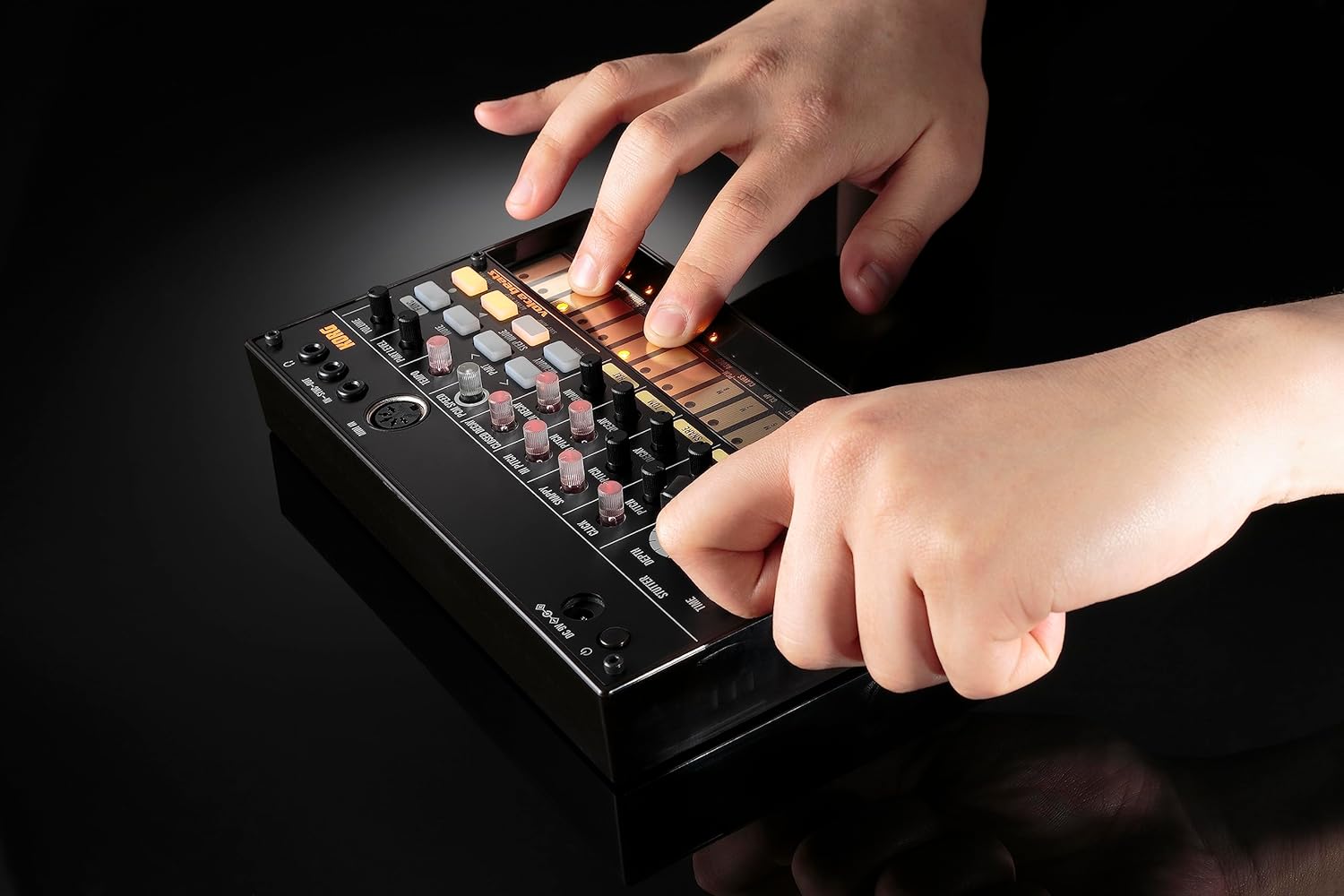
The Volca Beats uses analog synthesis for its core voices: kick, snare, hi-hat (open and closed), clap, claves, agogo, crash, and ride — ten sounds in total, each with a handful of dedicated knobs. “Analog” here means the circuitry generates waveforms directly through components like capacitors and transistors, rather than playing back samples or running audio algorithms on a processor. As covered in the Sound On Sound Korg Volca Beats review, the analog kick in particular is described as genuinely low-frequency-capable and responsive to tuning — not a toy kick, but a real synthesized thud that holds up in a mix. The PCM (digital sample-based) hi-hats draw criticism in that same review for sounding thinner than the analog voices, which is a legitimate limitation, but the overall consensus is that the package justifies its price clearly.
The tradeoff for that analog warmth is a fixed palette. You can sculpt each voice, but you cannot replace a kick with a woodblock. What you hear is what the circuit is built to do.
Korg
$129.98
In stock on Amazon
Check price on AmazonThe Volca Drum: Digital Physical Modeling
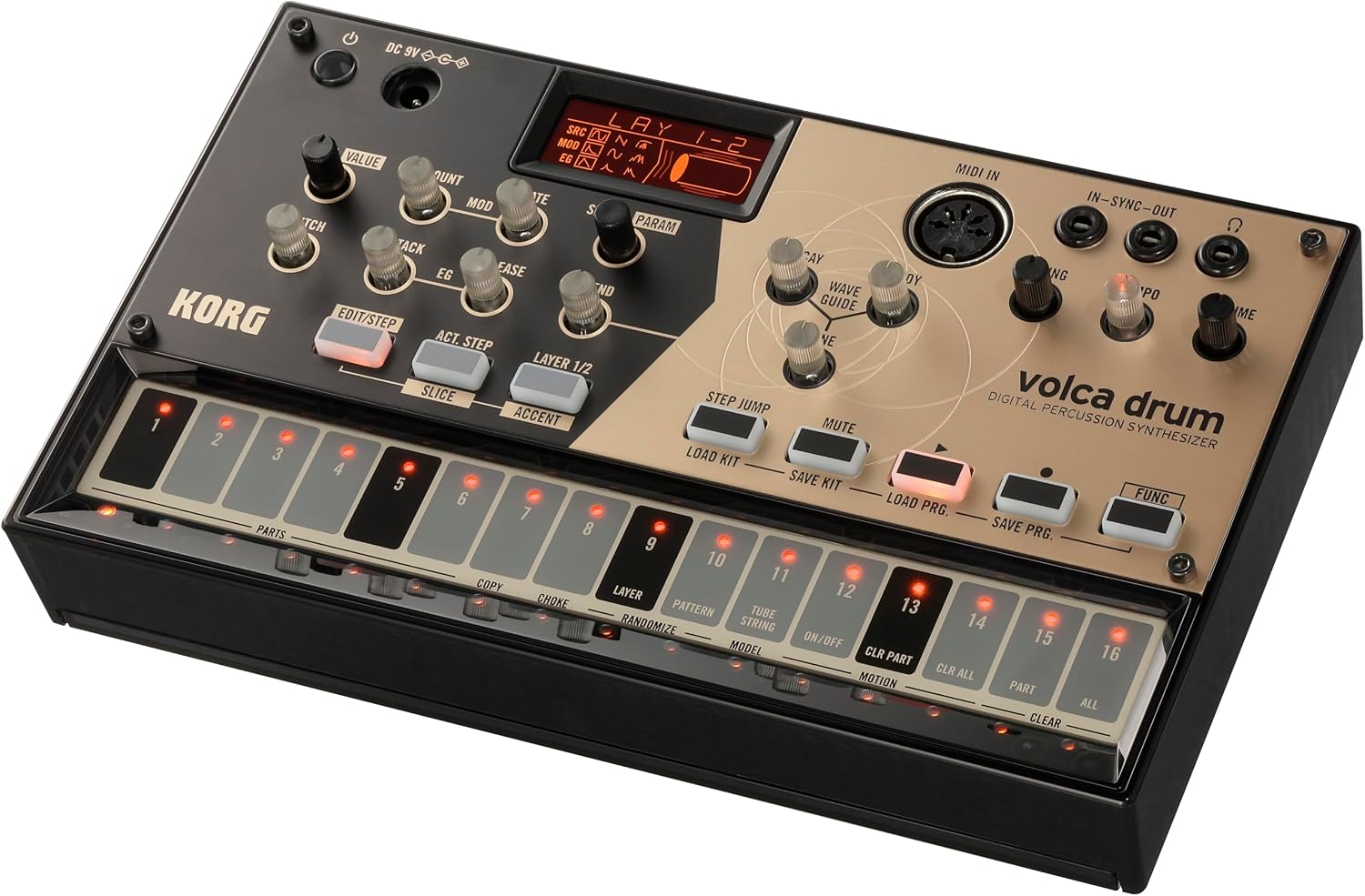
The Volca Drum uses a digital engine built around physical modeling — the synthesizer mathematically simulates the behavior of resonating physical objects (membranes, tubes, plates) to generate its sounds. Each of its six tracks has two layers, each with its own oscillator, waveguide (the resonant body model), and modulation routing. According to the MusicRadar Korg Volca Drum review, this architecture means you can coax results ranging from conventional kicks and snares to metallic textures, melodic tones, and sounds that have no real-world percussion equivalent.
The ceiling is genuinely high. But the floor requires investment: you need to understand what a waveguide is doing, at least loosely, before you can navigate the editing workflow fluently. The Sweetwater Korg Volca Beats product overview acknowledges that the Volca line is positioned specifically to lower the entry point to hardware synthesis, and the Drum is the member of that family that tests that positioning most seriously.
Korg
$149.80
In stock on Amazon
Check price on AmazonSide-by-Side Architecture at a Glance
| Feature | Volca Beats | Volca Drum |
|---|---|---|
| Voices / Tracks | 10 analog voices | 6 tracks × 2 layers |
| Step sequencer | 16-step | 16-step + 16 hits per step |
| Pattern memory | 16 patterns | 16 patterns |
| Synthesis type | Analog | Digital physical modeling |
| Built-in speaker | Yes | Yes |
| Sync I/O | Sync in/out | Sync in/out |
| Probability per step | No | Yes |
| Parameter step locking | No | Yes |
Korg
$149.80
In stock on Amazon
Check price on AmazonWhere the Volca Beats Wins
The Beats has one enormous practical advantage: immediacy. Owners consistently report that within five to ten minutes of unboxing, you are running a groove. The layout is purpose-built for the TR-style workflow — one button per instrument, step buttons along the bottom, dedicated knobs for each voice’s main parameters. That is the format Roland popularized with the TR-808 and TR-909, and Korg maps directly to that muscle memory.
The Sound On Sound Korg Volca Beats review praises the analog kick as punching well above the machine’s price bracket. Aggregated coverage across that review and the Attack Magazine Volca series buyer guide places the next meaningful analog drum machine tier at significantly higher price points — community consensus among writers covering budget hardware consistently identifies a gap of several hundred dollars between the Beats and the next tier of analog drum machines. That makes the Beats a genuine ceiling for what you can get at budget-analog price points.
The Beats also handles live sync cleanly. It accepts and transmits sync pulses — simple clock signals that keep multiple devices locked to the same tempo — and connects with other Volcas, MIDI-equipped gear, and older analog sequencers via its 3.5mm sync jacks. For a multi-device live rig, that interoperability is a real asset.
One honest limitation flagged in the Attack Magazine Volca series buyer guide: the interface is small. Knobs are close together, and in a live context — dim lighting, adrenaline, monitoring through a PA — reaching for a specific control reliably takes practice. It is a recurring practical note from live users rather than a dealbreaker, but it is worth naming if you are building a performance rig.
Korg
$129.98
In stock on Amazon
Check price on AmazonWhere the Volca Drum Wins
Parameter Step Locking and Sequencing Depth
The Volca Drum’s headline capability is parameter step locking — a feature that fundamentally changes what a step sequencer can do. In a standard step sequencer, you set a sound’s parameters (say, pitch and decay), and every time that step fires, those parameters are fixed. With parameter step locking, you assign different parameter values to each individual step. The result: a single drum track can play a short, high-pitched hit on step one, a long, low-pitched resonant bloom on step five, and something in between on step nine — all from one voice, without any external modulation.
Synthtopia’s hands-on coverage of the Korg Volca Drum notes that owners who buy it expecting a straightforward drum machine are often surprised to find it functioning closer to a melodic percussion synthesizer or a texture generator. One detail that emerges repeatedly: the machine supports up to 16 hits per single step per track, enabling rhythmic density that most drum machines at this price point cannot produce.
Korg
$149.80
In stock on Amazon
Check price on AmazonProbability and Pattern Evolution
The Volca Drum also supports probability settings per step. Each step can be assigned a likelihood of firing rather than a binary on/off. At 50% probability, a snare hits roughly half the time it is scheduled. This is the feature that separates static loops from patterns that breathe and evolve over time — and it is the kind of detail that sound designers and composers typically allocate significant modular budget to replicate in Eurorack.
As covered in the MusicRadar Korg Volca Drum review, the combination of physical modeling, parameter step locking, and probability puts the Drum in a category that is genuinely unusual at its price point. The machine is not trying to replicate a TR-808; it is trying to be a percussion synthesizer that happens to cost less than most synthesizer modules.
Korg
$149.80
In stock on Amazon
Check price on AmazonHonest Limitations of the Volca Drum
The honest counterweight: adjusting sounds on the Volca Drum is slower. Because parameters are shared across layers and accessed through a combination of button presses and knob turns, live sound design is less grab-and-go than on the Beats. The Sweetwater Korg Volca Beats product overview, in its broader Volca line context, acknowledges the general learning curve of the series, and experienced Drum owners tend to confirm that the machine rewards deliberate studio time more than impulsive live tweaking.
The built-in speaker is also worth addressing directly: owners and reviewers consistently describe it as adequate for previewing patterns but insufficient for hearing the low-frequency content that physical modeling can produce. For anything approaching a real listen — and certainly for recording — external speakers or headphones are necessary, not optional.
Korg
$149.80
In stock on Amazon
Check price on AmazonRig Integration: How These Machines Work Together
Both Volcas use Korg’s sync system and can be chained without any additional gear. If you are building a multi-Volca setup — a well-documented and widely validated approach covered in both the Synthtopia Korg Volca Drum hands-on piece and the Attack Magazine Volca series buyer guide — adding the Drum to a rig that already includes the Beats is genuinely additive rather than redundant. The Beats handles the immediate, tactile, analog core; the Drum adds evolving textures, melodic percussion, and probabilistic rhythm variation on top.
For producers working with MIDI-equipped gear or a DAW (digital audio workstation — the software environment where most recording and arrangement happens), both machines can be clocked externally. Neither sends MIDI note data out natively, which is a known limitation of the Volca line. You are using them as self-contained instruments that sync to your tempo, not as sound modules you play from a keyboard. That is a workflow distinction worth internalizing before purchase.
Korg
$149.80
In stock on Amazon
Check price on AmazonThe Decision Rule
If you want to start making beats in five minutes, build drum patterns intuitively, and have a machine that rewards physical performance and live knob-tweaking — the Volca Beats is the right choice. Its analog voices deliver real character, its layout is familiar, and its price-to-output ratio is difficult to argue with in the budget-analog tier.
If you want to design drum timbres from the ground up, explore probabilistic sequencing, and use percussion as a sound-design medium rather than a beat-making tool — the Volca Drum is the right choice. Expect a steeper learning curve and a more deliberate workflow, but the ceiling on what the machine can produce is meaningfully higher.
If you already own a Beats and are wondering whether the Drum is a worthwhile addition: based on the consensus across the MusicRadar Korg Volca Drum review and Synthtopia’s hands-on Volca Drum coverage, the answer is yes — with the caveat that you are adding complexity, not simplicity. The two machines complement each other in a way that is difficult to replicate by doubling up on either one alone.
Frequently Asked Questions
Does the Korg Volca Beats sync with other Volcas and third-party gear? Yes. The Beats has a 3.5mm sync in and sync out, compatible with all other Volca units and with any gear using Korg’s sync pulse standard. It also receives MIDI clock via its MIDI in port, allowing it to lock to a DAW or external sequencer.
How many patterns can you store on the Volca Beats for live recall? The Beats stores 16 patterns in memory. These can be chained or switched during performance, which is sufficient for live sets but requires planning if you are working with a large arrangement.
What does “parameter step locking” on the Volca Drum actually mean in practice? Each step in a sequence holds its own unique parameter values — pitch, decay, wave character — independently of every other step. A single track can play a completely different-sounding hit at each of its 16 steps, which allows one voice to behave like a melodic line, a chord stab, or a dynamically evolving texture rather than a repeated static hit.
Can the Volca Drum’s built-in speaker handle bass-heavy sounds? No — not effectively. The built-in speaker is useful for quick pattern auditioning but rolls off low-frequency content significantly. Physical modeling on the Drum can generate substantial sub-bass material, and you will not hear it accurately without external speakers or headphones.
Is the Volca Drum suitable for beginners? It is more of an intermediate tool. The synthesis engine is genuinely deep, and navigating parameter step locking and the layer architecture takes time to internalize. Beginners who buy it expecting a plug-and-play drum machine often find it frustrating initially. Owners who approach it as a sound-design instrument with a learning curve report much higher long-term satisfaction.
If I already own a Volca Beats, is the Volca Drum a worthwhile addition? According to the consensus in the MusicRadar Korg Volca Drum review and Synthtopia’s Korg Volca Drum hands-on coverage, yes — the two machines are complementary rather than redundant. The Beats handles rhythmic foundation and analog texture; the Drum adds probabilistic variation, melodic percussion capability, and synthesis depth. Together they form a more complete rhythm system than either achieves independently.