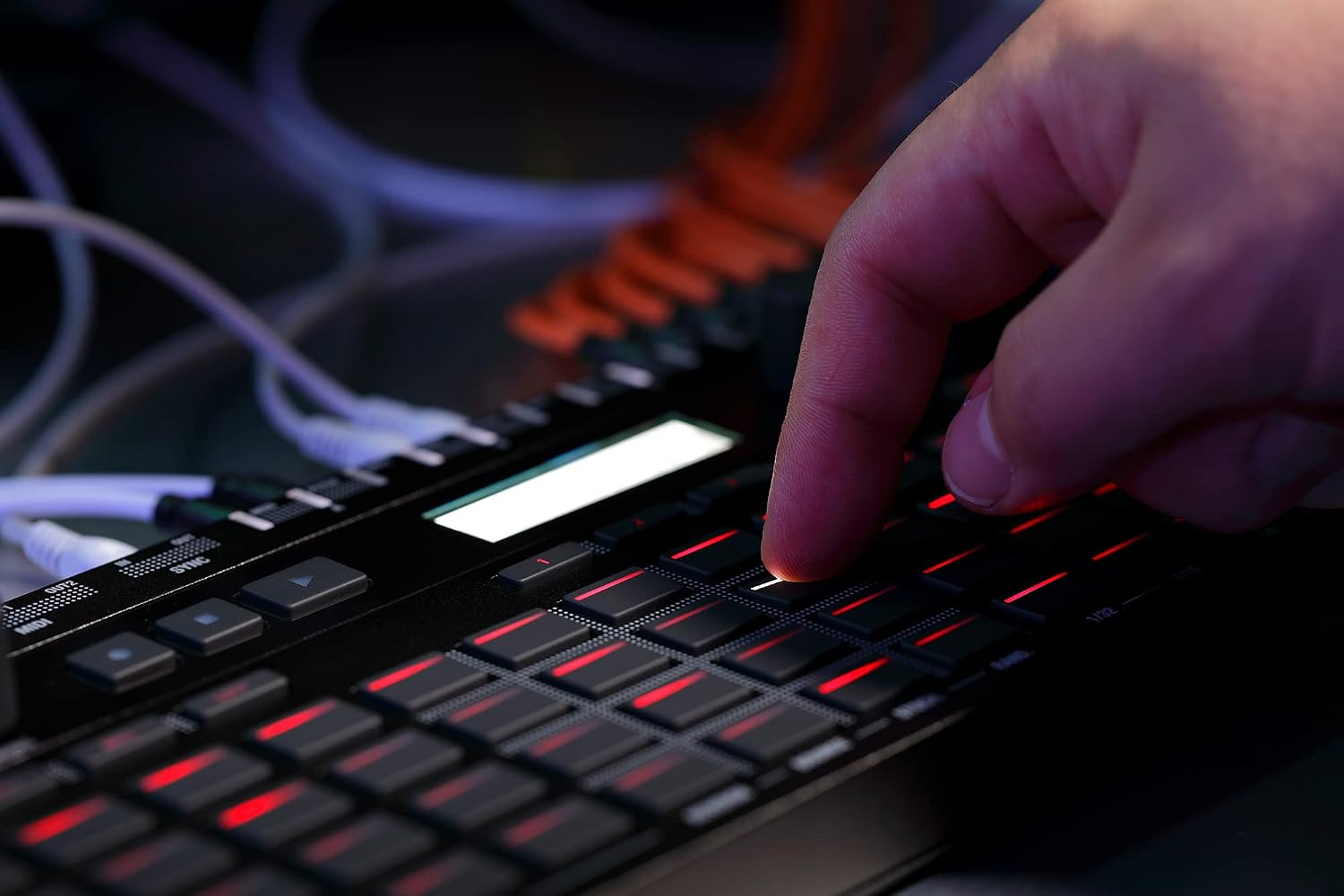
A hardware sequencer is the device that tells your drum machines and synthesizers when to play each note—essentially the conductor of your electronic music rig. Instead of drawing notes on a computer screen in a DAW (digital audio workstation, software like Ableton Live or Logic), a hardware sequencer lets you program rhythms and melodies using physical knobs, pads, and buttons, entirely without a laptop. If you’re building a drum rig around any combination of analog gear, Eurorack modules, or MIDI-connected drum machines, the sequencer is the single most important hub in your signal chain—and choosing the wrong one creates friction at every session.
This guide compares three of the most-discussed options in the intermediate hardware market right now: the Korg SQ-64, the Arturia BeatStep Pro, and the Arturia KeyStep 37. All three sit in the $100–$300 price range, all three can speak to both MIDI (a digital communication protocol that sends note and timing data) and CV/Gate (an older, analog voltage-based language that Eurorack modules and vintage synthesizers use), and all three have vocal, opinionated owner communities. The question is which one fits your rig’s actual requirements.
| EDITOR'S PICKKorg SQ-64 Polyphonic Sequencer | Mid-tierArturia BeatStep Pro Controller… | Budget pickArturia - BeatStep - Compact MI… | |
|---|---|---|---|
| Sequencer count | — | 2 melodic + 1 drum | — |
| Pads | — | 16 | 16 |
| Encoders | — | — | 16 |
| MIDI / CV / Gate I/O | — | ✓ | — |
| Aftertouch | — | ✓ | — |
| Velocity sensitive | — | ✓ | — |
| Price | $329.99 | $249.00 | $99.00 |
| See on Amazon → | See on Amazon → | See on Amazon → |
The Core Decision Frame: What Does Your Rig Actually Need?
Before comparing features, name the constraint that matters most for your setup. These three sequencers are not interchangeable—they solve different problems.
The Korg SQ-64 is a dedicated polyphonic step sequencer with four independent tracks (three pitched, one drum/chord), up to 64 steps per pattern, and a dense CV output section. It’s built for people whose primary language is modular Eurorack—the panel is full of 3.5mm minijack outputs for CV, Gate, and clock signals. Per MusicRadar’s Korg SQ-64 review, the hardware is genuinely compact and its per-track parameter control is more granular than anything else at this price point.
The Arturia BeatStep Pro is a wider, more performance-oriented device. It ships with two melodic sequencer tracks plus one dedicated 16-step drum track with 16 independent drum instruments per pattern. As Sound On Sound’s BeatStep Pro review notes, it’s become a reliable live-performance hub—owners describe it as a “beast” of a controller, and its DAW compatibility out of the box (including Reaper, Ableton, and Logic) is a consistent point of praise. The fact that a 76-year-old jazz pianist uses it live is one of those community data points that tells you the interface is genuinely learnable, not just technically capable.
The Arturia KeyStep 37 is fundamentally different from the other two: it’s a keyboard controller first, with a 37-key velocity-sensitive keyboard, a step sequencer, an arpeggiator, and CV/Gate outputs. It is not a drum sequencer in any meaningful sense. But for producers who come from a melodic/keys background and want a single device that handles keyboard input, simple melodic sequencing, and CV connectivity to a small Eurorack voice—reviewers including guitarists new to synthesis consistently flag it as the most approachable live performance controller they’ve tried. If your drum sequencing already lives in an Elektron box or a DAW and you just need a keyboard interface with CV connectivity, the KeyStep 37 earns its place.
The KeyStep 37 being in this comparison at all reflects a real buyer-behavior pattern: people shopping for a “sequencer for my drum rig” frequently have a mixed need—some drum sequencing, some melodic control—and the KeyStep 37 satisfies the latter half elegantly while the SQ-64 and BeatStep Pro handle the former.
By the Numbers
| Korg SQ-64 | Arturia BeatStep Pro | Arturia KeyStep 37 | |
|---|---|---|---|
| Dedicated drum tracks | 1 (16-step grid, 16 lanes) | 1 (16-step, 16 instruments) | None |
| Melodic sequencer tracks | 3 | 2 | 1 (+ arpeggiator) |
| CV outputs | Yes (per-track pitch + gate) | Yes (2 CV/Gate pairs) | Yes (1 CV + Gate + Mod) |
| Keyboard | No | No | 37 keys |
| Max steps per pattern | 64 | 16 (melodic) / 16 (drums) | 64 |
| Standalone (no computer) | Yes | Yes | Yes |
Clock Sync and Reliability: The SQ-64’s Known Weakness
This is where honest reporting matters. The Korg SQ-64 has genuine reliability concerns that the community has documented clearly, and Korg’s firmware update cadence has been slow enough that owners have expressed real frustration.
Clock sync inconsistency is the most frequently reported issue. When slaving the SQ-64 to an external clock over MIDI or syncing it to a CV clock source from a Eurorack system, owners report occasional drift, jitter, and erratic start/stop behavior—particularly when switching between internal and external clock sources mid-session. Perfect Circuit’s product notes acknowledge the SQ-64’s Eurorack-friendliness while owner feedback on the platform flags the clock behavior as a genuine reliability concern rather than an edge case.
The mod section (the SQ-64’s per-step modulation outputs, which let you sequence control voltage changes to parameters like filter cutoff or oscillator pitch) is also flagged as unpredictable. The theory is right: per-step CV modulation at this price is remarkable on paper. In practice, owners report that the mod outputs behave inconsistently across firmware versions, and the documentation is thin enough that troubleshooting requires community forum research.
The tradeoff math: If you’re building a static Eurorack patch where the SQ-64 runs as the master clock and you’re not hot-swapping clock sources, owners report it works well. If you need tight, reliable clock sync when slaving to an analog drum machine or a Eurorack master clock module mid-performance, the SQ-64 carries meaningful risk that you should price in before committing.
The BeatStep Pro doesn’t have this reputation. Sound On Sound’s review notes solid clock performance, and the owner community consistently describes it as reliable in live contexts—which is why it has become a staple in live performance rigs despite being a few years old. The KeyStep 37’s clock behavior is less stress-tested in the community simply because it’s rarely used as a clock master in complex rigs.
CV/Gate Routing: What You Actually Need to Know Before You Buy
A recurring buyer question across all three products—and across the broader hardware sequencer market—is how physical connection to modular or analog gear works. Here’s the plain version:
CV (Control Voltage) is an analog signal, typically 0–5V or 0–10V, that tells a synthesizer’s oscillator what pitch to play. One volt per octave (1V/Oct) is the standard in Eurorack. Gate is a separate signal that tells the synth when to trigger (on/off).
- The SQ-64 has the deepest CV/Gate output set of the three: dedicated 1V/Oct pitch CV and gate outputs per melodic track, plus separate mod CV outputs. It’s the right tool if you’re sequencing multiple Eurorack voices simultaneously from one device. All connections use 3.5mm minijacks, which is the Eurorack standard.
- The BeatStep Pro has two CV/Gate output pairs for its melodic tracks, plus a gate output per drum pad (16 gate outputs total via the drum sequencer, accessible via 3.5mm jacks). This makes it genuinely capable for triggering individual drum voices in a Eurorack system—one gate per drum hit, directly to your module’s trigger input. Sweetwater’s KeyStep 37 overview (which also covers Arturia’s broader lineup) confirms the family uses standard 3.5mm minijack CV connections throughout.
- The KeyStep 37 has one CV output, one Gate output, and one Mod output—all 3.5mm. It’s enough for one Eurorack voice or one analog synth. It’s not designed to sequence a multi-voice drum system.
MIDI routing works straightforwardly on all three via standard 5-pin DIN MIDI out. All three can send MIDI clock to analog drum machines like the Roland TR-8S or Arturia DrumBrute Impact, though the reliability caveat above applies to the SQ-64.
Who Should Buy Which One
The BeatStep Pro is the community consensus pick for producers who need a dedicated, reliable hub that handles both drum pattern sequencing and melodic sequencing simultaneously, speaks MIDI fluently to DAWs and hardware, and has a track record in live rigs. It’s not the most Eurorack-native device, but its 16 drum gate outputs and DAW compatibility make it the most versatile of the three for hybrid setups. If you’re routing into Reaper or Ableton during production and also performing with hardware, the BeatStep Pro handles both contexts without compromise.
The SQ-64 is the right call specifically if your rig is predominantly Eurorack and you need per-step CV modulation across multiple tracks—but go in with eyes open on the clock sync concerns. If your use case is a static patch where SQ-64 is master clock, the value proposition is strong. If you need bulletproof sync in a dynamic live context with multiple clock sources, the risk is real.
The KeyStep 37 belongs in your rig if you’re a keyboard player building into synthesis, need a bridge between your melodic ideas and a small modular system, and your drum sequencing lives elsewhere. It’s not competing with the other two for drum rig duty—it’s solving a different problem well.
Frequently Asked Questions
Does the Korg SQ-64 sync reliably with analog drum machines over MIDI or CV? In static setups where the SQ-64 acts as master clock, owners generally report acceptable performance. However, community feedback—aggregated across MusicRadar’s review and multiple owner forums—flags clock jitter and sync inconsistency as genuine concerns when slaving to external clock sources or switching sync modes during a session. This is a documented, unresolved firmware issue as of mid-2026.
What does the BeatStep Pro offer that the original BeatStep does not? The original BeatStep is a single-track 16-step sequencer prized for portability and its scale-conforming step mode (which keeps notes in a musical key automatically). The BeatStep Pro adds two melodic tracks, a full 16-instrument drum sequencer, real-time record, more CV outputs, a larger footprint with dedicated controls per track, and significantly more performance flexibility. Per Sound On Sound’s review, the Pro is a different class of device—the original BeatStep is a compact utility tool; the Pro is a performance hub.
Can the KeyStep 37 send CV/Gate signals to Eurorack or analog synths? Yes. The KeyStep 37 has dedicated CV (1V/Oct), Gate, and Mod outputs via 3.5mm minijack, making it directly compatible with Eurorack modules and analog synthesizers that accept these signals. It can sequence one voice at a time via CV/Gate.
Is the BeatStep Pro compatible with DAWs like Ableton and Reaper out of the box? Yes. Owners and reviewers consistently confirm the BeatStep Pro works as a MIDI controller and clock source with Ableton Live, Reaper, Logic, and other major DAWs without requiring custom drivers—plug in via USB and it’s recognized. Sound On Sound’s review notes this as a practical strength for producers who move between hardware sessions and DAW work.
How many drum tracks can the SQ-64 sequence simultaneously? The SQ-64 has one dedicated drum/chord track with a 16-step grid and 16 independent instrument lanes—so 16 simultaneous drum voices within that one track. Its other three tracks are melodic. Per Perfect Circuit’s product notes, this makes it capable but not equivalent to a dedicated drum machine in its drum-sequencing depth.
Do any of these sequencers work without a computer connected? All three operate fully standalone—no computer required. Each stores patterns internally, runs from USB power (or external DC adapter), and can clock and sequence hardware gear with no DAW or laptop in the chain. This is one of the primary reasons producers choose hardware sequencers over software alternatives.