A drum synthesizer is a hardware device that builds percussion sounds from scratch using electronic circuits and signal-processing algorithms — no audio recordings involved, just math and voltage shaping a raw waveform into a kick, snare, or clap. That distinction matters enormously for sound designers: synthesized drums are infinitely malleable at the architecture level, not just at the EQ stage. If you’re new to the category, think of it this way — a sample-based drum machine replays a photograph of a sound, while a drum synthesizer lets you sculpt the sculpture itself.
This article compares three instruments aimed squarely at that synthesis-first mindset: the Sonicware CyDrums, the Korg drumlogue, and the Korg Volca Drum. They sit at meaningfully different price points, offer radically different workflow philosophies, and attract different kinds of scrutiny from the community. If you have a buying decision pending — or if you already own one of these and are wondering whether to add a second — the goal here is to name the tradeoffs precisely and give you a clear decision rule at the end.
| EDITOR'S PICKSonicware CyDrums [Expressive D… | Mid-tierArturia DrumBrute Impact Analog… | Budget pickKorg Volca Drum Digital Percuss… | |
|---|---|---|---|
| Synthesis | Wavetable | Analog | Digital |
| Modulation | Velocity/Pressure | — | — |
| Sequencer | — | — | 16-step |
| Speaker | ✓ | — | — |
| Power | Battery | — | — |
| Price | $499.00 | $299.00 | $149.80 |
| See on Amazon → | See on Amazon → | See on Amazon → |
Synthesis Engines: What Each Machine Is Actually Doing
Understanding the architecture underneath each interface helps you predict how a machine will behave when you push it — not just how it sounds in a demo.
Korg Volca Drum
The Volca Drum runs six voices through a layered digital synthesis structure that Korg describes as a “waveguide resonator” model. Each of the six parts has two oscillator layers feeding into a shared resonator, and that resonator is where the characteristic metallic, physical-modeling color comes from. Sound On Sound’s 2019 Korg Volca Drum review describes the waveguide system as producing timbres that sit somewhere between physical modeling and FM synthesis — harmonically complex in ways that reward exploration but resist quick, intuitive dialing. Attack Magazine’s editorial coverage of drum synthesis and waveguide resonance identifies this style of resonator architecture as a foundational texture in modern percussive sound design, particularly in techno and industrial contexts.
Street price runs approximately $150–170 new.
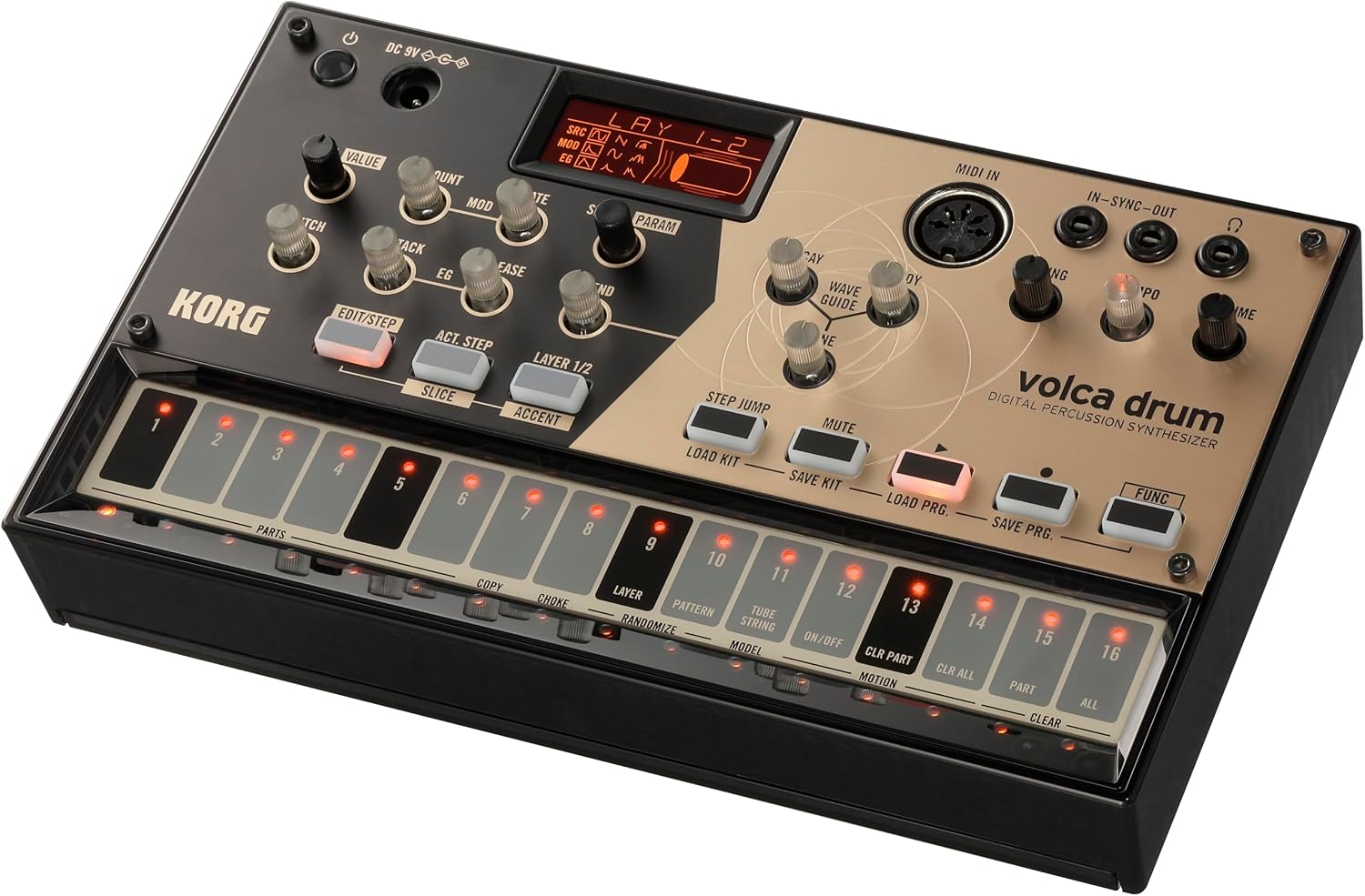
Korg
$149.80
In stock on Amazon
Check price on AmazonSonicware CyDrums
The CyDrums takes a different approach entirely: it is a pure synthesizer with no sample playback and no plugin ecosystem. Synthtopia’s 2024 CyDrums coverage describes it as offering multiple synthesis types per voice — combining analog-modeled, physical-modeling, and noise-synthesis engines across its ten voices in a single instrument. Reviewers are unanimous on one point: you cannot load your own samples into the CyDrums. It is a synthesizer, full stop. Owners who came in expecting a sampler workflow have reported surprise; those who understood the synthesis-only architecture from the start report deep satisfaction with the build and the sound engine.
The ergonomic gap is real and worth naming explicitly. Owners consistently report that the CyDrums’ small, stiff knobs cause noticeable finger fatigue during extended sound-design sessions — not a dealbreaker for studio work, but a meaningful consideration for live performance where you’re tweaking parameters between songs.
Street price runs approximately $300–350 new.

Arturia
$299.00
In stock on Amazon
Check price on AmazonKorg drumlogue
The drumlogue is a hybrid machine: it ships with analog circuitry for its kick voice and pairs that with digital synthesis engines for the remaining parts, plus a user-loadable plugin architecture (called logue SDK plugins) that third-party developers have used to port FM, wavetable, and noise-based drum voices onto the platform. MusicRadar’s 2023 Korg drumlogue review notes this as both the machine’s greatest theoretical asset and its practical complication — the ceiling is genuinely high, but reaching it requires sourcing, evaluating, and loading community-developed plugins. The review gives the instrument a respectful assessment of its sonic capabilities while noting that the plugin ecosystem was still maturing at the time of publication.
Street price runs approximately $350–400 new.
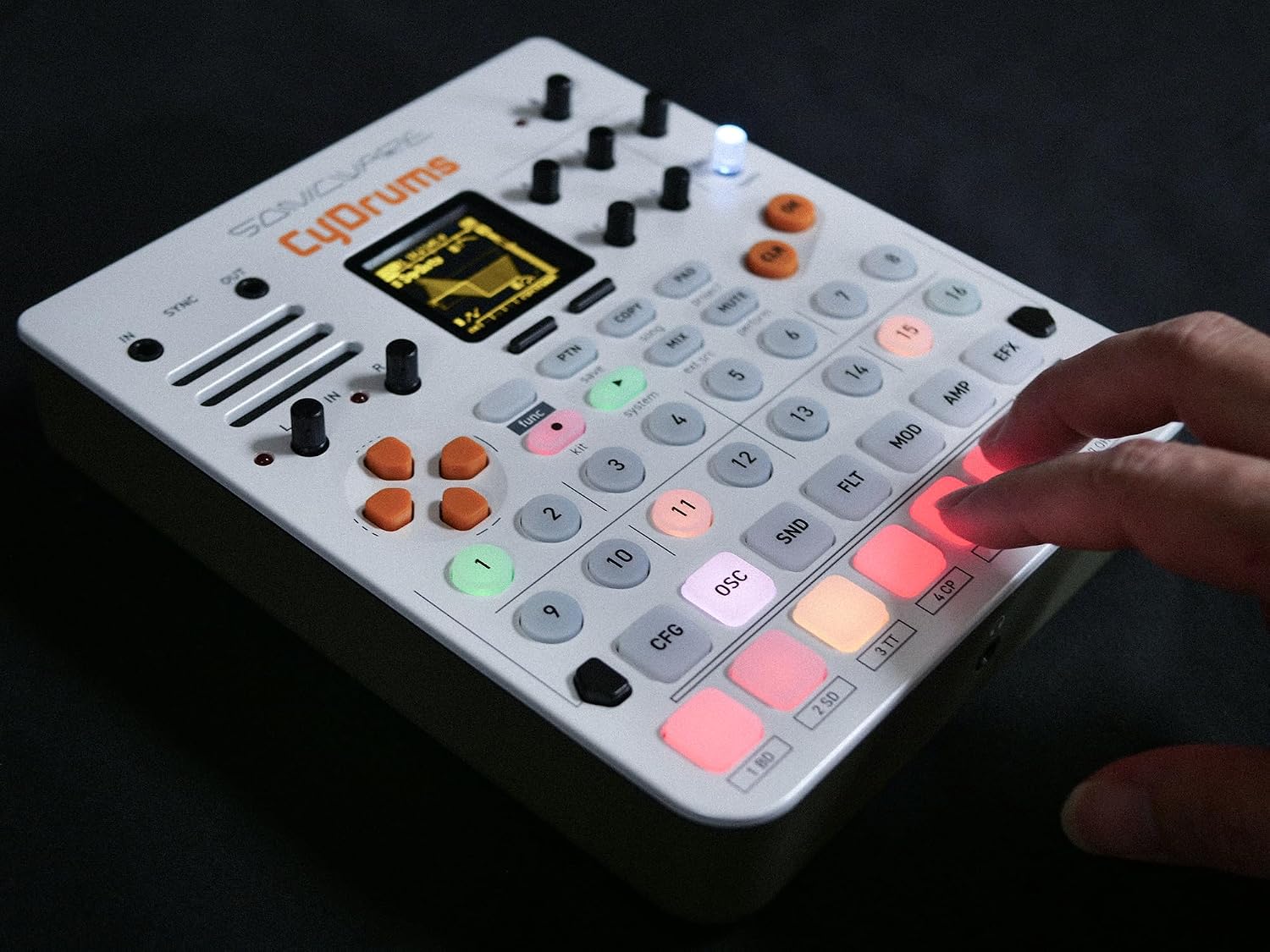
Sonicware
$499.00
In stock on Amazon
Check price on AmazonSequencer Depth and Live Performance Utility
The synthesis engine gets the sound into the machine; the sequencer determines how playable and performable the machine becomes in practice.
Volca Drum Sequencer
The Volca Drum’s sequencer is frequently called out — sometimes with genuine surprise — as one of the deepest in its price class. Sound On Sound’s 2019 Volca Drum review describes features including up to 16 hits per step (effectively sub-steps), per-step probability, and step-locked pitch that allows melodic and tonal variation within a single pattern. Attack Magazine’s drum synthesis coverage notes that step-locked pitch is a feature more commonly found in modular environments than in self-contained hardware at this price point — the Volca Drum’s inclusion of it has led multiple reviewers to call the sequencer exceptional for what the machine costs.
The interface friction is the counterpoint: the Volca Drum uses a hash-mark LCD display for parameter editing that the community is divided on. Longtime owners describe it as an acquired skill that becomes second nature; newcomers frequently report frustration in the first two to four weeks. If your workflow involves fast parameter edits mid-performance, factor in a real learning curve before committing.
Korg
$149.80
In stock on Amazon
Check price on AmazonCyDrums Sequencer
The CyDrums sequencer is less discussed in published coverage than the synthesis engine. The consensus from owner reports is that it is competent rather than exceptional — adequate for pattern building but not the primary selling point. The machine’s draw is clearly the synthesis architecture and the build quality, which multiple reviewers compare favorably to other mid-tier hardware in terms of physical feel. If sequencer depth is your primary criterion, the Volca Drum or drumlogue will serve you better; if synthesis range across ten voices is the priority, the CyDrums stands apart.
Arturia
$299.00
In stock on Amazon
Check price on Amazondrumlogue Sequencer
The drumlogue offers a more conventional step-sequencer interface with per-step parameter locks (Korg’s motion sequencing), pattern chaining, and real-time recording. MusicRadar’s 2023 review describes the sequencer as functional and approachable — it does not have the Volca Drum’s sub-step depth, but it is easier to operate without consulting the manual. For users who want a lower learning curve on sequencer operation paired with a high ceiling on synthesis, the drumlogue’s workflow is the most immediately accessible of the three.
Sonicware
$499.00
In stock on Amazon
Check price on AmazonThe drumlogue Reliability Question — and Why It Matters Here
Any honest comparison of these three machines has to address the drumlogue’s reliability record, because the community conversation around it is substantive and unresolved.
At least one owner has publicly reported a hardware defect in which individual instrument voices randomly skip steps — the sequencer advances, but the voice does not fire. Critically, Korg support could not diagnose or resolve the issue remotely, and the return window had already closed by the time support responded. MusicRadar’s 2023 drumlogue review documents the instrument’s sonic strengths without addressing these reliability reports directly, which is worth noting: the review reflects a functioning production unit, and user experience after that window has been more variable.
The drumlogue’s lower average user rating compared to the other two instruments in this comparison is not purely about sound quality — it reflects eroded trust from users who received defective units and found support response times too slow to stay within return windows. If you are buying from a retailer with a 30-day no-questions return policy, that risk is partially mitigated. If you are buying used or from a marketplace with short return windows, price that risk explicitly into your decision.
By the numbers at a glance:
| Machine | Voices | Key Feature | Approx. Street Price |
|---|---|---|---|
| Korg Volca Drum | 6 synth parts | Sub-step sequencing, step-locked pitch | $150–170 |
| Sonicware CyDrums | 10 synthesis voices | Multi-engine synthesis, no samples | $300–350 |
| Korg drumlogue | 8 parts (1 analog + 7 digital/plugin) | Hybrid analog/digital, logue SDK plugins | $350–400 |
Decision Framework: If X, Then Y
Here is the comparison distilled into explicit decision rules, because the right answer genuinely depends on what you are optimizing for.
If you want the deepest sequencer in the lowest price bracket: The Volca Drum is the clear answer. Its sub-step sequencing, probability, and step-locked pitch do not appear together at this price anywhere else in the hardware market as of mid-2026. Budget two to four weeks to internalize the LCD interface. It rewards patience with genuine compositional capability.
If you want techno and industrial textures specifically: The Volca Drum’s waveguide resonator engine is well-suited to the metallic, physical-modeling timbres that appear throughout techno, industrial, and experimental electronic production. Attack Magazine’s drum synthesis editorial writing consistently identifies waveguide-style resonance as a foundational texture in these genres. The machine handles groove-based patterns effectively once the sequencer is internalized — it is not limited to experimental use.
If build quality and synthesis depth matter more than sequencer flash: The CyDrums is the argument. Owners report a premium feel, a genuinely varied synthesis architecture across ten voices, and a sound engine that rewards sustained exploration. Know going in that the small knobs are stiff and that extended sessions may cause hand fatigue. Know also that you are buying a synthesizer — there is no sample loading, no exceptions.
If you want the hybrid analog/digital architecture and are comfortable with a maturing ecosystem: The drumlogue has a ceiling higher than either competitor, thanks to the logue SDK plugin system. But that ceiling requires active maintenance — finding plugins, vetting them, loading them. And the reliability question is real. Buy new from a retailer with a generous return window, test every voice and sequencer step thoroughly in the first week, and register the product immediately for warranty purposes.
If MIDI and analog clock sync is essential to your rig: All three machines support MIDI sync. The Volca Drum additionally supports Korg’s analog sync standard — a 3.5mm pulse clock shared across the Volca line — making it easy to chain with other Volca instruments without a MIDI interface. For multi-machine live rigs where clock distribution friction matters, the Volca Drum’s analog sync compatibility is a small but real operational advantage.
Frequently Asked Questions
Can the Sonicware CyDrums load custom samples or only synthesize sounds internally? The CyDrums is a pure drum synthesizer with no sample playback capability. You cannot import WAV files, user recordings, or any external audio. Every sound it produces is generated internally by its synthesis engines. Synthtopia’s 2024 coverage and owner consensus are unanimous on this point — it is the architecture by design, not a limitation to be patched.
Is the Korg Volca Drum good for techno and electronic music or only experimental use? It is genuinely versatile. The waveguide resonator system produces metallic and physical-modeling timbres that appear throughout techno, industrial, and experimental electronic music, but the machine handles more conventional groove-based patterns effectively. Sound On Sound’s 2019 Volca Drum review notes the synthesis character is distinctive, not limiting.
How serious is the Korg drumlogue reliability issue and is it widespread? The documented reports involve voices randomly skipping steps, with Korg support unable to diagnose or resolve the defect remotely. It is not possible to confirm from published data alone how widespread the issue is. The practical advice from community consensus: buy new with a solid return window, test exhaustively in week one, and do not let the return window expire before you have stress-tested every voice and every sequencer step.
Does the Korg Volca Drum require good monitors to sound its best? Its synthesis engine produces harmonically complex, sometimes subtle timbres that can get lost in poor monitoring environments. Owners consistently note that the machine’s full character — particularly the resonator layer — is more audible on full-range monitors or quality headphones. It is not that the machine requires expensive monitoring; the synthesis detail is simply easier to evaluate and mix with accurate playback.
Can these drum synthesizers sync together via MIDI or analog clock? Yes. All three sync via MIDI clock. The Volca Drum additionally supports Korg’s 3.5mm analog sync standard, which allows pulse-based clock distribution across the Volca ecosystem without MIDI. For multi-machine rigs mixing these three units, MIDI sync works reliably across all of them.