If you play guitar or bass solo — at an open mic, in your bedroom, at a small gig — you’ve probably felt the gap where a drummer should be. A drum machine pedal is a compact, floor-mounted device that plays pre-programmed drum patterns so you can trigger beats hands-free with your foot while you keep playing. Unlike a full standalone drum machine (a tabletop box like a Roland TR-8S), these pedals are designed to live on a pedalboard and behave like a band member you stomp in and out of. The three most-discussed options in this category right now are the Singular Sound BeatBuddy family, the MOOER Micro Drummer II, and the BOSS RC-10R — a looper pedal (a device that records and plays back your playing in real time) with a built-in drum machine. This article maps out exactly where each one wins, where each one frustrates, and which one belongs on your board based on your actual use case.
The Core Tradeoff: Realism vs. Workflow Speed
Before comparing specs, it helps to name the central tension in this category. The more realistic and flexible a drum machine pedal sounds, the more setup it typically requires. The faster it is to dial in mid-set, the more it tends to sound like a loop rather than a live drummer.
BeatBuddy: Maximum Realism, Steeper Workflow
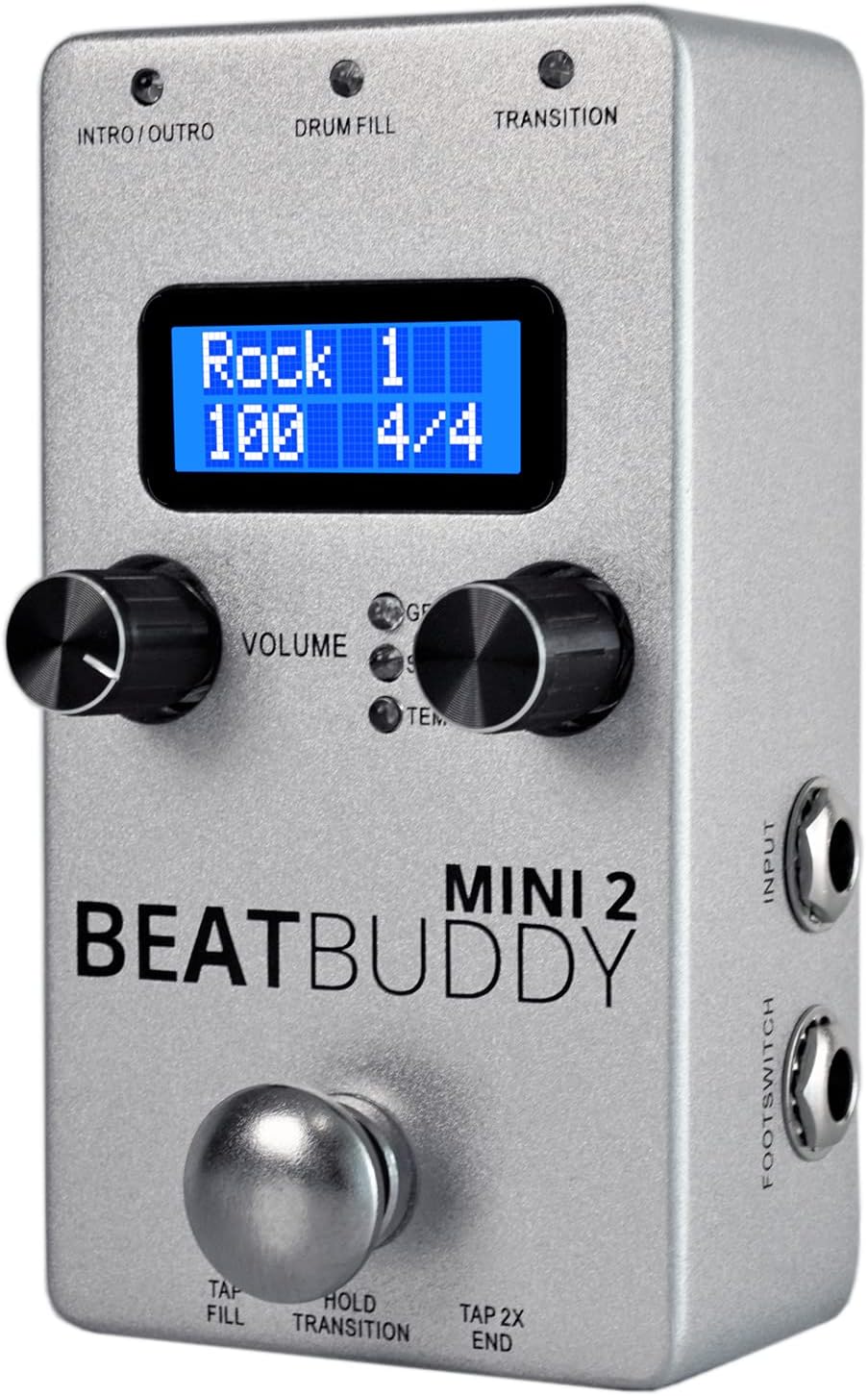
The Singular Sound BeatBuddy sits at the realism end of that spectrum. Sweetwater’s product overview for the BeatBuddy platform and Synthtopia’s coverage of the BeatBuddy line both highlight the same strength: multi-layered, velocity-sensitive drum samples that respond to footswitch pressure and give performances a humanized feel. The BeatBuddy runs full drum songs — intro, main loop, fill, outro — rather than static loops, which gives performances a sense of arc that loop-based alternatives cannot replicate at this price tier.
The tradeoff, flagged consistently across owner commentary aggregated by Sweetwater and by MusicRadar’s 2025 overview of drum machine hardware (titled “Best drum machines 2025: the best beat-making hardware for every budget and genre”), is tempo management. Every time you change song or genre on the BeatBuddy, the tempo resets to that song’s default. In a live set where you are moving between songs in variable order, that means manually re-dialing tempo each time. For a solo performer playing a carefully curated setlist in a fixed order, this is manageable. For anyone improvising set order or playing to shifting room energy, it is a meaningful friction point.
A second persistent complaint from owners involves the outro — an ending fill that triggers when you double-tap the footswitch. For performers who want to cut songs cleanly and immediately, routing around the outro requires deliberate planning. Neither the Mini 2 nor the full-size 10th Anniversary Edition currently offers a native disable option for this behavior.
Singular
$149.00
In stock on Amazon
Check price on AmazonMOOER Micro Drummer II: Fastest Workflow, Workmanlike Sound
The MOOER Micro Drummer II occupies the opposite end of the realism-versus-workflow spectrum. Sweetwater’s product listing for the Micro Drummer II confirms the design philosophy: every major parameter — tempo, volume, style, pattern — has a dedicated physical knob or button accessible without menu navigation. You can reach down and twist tempo between songs in under two seconds. Several owners have noted genuine surprise at finding non-4/4 time signatures (waltz patterns, 6/8 feels) in the style banks, which meaningfully expands the use case for folk, jazz, and acoustic players.
The tradeoff is sound quality. The Micro Drummer II uses loop-based patterns rather than fully layered, velocity-sensitive samples. The sounds hold up in a mix and under a loud acoustic guitar, but reviewers who have used both the MOOER and the BeatBuddy consistently describe the BeatBuddy as noticeably more organic. The MOOER is workmanlike rather than stunning — which is exactly the right tool when workflow speed matters more than sonic realism.
Akai
$115.85
In stock on Amazon
Check price on AmazonBOSS RC-10R: Looper-First, Drums Included
The BOSS RC-10R is structurally different from the other two pedals. It is primarily a looper — you record yourself playing, layer parts, and play back loops live — with an integrated rhythm section of drums and bass patterns. Paul White’s review of the RC-10R in Sound On Sound describes it as a creative powerhouse for the solo performer who wants to build full arrangements on stage. The drum patterns are solid, the integration with looping is tight, and the bass patterns add a harmonic anchor that neither the BeatBuddy nor the MOOER can match.
The RC-10R rewards familiarity. White’s Sound On Sound review and owner commentary aggregated by Sweetwater both note that Boss’s menu system is logical once learned but carries a steep initial curve. Multiple reviewers specifically recommend working through tutorial videos before the first gig. If you already own and understand a Boss looper, that learning curve is shorter. If you are new to Boss interface logic, budget at least a week of focused practice time before performing live.
If looping is not part of your performance approach and you exclusively want a drum pedal, the RC-10R is functional in that role — the rhythm section runs independently of the loop functions — but you are paying for looping capability you are not using. Sound On Sound’s review notes the design language is optimized around the looper-plus-drums workflow, and using it purely as a drum pedal underutilizes the hardware.
Singular
$379.00
In stock on Amazon
Check price on AmazonBy the Numbers
| Feature | BeatBuddy (10th Anniv. Ed.) | MOOER Micro Drummer II | BOSS RC-10R |
|---|---|---|---|
| Primary function | Drum machine pedal | Drum machine pedal | Looper + drum machine |
| Sound engine | Multi-layer WAV samples | Loop-based patterns | Pattern-based rhythms |
| Tempo persistence between songs | Resets per song | Holds until changed | Holds until changed |
| MIDI sync | Yes (in/out) | Yes (MIDI out, select variants) | Yes (MIDI in/out/thru) |
| SD card / custom kits | Yes (microSD) | No | No |
| Headphone output | Yes | Yes (practice level) | Yes |
| Bass patterns included | No | No | Yes |
BeatBuddy Mini 2 vs. 10th Anniversary Edition
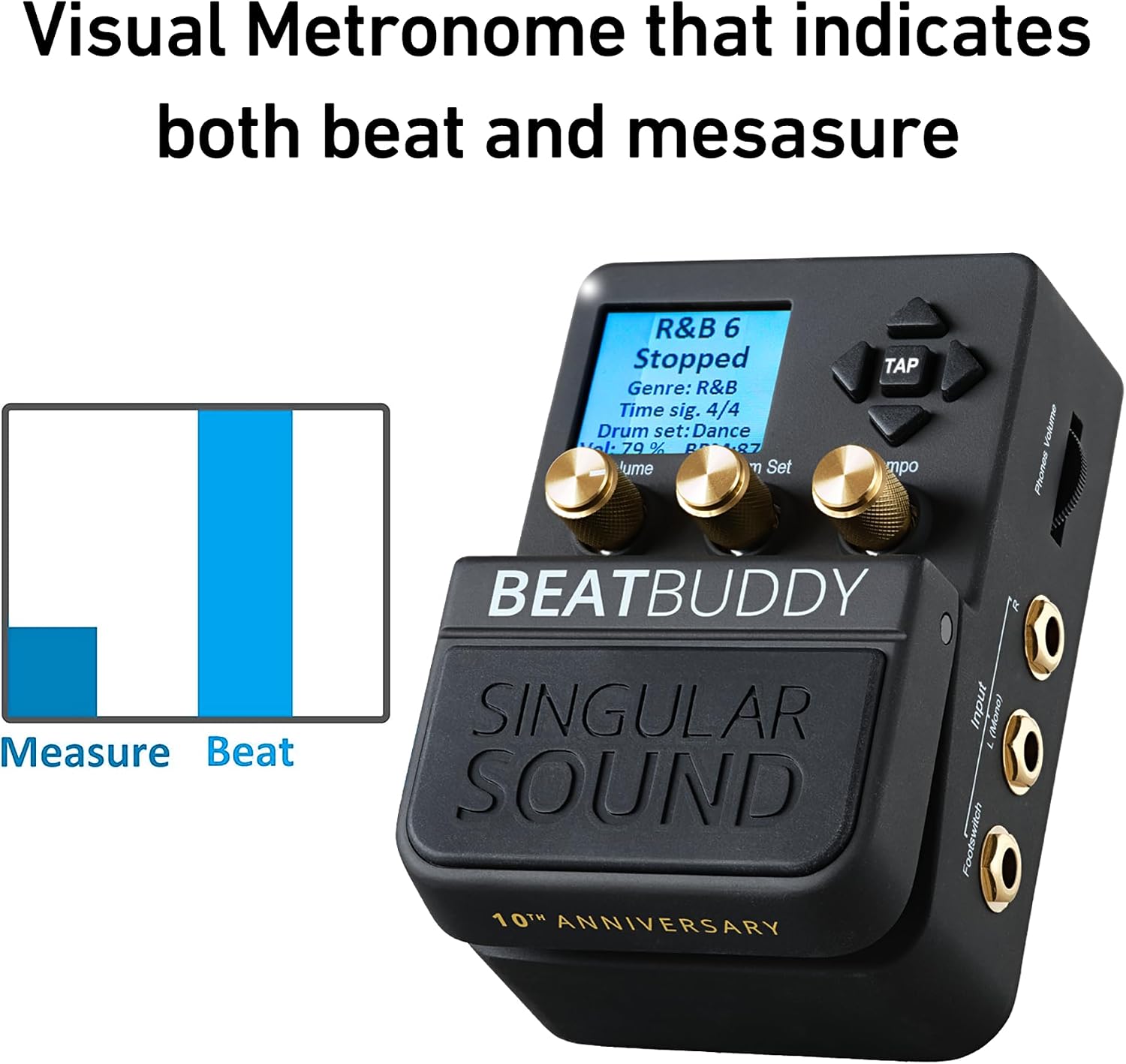
This is one of the most common decision points buyers flag before purchase. The BeatBuddy Mini 2 is the entry-level version — smaller footprint, fewer onboard controls, no SD card slot. The 10th Anniversary Edition adds SD card expandability, more onboard buttons, and access to Singular Sound’s full content ecosystem, including custom drum kits and community-built song libraries.
For home practice and casual use, the Mini 2 is adequate. For live performance where you want to load genre-specific kits — brushed jazz, acoustic country, hard rock — the 10th Anniversary Edition’s SD card slot is a meaningful differentiator. Sweetwater’s product overview for the BeatBuddy platform confirms the SD card workflow enables user-created content from Singular Sound’s active community forum, and Synthtopia’s coverage of the BeatBuddy ecosystem describes the custom kit library as one of the platform’s strongest long-term assets.
The process for loading custom kits involves downloading Singular Sound’s free BeatBuddy Manager software, locating kits from the community library or building your own, and loading them onto a microSD card. Owners with basic computer literacy describe the process as straightforward but with a learning curve on first attempt. Singular Sound maintains documentation and a community forum that make troubleshooting accessible.
The tempo reset frustration and the outro limitation apply identically to both versions. If your setlist is locked and rehearsed, the BeatBuddy rewards you with the most realistic feel in this comparison category. If your setlist is fluid or you play to the room, the MOOER’s instant knob access removes friction that the BeatBuddy does not.
MIDI Sync: Connecting These Pedals to Other Gear
All three pedals offer some level of MIDI connectivity, but the implementations differ in meaningful ways. MIDI (Musical Instrument Digital Interface) is a standard communication protocol that lets music hardware stay in rhythmic sync — if your drum pedal and your looper both receive MIDI clock, they lock to the same tempo automatically.
The BeatBuddy’s MIDI in/out is well-documented in Singular Sound’s official product documentation and is widely used in gigging rigs to sync with vocal loopers, external effects, and DAW (digital audio workstation) software. The MOOER Micro Drummer II supports MIDI out on applicable variants, enabling it to send tempo information to downstream gear — confirmed in Sweetwater’s spec sheet for the unit. The BOSS RC-10R has full MIDI in/out/thru implementation, which aligns with Boss’s broader ecosystem of MIDI-enabled pedals and represents the most flexible option for performers building larger synchronized rigs. Paul White’s Sound On Sound review of the RC-10R specifically highlights the MIDI implementation as a strength for players who want tight integration with other hardware.
For the solo acoustic performer playing into a PA (public address system, i.e., the venue’s speaker system) with no other synchronized devices, MIDI may be irrelevant. For the working performer building a signal chain with multiple synchronized devices, the RC-10R’s MIDI implementation is the most robust of the three.
Who Should Buy Which
If you are a singer-songwriter or solo acoustic performer with a rehearsed setlist who wants the most realistic drum feel available in a floor pedal: the BeatBuddy 10th Anniversary Edition is the community consensus pick, as reflected across Sweetwater’s product coverage and Synthtopia’s platform reviews. The sample quality and song-arc structure give performances a live band feel that loop-based alternatives cannot match at this price tier. Accept the tempo-reset workflow cost as a known tradeoff.
If you play sets with variable order, frequently improvise tempo or style, or simply want a no-menu-dive experience on a busy gig night: the MOOER Micro Drummer II’s knob-per-function layout removes friction that other pedals do not. The sounds are workmanlike rather than stunning, but the workflow is genuinely the fastest in this comparison. MusicRadar’s 2025 drum machine roundup notes that instant physical control access is a consistent differentiator for live performers who cannot afford to pause between songs.
If looping is already central to your performance — you build arrangements live, layer parts, and use a looper as a core instrument — the BOSS RC-10R’s drum integration is the tightest available in a single floor unit. Sound On Sound’s review by Paul White describes it as purpose-built for exactly this kind of solo live performance approach. Invest time in tutorials before the first gig; once it clicks, the RC-10R functions as a foundational piece of a solo live rig.
If you are primarily a bedroom producer or studio composer: all three of the reviewed pedals are optimized for live floor use. You will get more flexibility, better sound design options, and more creative range from a dedicated hardware drum machine or a DAW-based workflow. MusicRadar’s 2025 drum machine overview consistently distinguishes the live-performer category from the studio-producer category when recommending hardware, and these three pedals fall firmly in the former.
Frequently Asked Questions
Can you lock tempo on the BeatBuddy so it does not reset between songs? Not natively as of current firmware. Tempo resets to the default for each song when you change tracks. The most common workaround owners describe is setting all songs in a setlist to the same tempo before the gig, or using a MIDI controller to send tempo externally. Singular Sound’s user community has requested a global tempo lock feature across multiple firmware cycles.
Does the MOOER Micro Drummer II work as a headphone amp on its own? The Micro Drummer II has a headphone output. Per Sweetwater’s product listing for the unit, the headphone output is functional for quiet practice monitoring but is not designed or powered to serve as a standalone headphone amplifier for general audio use.
How hard is it to add custom drum kits to the BeatBuddy via SD card? The process involves downloading Singular Sound’s free BeatBuddy Manager software, locating kits from the community library or creating your own, and loading them onto a microSD card. Owners with basic computer literacy describe the process as manageable with a first-attempt learning curve. Singular Sound’s documentation and community forum make troubleshooting accessible. Sweetwater’s product overview and Synthtopia’s platform coverage both identify the custom kit ecosystem as one of the BeatBuddy’s strongest long-term advantages.
Can the BOSS RC-10R be used without looping — just as a drum pedal? Yes. The rhythm section runs independently of the loop functions. You can use the RC-10R purely as a drum machine pedal without recording any loops. As noted in Paul White’s Sound On Sound review, the design is optimized around the combined looper-plus-drums workflow, so using it as drums only is functional but underutilizes the hardware.
Do any of these pedals have MIDI sync for use with other gear? All three offer MIDI functionality. The BeatBuddy supports MIDI clock in and out per Singular Sound’s product documentation. The MOOER Micro Drummer II supports MIDI out on applicable variants per Sweetwater’s spec sheet. The BOSS RC-10R has full MIDI in/out/thru, making it the most flexible option for synced multi-device rigs, as highlighted in Sound On Sound’s RC-10R review.
Is the BeatBuddy 10th Anniversary Edition meaningfully different from the Mini 2 for live use? Yes, in two practical ways: the SD card slot for loading custom drum kits and community content, and more onboard controls. For a musician who plans to curate genre-specific kits or access Singular Sound’s content library, the upgrade is meaningful. For a player who will use factory content only, the Mini 2 covers the core use case at a lower price point. The tempo reset behavior and outro limitations apply identically to both versions.