If you’ve been spending time in production forums lately, you’ve probably noticed a recurring argument: which of the new generation of standalone sampler-sequencers deserves the top slot in a serious hardware rig? A sampler-sequencer is a self-contained device—meaning it doesn’t need a laptop to function—that lets you record real-world sounds or import audio clips, then arrange and trigger them in musical patterns. Three machines are dominating that conversation right now: the Elektron Digitakt II, the Akai MPC Sample, and the Ableton Move. They overlap in price bracket and intent, but they’re built around genuinely different philosophies. This article maps those differences, names the tradeoffs explicitly, and ends with a clear decision framework so you can stop second-guessing and move.
| EDITOR'S PICKElektron Digitakt II 16-Track D… | Mid-tierAbleton Move Standalone Instrum… | Budget pickAkai Professional MPC Sample St… | |
|---|---|---|---|
| Track count | 16 | — | — |
| Battery power | — | — | ✓ |
| Built-in speaker | — | — | ✓ |
| Built-in mic | — | — | ✓ |
| USB-C | — | — | ✓ |
| Price | $1,099.00 | $499.00 | $399.00 |
| See on Amazon → | See on Amazon → | See on Amazon → |
The Lay of the Land: What Each Machine Is Actually For
Before diving into the head-to-head, it helps to understand what these three machines think they are.
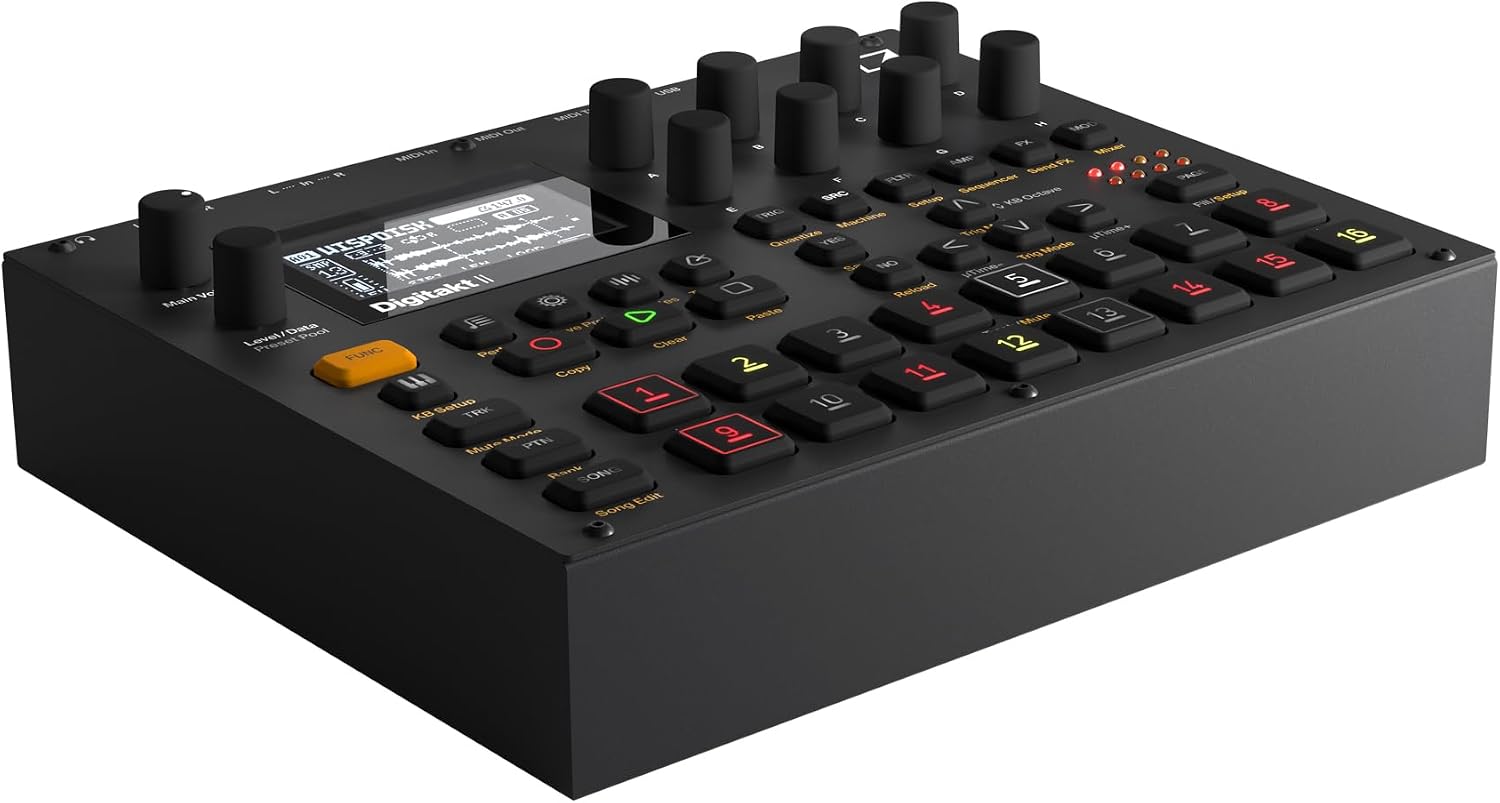
The Elektron Digitakt II is a Swedish-engineered eight-voice stereo sampler and MIDI sequencer aimed squarely at producers who want deep, unconventional control over every event in a pattern. It inherits Elektron’s signature parameter locks—the ability to automate virtually any parameter on a per-step basis, so each drum hit can have its own filter cutoff, pitch, or envelope shape—and conditional triggers, which are probabilistic step logic that keeps patterns evolving without a computer. Sound On Sound’s Elektron Digitakt II review (2024) describes it as “an instrument for producers who want to feel the machine pushing back.”
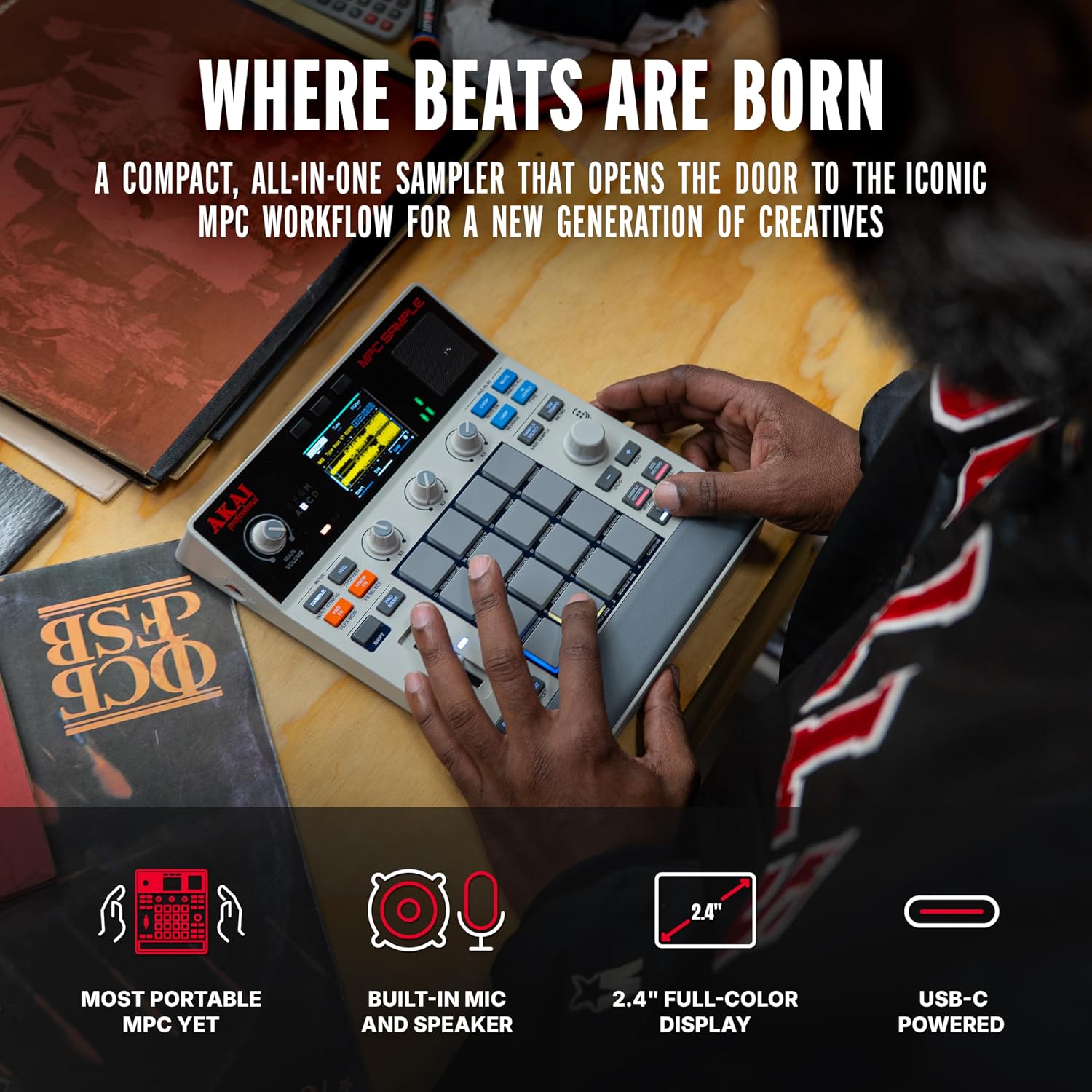
The Akai MPC Sample is Akai’s most compact MPC to date: a battery-powered, USB-C-connected pad controller and sampler that positions itself as the most approachable entry point into the legendary MPC workflow. MusicRadar’s Akai MPC Sample review (2025) highlights its built-in microphone, rechargeable battery, and no-subscription standalone operation as core selling points over prior MPC iterations.
The Ableton Move is Ableton’s first fully standalone device—a hardware companion to Ableton Live (the popular desktop music production software) that runs a trimmed but functional version of the Live environment on its own silicon. Attack Magazine’s Ableton Move workflow feature (2025) notes that Move is “unmistakably a gateway into the Live ecosystem, but more capable as a standalone sketchpad than anyone anticipated.”
The overlap: all three can sample live audio, sequence patterns without a computer, and connect to a DAW for deeper production. The divergence: workflow philosophy, depth versus accessibility, and how they handle the moment when you want to grow beyond the device.
Workflow Deep-Dive
Elektron Digitakt II — Depth That Rewards the Patient
The Digitakt II’s reputation for depth is not marketing copy. Sound On Sound’s Elektron Digitakt II review (2024) and CDM’s ongoing standalone sequencer coverage both document a machine that owners consistently report still reveals undocumented functions after many months of use. That’s either thrilling or alarming depending on your temperament.
The Elektron workflow centers on a step sequencer—a grid where each button represents a point in time and you decide whether a sound plays at that moment. On most hardware, that’s the whole story. On the Digitakt II, each step is a universe: hold it and dial in a unique pitch, a unique filter setting, a unique reverb send—all without breaking out of the performance flow. Sound On Sound’s review quotes a long-term MPC veteran who described switching to the Digitakt II as “justified despite real initial uncertainty,” a significant endorsement from someone with a deeply ingrained alternative workflow.
The honest warning: the included documentation is sparse relative to the machine’s depth, and the community of tutorial creators is smaller than Akai’s or Ableton’s. Every owner review recommends supplementing with video tutorials. If you need a thick manual and a large course library to feel confident, the Digitakt II will test you. Sweetwater’s Elektron Digitakt II editorial notes (2025) specifically flag this for buyers who are new to Elektron’s operating system.
Where Digitakt II wins: Per-step parameter automation (p-locks), probabilistic sequencing, eight stereo voices with independent processing chains, MIDI sequencing for external gear. It’s the right tool if your production approach is generative, experimental, or groove-focused in ways that require microscopic timing control.
Where it concedes ground: No touchscreen, no battery power, steeper initial learning curve, thinner tutorial ecosystem.
Elektron
$1,099.00
In stock on Amazon
Check price on AmazonAkai MPC Sample — The Accessible On-Ramp with Real Legs
The MPC Sample is genuinely trying to lower the barrier. MusicRadar’s Akai MPC Sample review (2025) specifically calls out the built-in microphone, USB-C charging, rechargeable battery, and what the publication describes as a “manageable learning curve for someone tech-comfortable even without MPC experience.” That last phrase matters—prior MPC experience is not required to get productive quickly.
The MPC workflow revolves around pads—pressure-sensitive rubber buttons you tap like a drum kit to trigger samples—and a touchscreen-based grid that mirrors desktop music production software logic more closely than Elektron’s approach does. Patterns are built by playing or programming notes into a timeline, and the editing interface uses visual metaphors that most DAW users will recognize immediately.
The battery and built-in mic are practical advantages that neither of the other two machines offer. If you produce in transit—on a train, in a green room, during a writing session that started in a park—the MPC Sample removes friction that the Digitakt II and Move do not. MusicRadar’s review is explicit that this portability is a genuine workflow multiplier rather than a marketing footnote.
Where MPC Sample wins: Accessible learning curve, battery-powered portability, built-in mic for on-the-spot sampling, strong existing MPC tutorial ecosystem, USB-C integration with computers for extending capabilities.
Where it concedes ground: Less deep per-step modulation than the Digitakt II. As a newer, smaller form factor, the long-term ceiling of the MPC Sample’s standalone depth is still being tested by the community. Owners note the experience is warm and encouraging but may prompt an upgrade to a larger MPC sooner than expected.

Ableton
$499.00
In stock on Amazon
Check price on AmazonAbleton Move — The Surprising Dark Horse
The most counterintuitive finding across aggregated Move coverage: producers who have used Ableton Push 2—the larger, more expensive Ableton hardware controller—for years consistently describe Move as feeling more intuitive, not less. Attack Magazine’s Ableton Move workflow feature (2025) calls this “a counterintuitive reversal worth taking seriously.”
The reason is architectural. Push 2 was designed as a controller that extends a laptop-running instance of Live, so the laptop always held the real logic. Move is designed from day one to be its own thing, and that clarity of purpose shows in the interface design. Every button does exactly one job, and the color coding maps directly to Live’s session view—the clip-launching grid that Live users already know. CDM’s standalone sequencer coverage (2025) notes that the Move-to-Live integration is “closer to seamless than any previous Ableton hardware pairing,” making it the fastest path from hardware sketch to full production for existing Live users.
Where Move wins: Native Ableton Live integration, fastest on-ramp for existing Live users, clean and purposeful hardware design, strong Ableton-native tutorial library.
Where it concedes ground: Move is most powerful inside the Ableton ecosystem. Without Live on a connected laptop, it functions well as a sketchpad but lacks the deep standalone sequencing muscle of the Digitakt II. It is not battery-powered, and external sampling requires a connected audio source via its inputs.
Akai
$399.00
In stock on Amazon
Check price on AmazonSide-by-Side Specifications
| Feature | Elektron Digitakt II | Akai MPC Sample | Ableton Move |
|---|---|---|---|
| Voices / Tracks | 8 stereo | 8 pads / MIDI tracks | 8 tracks |
| Battery power | No | Yes (USB-C rechargeable) | No |
| Built-in microphone | No | Yes | No |
| Touchscreen | No | Yes | No |
| Tutorial ecosystem | Thin but growing | Strong (MPC legacy) | Strong (Live community) |
| Best-fit user | Advanced / experimental | Beginner–intermediate | Existing Live users |
Sources: manufacturer specification sheets; Sound On Sound Elektron Digitakt II review, 2024; MusicRadar Akai MPC Sample review, 2025; Sweetwater Elektron Digitakt II editorial notes, 2025.
The Decision Framework: If X, Then Y
This is where most comparison articles go vague. Here’s the explicit version.
If you are an intermediate-to-advanced producer who values deep sequencing control, works primarily from a fixed studio or live rig, and is willing to invest weeks—not days—into learning a machine that will keep surprising you for years: the Digitakt II is the right call. Budget time for supplementary video tutorials; as Sweetwater’s editorial notes acknowledge, the official documentation alone will not carry you all the way.
If you are a producer who wants to sample anywhere, values an encouraging and relatively fast learning curve, and either already uses Akai’s MPC software or wants a clear on-ramp to it: the MPC Sample earns its place. Its battery and built-in mic are not gimmicks—MusicRadar’s review treats them as genuine workflow multipliers for producers who don’t always work at a desk.
If you are an existing Ableton Live user who has wanted to take Live into hardware territory without rebuilding your entire workflow from scratch—and Push 2 felt like too much overhead: Move deserves a serious audition. The finding that it feels more natural than Push 2 for standalone use, documented in Attack Magazine’s feature, is now consistent enough across reviewer reports to treat as signal rather than noise.
Frequently Asked Questions
Can the Elektron Digitakt II work as a standalone device without a computer? Yes. The Digitakt II is fully self-contained—you can load samples, build sequences, and perform complete sets without any computer connection. A computer is optional, used primarily for transferring sample content and backing up projects.
Does the Akai MPC Sample require a subscription to use fully? No subscription is required for standalone use. The MPC Sample operates independently as a sampler and sequencer out of the box, as confirmed by MusicRadar’s Akai MPC Sample review. Connecting to a computer unlocks deeper integration with Akai’s MPC software, but it is not mandatory for core functionality.
How does Ableton Move compare to Push 2 for existing Live users? Attack Magazine’s Ableton Move workflow feature documents a consistent finding from owners of both devices: Move feels more intuitive for standalone use because it was designed from the start as a self-contained device rather than a computer controller. Push 2 remains more powerful as a Live controller when a laptop is present, but Move wins for portability and standalone clarity.
Do any of these machines allow sampling from an external audio source? All three support external audio sampling. The MPC Sample adds a built-in microphone as a bonus input source. The Digitakt II and Move require an external audio connection—a microphone or line-level source plugged into their inputs.
Which machine has the shortest learning curve for a producer new to hardware? Across the reviews surveyed—MusicRadar on the MPC Sample, Sound On Sound on the Digitakt II, and Attack Magazine on the Move—the MPC Sample is described as the most accessible starting point, particularly for producers who have some DAW experience but no prior hardware sampler ownership. Move is a close second for existing Ableton Live users specifically.
Is additional storage required for the MPC Sample or Digitakt II? The Digitakt II includes 1 GB of internal flash storage and a USB port for transferring content; no SD card slot is present. Sweetwater’s Digitakt II editorial notes suggest that producers working with large sample libraries should plan their storage workflow carefully before committing. The MPC Sample uses internal storage and USB-C for file transfer. Neither requires an SD card for standard operation.