If you’ve ever wanted the punchy, physical sound of a classic drum machine—the kind of warm thump and snappy crack you hear on decades of hip-hop, techno, and pop—but didn’t want to spend thousands chasing a vintage Roland original, you’re in exactly the right place. Analog drum machines generate their sounds using real electronic circuits: oscillators, filters, transistors, and envelope shapers. That distinction matters because analog circuits respond dynamically to real-time parameter changes in ways that digital samples rarely replicate with the same natural feel. This article puts four hardware machines under $500 head-to-head: the Arturia DrumBrute Impact, the Behringer RD-8, the Behringer RD-9, and the newer Behringer LM. By the end you’ll have a clear decision frame—real tradeoffs, real workflow caveats, and direct “if X, then Y” recommendations at the close.
| EDITOR'S PICKBehringer LM Hybrid Drum Machine | Mid-tierArturia DrumBrute Impact Analog… | Budget pickBehringer Rhythm Designer RD-6-… | |
|---|---|---|---|
| Drum Sounds | — | — | 8 |
| Sequencer Steps | — | — | 64 |
| Analog | — | ✓ | ✓ |
| Distortion FX | — | — | ✓ |
| Color | — | — | Black |
| Hybrid Design | ✓ | ✗ | ✗ |
| Price | $459.00 | $299.00 | $149.00 |
| See on Amazon → | See on Amazon → | See on Amazon → |
The Contenders at a Glance
Before diving into sound and workflow, it helps to know what archetype each machine is chasing.
- Arturia DrumBrute Impact — Arturia’s own design; not a clone of any specific vintage machine. Twelve voices, a per-voice distortion circuit, and a sequencer built around live performance.
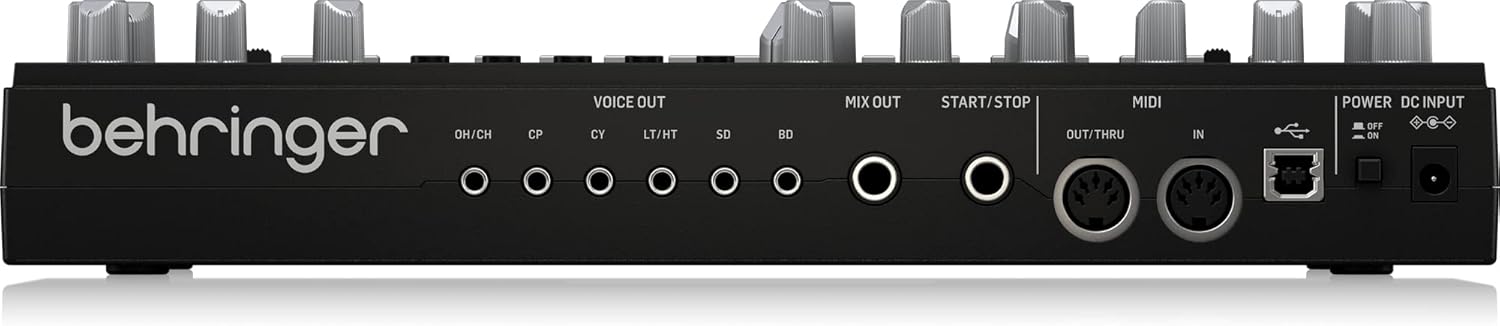
- Behringer RD-8 — A circuit-level recreation of the Roland TR-808, the drum machine that defined four decades of bass-heavy club music. Ten individual outputs.
- Behringer RD-9 — A recreation of the Roland TR-909, the kick-and-snare workhorse of techno and house. Adds an accent system and individual outputs.
- Behringer LM — Behringer’s newest entry in this tier (shipping mid-2025), modeled after the classic LinnDrum architecture. Different heritage from the Roland clones: Behringer’s version layers analog voice circuitry over the LinnDrum’s multi-voice design.
By the numbers (street prices, May 2026):
| Machine | Approx. Street Price | Voices | Individual Outs |
|---|---|---|---|
| DrumBrute Impact | ~$299 | 12 | Yes (select voices) |
| Behringer RD-8 | ~$299–$329 | 11 | 10 individual |
| Behringer RD-9 | ~$329–$349 | 10 | Individual |
| Behringer LM | ~$399–$449 | 14 | Partial |
All four land comfortably under $500 even after factoring in a power supply and a basic cable kit.
Sound Character: Where Each Machine Actually Lives
Behringer RD-8 — Faithful to the Source, With One Real Limitation
Behringer
$149.00
In stock on Amazon
Check price on AmazonThe perennial question with 808 clones is whether the analog circuitry is actually faithful or just marketing copy. Sound On Sound’s review of the Behringer RD-8 concluded that the analog sounds are genuinely close to the original TR-808—particularly the bass drum, hi-hats, and cowbell. That is a meaningful endorsement from a publication with a long track record of critical hardware analysis and access to vintage reference units.
The limitation to know before buying: maracas and hand clap cannot be triggered simultaneously, whether from the internal sequencer or via external MIDI. On an original TR-808, a shared circuit prevents both voices from firing at the same moment, and Behringer replicated that hardware constraint faithfully. For producers committed to authentic 808 patterns, this is pure fidelity. For anyone who needs both layers hitting together in a dense arrangement, it is a genuine workflow blocker. Know this before you commit.
A side note worth including if your research leads you toward the Behringer RD-6 (the 606-style sibling, priced slightly lower): that machine carries more widespread owner reports of all-plastic construction that feels noticeably cheaper in hand, and outputs that can run hot enough to overdrive standard mixer channels. The RD-8 does not draw those same complaints with comparable frequency, which makes it the stronger buy at the small price difference.
Behringer
$149.00
In stock on Amazon
Check price on AmazonBehringer RD-9 — Raw, Dark, and Built for the Signal Chain

Arturia
$299.00
In stock on Amazon
Check price on AmazonThe TR-909 carries mythological status in techno and house, partly because the records producers made with it were processed and layered extensively—the raw machine almost never appears on finished tracks without significant outboard treatment. Sweetwater’s product page for the Behringer RD-9, including its user Q&A section populated by buyers with firsthand experience, reflects this clearly: the RD-9 out of the box is very dry and dark. The snare in particular sits back in a way that can feel thin compared to the polished studio versions producers are trying to chase.
This is not a flaw in the machine—it is a realistic corrective to hype-driven expectations. The 909 was always a starting point for processing, not a finished-sounding instrument. If your signal chain routes through a reverb unit, outboard compression, or a DAW bus with saturation, the RD-9 rewards that investment substantially. If you want plug-and-play club-ready drum sounds with minimal post-processing, temper your expectations before purchase.
The accent system—a feature where “accented” steps hit louder and with a different harmonic character, functioning as a velocity-adjacent expressive tool—is one of the RD-9’s genuine advantages over the DrumBrute Impact in techno and house contexts. It adds dynamics that the sequencer alone cannot provide.
Arturia
$299.00
In stock on Amazon
Check price on AmazonArturia DrumBrute Impact — Playability as a Core Design Value
Behringer
$149.00
In stock on Amazon
Check price on AmazonMusicRadar’s review of the Arturia DrumBrute Impact consistently returns to one theme: it is fun to play live. The layout prioritizes performance over studio recreation, and the per-voice distortion circuit—Arturia calls it “Brute Factor”—lets producers push individual voices from clean to aggressively saturated without touching the mixer. That kind of integrated sound-shaping is a meaningful differentiator at this price point.
Owners who use the DrumBrute Impact in live rigs frequently describe a machine that rewards real-time tweaking. The MIDI output is flexible enough to sequence external modules, expanders, and even drum pedals, which expands the Impact’s role from standalone instrument to sequencing hub. That reach matters for producers building modular or hybrid setups where the drum machine anchors a larger signal network.
The DrumBrute Impact does not try to sound like an 808 or 909—it has its own voice and its own synthesis architecture. That is a genuine advantage if you want a sound palette that does not carry specific genre associations or invite direct vintage comparison; it is a limitation if you specifically need that Roland DNA in your mix.
MusicRadar’s review also highlights the machine’s approachability as a first piece of analog drum hardware for producers coming from software environments. The sequencer produces musical results quickly, and the Brute Factor distortion gives beginners a powerful sound-shaping tool that does not require deep synthesis knowledge to use effectively.
Behringer
$149.00
In stock on Amazon
Check price on AmazonBehringer LM — Promising and Patient-Requiring
Arturia
$299.00
In stock on Amazon
Check price on AmazonThe LM is the newest of the four machines covered here. Synthtopia’s first-look coverage from the 2025 launch period captured early owner sentiment accurately: genuine enthusiasm about the sounds—the snare and rim voice earning specific praise—alongside honest acknowledgment of a non-trivial learning curve on the interface. The LM takes design cues from the LinnDrum’s multi-voice architecture while incorporating analog voice circuitry, which produces an unusual hybrid character that rewards sustained time investment rather than immediate intuition.
Attack Magazine’s analog drum machine buyer’s guide, published in late 2025, categorizes the LM as a strong option for producers seeking a different tonal palette who are patient with unfamiliar workflows. The same guide recommends the RD-8 or DrumBrute Impact for buyers who need to reach workflow confidence quickly. That framing is useful: the LM is not the wrong answer for an intermediate-to-advanced producer with time to invest, but it is probably not the right first analog drum machine for someone new to hardware.
With fewer months of owner experience accumulated in the wider community compared to the RD-8 or DrumBrute Impact, the LM carries more uncertainty. Based on published specifications and Synthtopia’s coverage, the LM’s architecture centers on its onboard analog voice circuitry and is not designed as a general-purpose sample-import machine in the way a digital workstation would be.
Arturia
$299.00
In stock on Amazon
Check price on AmazonWorkflow and Integration: The Practical Layer
Output Behavior and Mixer Compatibility
Across the four machines, individual outputs are a key differentiator for both studio recording and live use. The RD-8’s ten individual outputs allow independent processing of each voice in a DAW—essential for modern mixing where kick and snare typically live on separate bus chains with distinct compression and EQ. The RD-9 offers comparable voice separation.
The DrumBrute Impact’s individual outputs cover select voices but not every voice on the machine. For a full mix-bus workflow where every drum element needs its own chain, this matters. For live performance through a minimal mixer configuration, it rarely does.
On output levels: as noted above, the RD-6 sibling draws consistent owner complaints about hot outputs overdriving standard mixer inputs. The RD-8 and RD-9 are more frequently reported as well-behaved at standard line levels. Even so, producers routing any analog drum machine into interfaces with low-headroom preamps should check gain staging carefully before a session or set. A pad switch or attenuator cable is inexpensive insurance.
MIDI and External Control
All four machines accept MIDI clock and note triggering, but behavior varies in the details. The RD-8’s maracas and clap simultaneous-trigger limitation applies via MIDI just as it does from the internal sequencer—it is a hardware voice-sharing issue, not a MIDI implementation gap. Producers who plan to sequence from a DAW or hardware sequencer should map their specific patterns against this constraint before finalizing their rig.
The DrumBrute Impact’s MIDI output flexibility—able to sequence external modules, expanders, and pedal-based instruments—makes it the strongest candidate of the four for producers who want their drum machine to anchor a larger hybrid system rather than operate in isolation.
Decision Frame: If X, Then Y
Here is the direct version of what the available evidence supports:
If you want the most faithful analog 808 recreation under $500 and can work around the maracas/clap limitation: The RD-8 is the answer. Sound On Sound’s review validates the analog circuit fidelity against original Roland units. Go in knowing the limitation; route around it with arrangement choices or pattern structure.
If you’re building a techno or house rig and plan to run your drum bus through real effects processing: The RD-9 rewards that investment. Per Sweetwater’s user-sourced feedback, do not expect finished-sounding tracks raw out of the machine. Expect a dry, honest starting point that processes beautifully with reverb, compression, and saturation.
If you want a machine that is genuinely fun to play live, has its own sound identity independent of Roland history, and can sequence external gear: The DrumBrute Impact earns the strongest recommendation for performers and for producers moving from software to hardware for the first time. MusicRadar’s review supports its playability and approachability as consistent strengths.
If you want a different tonal palette and are willing to invest time in learning an unfamiliar interface: The LM has real promise. Attack Magazine’s buyer’s guide frames it as a patient producer’s choice. If early-adopter exploration suits your working style, the LM rewards it. If you need immediate workflow confidence, start elsewhere and revisit the LM after its user community has another year of documentation behind it.
Frequently Asked Questions
Can the Behringer RD-8 trigger maracas and clap simultaneously? No. The maracas and hand clap voices share a hardware circuit and cannot fire at the same moment—whether triggered by the internal sequencer or by external MIDI. This replicates a constraint present in the original Roland TR-808. It is a real workflow consideration for patterns that need both sounds on the same step.
Does the RD-9 sound like finished 909 records out of the box? It does not. Sweetwater’s user Q&A for the RD-9 reflects consistent feedback from buyers with firsthand 909 experience: the raw sound is very dry and dark, particularly the snare. The machine is an accurate starting point, not a polished end result. Budget for reverb, compression, and saturation in your signal chain.
Is the DrumBrute Impact a good first analog drum machine for someone coming from software production? Community consensus and MusicRadar’s review both support yes. The per-voice Brute Factor distortion gives beginners expressive sound-shaping without requiring deep synthesis knowledge, and the sequencer reaches musical results quickly enough to stay motivating during the learning period.
How do the outputs behave when going into a standard mixer or audio interface? The RD-8 and RD-9 are generally reported as well-behaved at standard line levels. The RD-6—a cheaper sibling not covered in depth here—draws more frequent owner complaints about hot outputs overdriving mixer inputs. Keep these machines distinct in your research. Check gain staging on any analog drum machine before a live set.
Does the Behringer LM support external sample import? Based on published specifications and Synthtopia’s first-look coverage, the LM’s design centers on onboard analog voice circuitry and is not built to function as a general-purpose sample-import or sample-playback host. It is not a digital workstation in that regard.