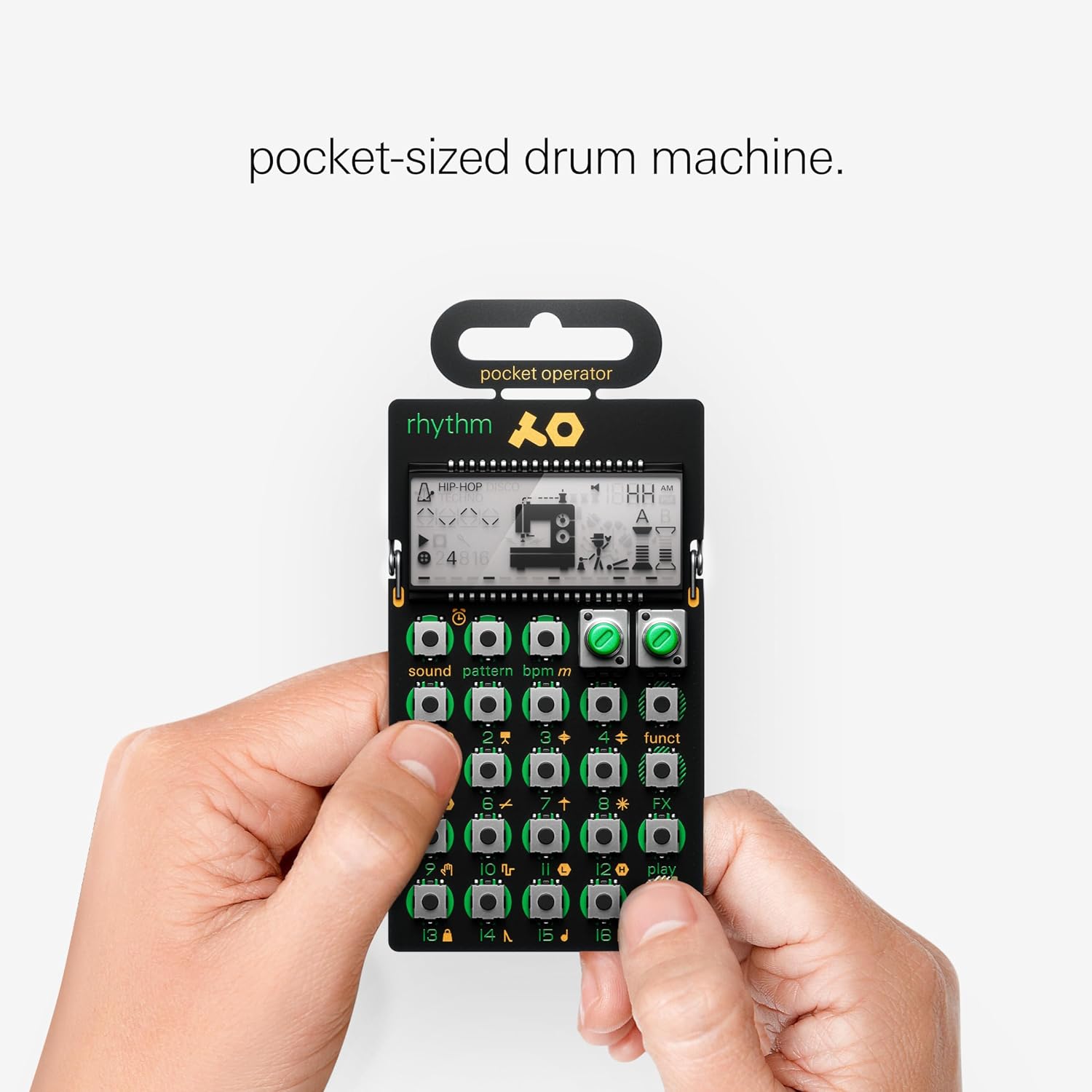
Teenage Engineering makes some of the smallest, cheapest drum machines on the planet — and some of the most divisive. The Pocket Operator line (often abbreviated PO) is a series of credit-card-sized synthesizers and sequencers that retail for roughly $60–$99. Each one runs on two AAA batteries, has no case, and is operated almost entirely through a grid of rubber buttons on a bare circuit board. That sounds like a toy, and in some rooms it is. In others, it is a serious sketching tool, a live warm-up box, or a gateway into a full Teenage Engineering workflow that eventually includes the EP-133 K.O. II — a $349 sampler/beat-maker that shares Pocket Operator DNA but plays in a different weight class entirely. This guide maps out which PO is right for which buyer, names the real tradeoffs between the PO-12, PO-24, and PO-32, and gives you a decision rule for when the EP-133 (or even the EP-1320 Medieval) makes more sense than stacking more POs.
| EDITOR'S PICKteenage engineering EP–133 K.O.… | Mid-tierteenage engineering pocket oper… | Budget pickTeenage Engineering EP-1320 Med… | |
|---|---|---|---|
| Sampling | ✓ | ✗ | ✓ |
| Memory | 128MB | — | — |
| Built-in mic | ✓ | ✗ | ✓ |
| Effects | ✓ | — | ✓ |
| Price | $329.00 | $59.00 | |
| See on Amazon → | See on Amazon → | See on Amazon → |
The Three Drum-Focused Pocket Operators at a Glance
Not every PO makes percussion sounds — some are bass synths or chord machines — so the relevant models for this audience are the PO-12 Rhythm, the PO-24 Office, and the PO-32 Tonic. Here is where they sit:
| Model | Core Sound Engine | Unique Capability | Street Price (2026) |
|---|---|---|---|
| PO-12 Rhythm | 16 classic drum voices | Punch-in effects, BPM sync | ~$59 |
| PO-24 Office | Office machine noise sources | Experimental/industrial palette | ~$79 |
| PO-32 Tonic | Microtonic synthesis engine | Microtonic sound transfer via audio | ~$99 |
All three run the same sequencer architecture: 16 steps, 16 patterns, real-time punch-in effects, a tempo-matched alarm clock, and sync I/O over the headphone jack. That last point matters more than it looks — the 3.5 mm sync signal is how you chain POs together and how you lock them to other gear.
Sound On Sound’s overview of the Pocket Operator series notes the hardware is intentionally minimal and that the lack of a case is a design statement, not an oversight — TE sells optional silicon cases separately, which the community broadly recommends for anyone gigging with one.
PO-12 Rhythm: The Floor Model Everyone Keeps
The PO-12 is the entry point and, by almost any measure, the most forgiving starting place. Its 16 voices cover the expected toolkit: kick, snare, hi-hat variants, clap, rim, cowbell, and a handful of tonal percussion hits. None of it is groundbreaking by 2026, but the groove-quantization and effect system punch well above the price.
What reviewers keep noting about the PO-12 is how far its use cases drift from the obvious. Aggregated owner accounts describe guitarists carrying it on commutes as a pocket-sized practice metronome that has actual feel to it — not just a click. Parents describe learning patterns alongside their children. Live performers mention it as a warm-up or compositional sketch tool that lives in a jacket pocket rather than a gig bag. Attack Magazine’s budget drum machine feature places it in exactly this category: not a replacement for anything, but a creative companion that earns its keep through friction-free portability.
The honest tradeoff: The PO-12 is a great first PO and a decent fifth PO. It does not grow much beyond its initial ceiling. If you already know you want synthesis depth, start with the PO-32 and come back to the PO-12 later — or skip it.
PO-24 Office: The Most Overlooked Model in the Family
The PO-24 slots between the PO-12 and PO-32 in price, but it is operating in a different aesthetic entirely. Its sound palette is built from sampled office equipment: floppy drive heads, dot matrix printer mechanisms, hard drive platters, mechanical keyboards. On paper this sounds like a novelty. In practice, owners consistently call it the most underestimated model in the lineup — particularly for producers working in industrial, noise, experimental electronic, or lo-fi contexts where a clean, Roland-style drum kit is actively the wrong texture.
The caveat is real, though. One reviewer in an aggregated buyer discussion notes honestly that several of the 16 voices sit so close together in character that distinguishing them in a mix requires effort — some sources in the Office palette are more similar to each other than they first appear in the menu. If you need clear, separated transients across every slot, the PO-24 will frustrate you. If you are layering a drum machine under distorted synths or field recordings, that smeared character may be exactly right.
The honest tradeoff: The PO-24 is a specialist tool. Buy it if the source material — office noise textures — is itself useful to you. If you are unsure, the PO-12 or PO-32 is a safer first purchase.
PO-32 Tonic: The One That Thinks Like a Synthesizer
The PO-32 is a different kind of machine. Where the PO-12 and PO-24 play back fixed samples, the PO-32 runs a version of the Microtonic synthesis engine — a well-regarded drum synthesizer software originally developed by Magnus Lidström and published by Sonic Charge. Every voice on the PO-32 is synthesized in real time from oscillators, noise generators, and envelopes, not played back from a memory chip.
This matters to intermediate-to-advanced producers in two specific ways.
First, the sounds are fully malleable. You are not choosing between 16 preset voices; you are shaping 16 synthesis voices that can range from snappy analog-style kicks to metallic noise bursts to melodic tonal percussion. Owners who own both the PO-12 and PO-32 routinely describe the Tonic as “just better” in a fundamental sense — not better at the same thing, but operating at a higher level of expressive control.
Second, the Microtonic audio transfer feature is genuinely unique in this price bracket. Sonic Charge’s Microtonic software can encode preset kits into an audio signal — essentially a data tone — that plays from a computer or phone into the PO-32’s input jack. The PO-32 decodes that signal and loads the kit directly. Synthtopia’s coverage of this feature at launch highlighted it as one of the more clever hardware/software bridges in affordable drum synthesis. In 2026, the Microtonic patch library has grown substantially through community contributions, so the practical library available to a PO-32 owner is far larger than the onboard starting kits suggest.
The honest tradeoff: The PO-32 costs about $40 more than the PO-12. For any producer who cares about sound design at even a basic level, that delta is not a meaningful consideration. The PO-32 is the drum-focused PO to buy first.
When to Step Up: EP-133 K.O. II and EP-1320 Medieval
Both the EP-133 and EP-1320 carry Pocket Operator DNA — the same cheeky industrial design, the same TE sensibility — but they are not POs. They are a tier above in both price and capability, and the decision to step up is a real one.
EP-133 K.O. II (~$349): MusicRadar’s review describes the EP-133 as a lo-fi sampler and beat-maker that feels like a natural companion to the PO ecosystem for producers who have outgrown 16-step sequences and single-kit machines. The song mode is the specific upgrade owners cite most — it enables actual arrangement across multiple patterns rather than manual chain-switching mid-performance. If you are building lo-fi hip-hop, sample-based electronic music, or any genre where sample chopping and pattern arrangement are central to the workflow, the EP-133 is the upgrade that makes sense. The price gap over a PO is real, but so is the capability gap.
EP-1320 Medieval (~$449): Community reception here splits sharply. The effects architecture and arrangement tools receive consistent praise — this is a more powerful machine than the EP-133 in several dimensions. But the UI is a genuine friction point that shows up in nearly every detailed review. Perfect Circuit’s product notes and broader owner accounts both flag the same issue: Teenage Engineering renamed every control element with medieval terminology — knobs, buttons, modes, and functions all carry names drawn from the theme. For experienced TE users, this is a quirk. For anyone new to the platform, it extends the learning curve considerably beyond what the underlying complexity actually requires. If you are already comfortable with TE workflow and want more power, the EP-1320 earns its price. If this is your entry point into TE gear, the EP-133 is the more sensible first machine.
The decision rule: If your primary need is drum synthesis and pattern sketching under $100, the PO-32 is the right answer. If you need arrangement capability, sampling, and song-level structure, step to the EP-133. Only move to the EP-1320 once you know the TE ecosystem well enough that its naming conventions will not slow you down.
Frequently Asked Questions
What is the difference between the PO-12 and PO-32 — is the PO-32 just a better drum machine? In a practical sense, yes — at least for most use cases. The PO-12 plays back fixed sample voices; the PO-32 synthesizes every sound in real time using the Microtonic engine. Owners who have used both consistently describe the PO-32 as operating at a higher expressive level. The PO-12 has its place as a grab-and-go rhythm tool, but if synthesis depth matters to you, the PO-32 is the better starting point.
How does the Microtonic sound transfer actually work on the PO-32 Tonic? Sonic Charge’s Microtonic software encodes drum kit settings as an audio data signal. You play that signal from a computer or phone into the PO-32’s 3.5 mm input, and the PO-32 decodes it and loads the kit. Synthtopia’s coverage of the feature confirmed it works reliably across standard audio outputs. The Microtonic community patch library is extensive, so the practical sound set available to a PO-32 owner is large.
Can Pocket Operators sync together and with other hardware? Yes. All POs send and receive a sync pulse over the 3.5 mm headphone/line jack. You can chain multiple POs together, sync them to a DAW sending a click track, or lock them to other hardware that outputs a compatible sync signal. The sync is tempo-only — it does not transmit pattern or note data — but it is solid for keeping a PO in time with a larger rig.
Is the EP-133 K.O. II worth the higher price over a Pocket Operator for a first TE purchase? It depends entirely on workflow. If you want to sample, chop, arrange, and build complete tracks, the EP-133’s song mode and sampler justify the cost gap. If you primarily want a drum synthesis sketchpad, start with the PO-32 and upgrade later. The EP-133 is not a more powerful PO — it is a different class of instrument.
How do you save patterns on the Pocket Operators — is there a risk of losing work? Patterns are stored in memory as long as the batteries have power. Swapping batteries without a backup risks losing patterns. The community-standard practice is to record your patterns out to audio (a phone, DAW, or recorder) before a battery swap. There is no cloud backup, no USB save — audio recording is the backup method. This is a real limitation worth knowing before you build something you care about.
Is the EP-1320 Medieval too confusing for someone new to Teenage Engineering gear? For most new users, yes — the medieval naming of every control element adds a layer of UI translation on top of the underlying learning curve. Owner accounts and Perfect Circuit’s product notes both flag this as a genuine barrier that is separate from the machine’s actual complexity. The EP-133 is the better entry point into TE’s higher-tier ecosystem. Return to the EP-1320 once the platform feels familiar.