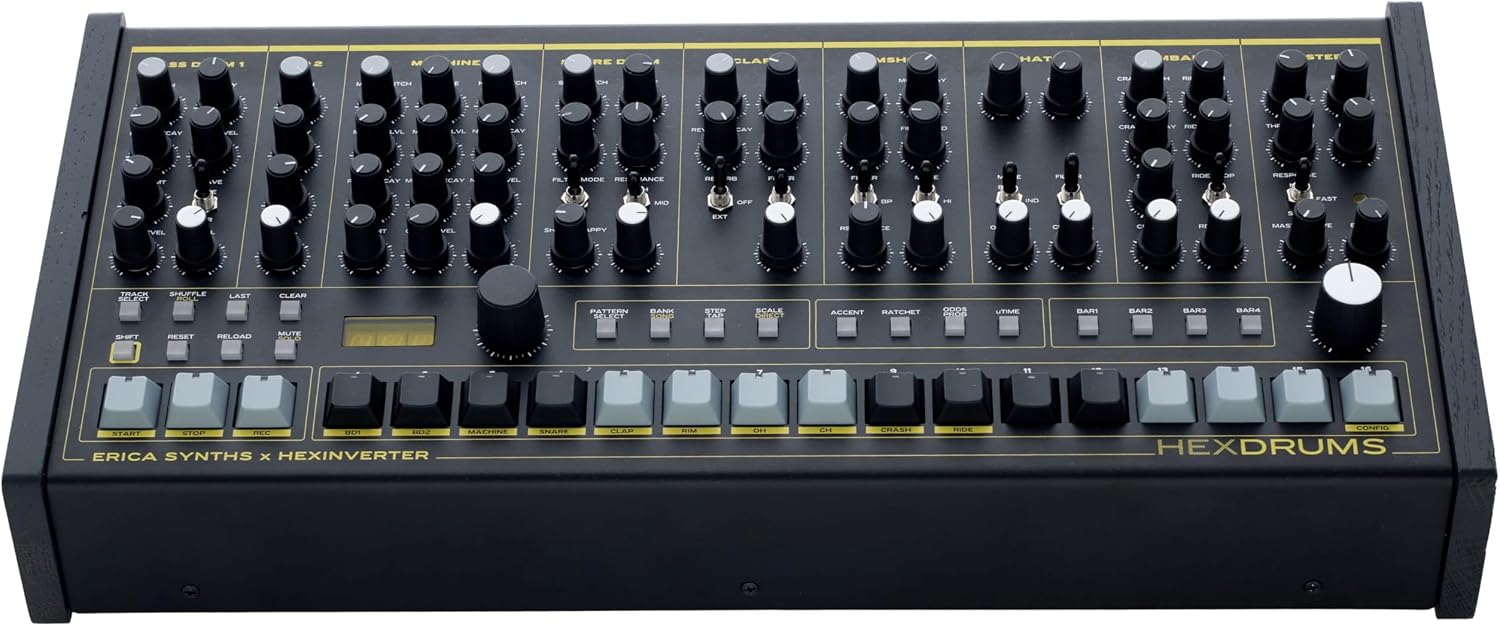
If you’ve been producing with a standalone drum machine — something like a Roland TR-8S or an Arturia DrumBrute Impact — you’ve probably hit a moment where you wanted a sound the box just couldn’t give you. That’s the moment a lot of producers start looking at Eurorack modular synthesis. Eurorack is a hardware format — a standardized system of small electronic modules that slot into a powered metal case called a rack — where each module handles one specific job: generating a tone, shaping its volume over time, filtering its frequency content, or routing it somewhere else. Unlike an all-in-one drum machine, a modular system has no fixed voice count and no factory presets. You design each percussion sound by choosing and connecting individual modules. The upside is complete creative control. The honest downside is that the learning curve is real, and costs add up fast if you don’t have a plan going in. This guide is built to give you that plan: what module categories you actually need, what they cost in mid-2026, and a clear framework for making your first purchase decision.
What “A Percussion Voice” Actually Means in Modular
Before you start browsing Perfect Circuit listings, it helps to think in functional blocks rather than product names. A single percussion voice — one kick, one snare, one hi-hat — requires at least three things working together:
1. A sound source (oscillator or noise generator). This produces the raw audio. For drums, that might be a sine wave for a kick body, white noise for a snare crack, or a more complex digital waveshaper for metallic tones.
2. An envelope generator (EG). An envelope shapes how a sound changes over time — how fast it attacks, how quickly it decays. In drum synthesis, tight percussive envelopes are everything. Without one, you have a drone, not a hit.
3. An amplifier or VCA (Voltage Controlled Amplifier). The VCA opens and closes like a gate, letting the envelope’s shape actually reach your output. Many dedicated drum modules combine the VCA and envelope into a single unit, but understanding the split matters when you’re patching a more complex voice.
Some dedicated drum modules — like the Noise Engineering Basimilus Iteritas Alter or the Moog DFAM (Drummer From Another Mother) — bundle all three functions into one voice, which is a compelling entry point. Others, like Make Noise’s Manis Iteritas, are pure oscillator/voice engines that expect you to supply the envelope and VCA externally. Neither approach is wrong, but they imply very different build strategies and budgets.
Sound On Sound’s Eurorack drum synthesis feature series describes this exactly: “dedicated percussion modules trade patching flexibility for immediacy, while raw oscillator-based approaches reward patience with sounds no preset system can reproduce.”
The Four Module Categories You Need to Budget For
Here’s where most first-time Eurorack buyers underestimate the cost: the “cool” drum voice module is only part of what you need to spend. Plan your budget across four categories.
1. The Drum Voice Module Itself
This is your centerpiece. The market in 2026 covers a wide range:
- Entry-level dedicated voices — Modules like the Erica Synths Bassline or the 4ms Spherical Wavetable Navigator adapted for percussion fall in the $150–$250 range. These are typically digital and offer immediate playability.
- Mid-tier analog and hybrid voices — Noise Engineering’s lineup (Basimilus Iteritas Alter, Loquelic Iteritas, Cursus Iteritas) sits around $299–$349 new at retailers like Perfect Circuit. These are among the most community-recommended drum voice modules available; MusicRadar’s best Eurorack drum modules roundup consistently cites the Basimilus Iteritas Alter as a benchmark for percussive versatility.
- Premium analog voices — The Moog DFAM at $699 is technically a semi-modular synthesizer that fits a Eurorack context via patch cables even though it doesn’t mount in a rack. Make Noise’s Manis Iteritas runs around $299 and is positioned as a raw voice engine for operators who want to build around it.
2. Envelope Generators and VCAs
If your drum voice module doesn’t include its own envelope (many don’t), you need dedicated envelope and VCA modules. Budget $80–$180 per voice for a simple EG/VCA pair. Makers like Mutable Instruments (now open-source and available through licensed builders), Intellijel, and 4ms offer well-reviewed options. Attack Magazine’s modular drum kit tutorial specifically recommends pairing any raw voice module with a fast, snappy EG — noting that “a slow attack on a drum envelope is the single fastest way to lose the transient punch that makes percussion feel alive.”
3. A Sequencer or Trigger Source
Modules don’t play themselves. You need something sending rhythmic trigger signals — short voltage pulses that tell each voice “hit now.” Dedicated Eurorack sequencers like the Intellijel Metropolix ($399), the Squarp Rample ($299), or even a basic clock divider module can fill this role. Alternatively, many producers drive their Eurorack percussion from an external device like an Elektron Digitakt or a DAW (digital audio workstation, your recording software) via CV/gate interfaces. CDM’s Eurorack percussion workflow features note that hybrid setups — external sequencer clocking internal Eurorack voices — are increasingly common and often the most practical starting point.
4. The Case and Power Supply
This is the cost that blindsides people. Eurorack modules need a powered case, measured in HP (horizontal pitch) — basically rack-space units. A starter case of 84HP (enough for 5–8 small modules) costs $120–$250 from makers like Intellijel, Tiptop Audio, or Pittsburgh Modular. Sweetwater’s Eurorack buying guide recommends buying at least 30% more case space than you think you need immediately, since most builders expand within six months.
By the Numbers: Entry Budget vs. Serious Starter Rig
| Build Tier | Voice Module | Envelope/VCA | Sequencer/Trigger | Case + Power | Estimated Total |
|---|---|---|---|---|---|
| Minimal first voice | ~$200 | ~$120 | External (DAW/MIDI) | ~$150 | ~$470 |
| Solid single voice | ~$330 | ~$160 | ~$200 (basic) | ~$200 | ~$890 |
| Two-voice starter rig | ~$650 | ~$280 | ~$350 | ~$250 | ~$1,530 |
These are 2026 street-price estimates based on current listings at Perfect Circuit and Sweetwater. Used market pricing on Reverb tends to run 20–30% below new for popular modules like Noise Engineering’s lineup, which have held value well.
The Tradeoffs You Need to Name Before You Buy
Dedicated Drum Module vs. Raw Voice + External Envelope
A dedicated percussion module (one that has envelope, VCA, and voice source integrated) gets you making sounds in an afternoon. The Noise Engineering Basimilus Iteritas Alter is the canonical example here — owners consistently report it as one of the most immediately expressive drum voice modules available, capable of covering kick, snare, tom, and metallic percussion territory from a single module. The tradeoff is that its internal architecture is fixed. You’re working within Noise Engineering’s design decisions.
A raw voice module plus external envelope and VCA takes longer to learn but gives you more modulation possibilities — you can swap in different envelope shapes, use external LFOs (low-frequency oscillators, slow modulation sources) to animate the sound over time, or process the voice through filters and effects in ways a self-contained module can’t accommodate.
For a first voice: if you want to learn synthesis principles through percussion, go raw voice + external envelope. If you want musical results faster and plan to layer Eurorack sounds alongside an existing drum machine, go dedicated module.
Analog vs. Digital Voice Modules
Analog drum modules (circuits built around transistors and capacitors rather than a microprocessor) are generally described by the community as warmer and more responsive to CV (control voltage) modulation in subtle, musical ways. The Moog DFAM and vintage-style kick modules from makers like Jomox and TipTop exemplify this. Digital voice modules like the Noise Engineering lineup use digital signal processing but are designed to behave expressively under modulation — reviewers at MusicRadar and Sound On Sound consistently note that the line between “analog feel” and “digital precision” has blurred considerably in the 2024–2026 generation of modules.
The practical difference for a first build: analog modules often cost more and are more sensitive to build quality; digital modules offer more timbral range per dollar at this price tier.
Building Around a Theme vs. Collecting Individual Voices
This is the intuition trap. It’s tempting to buy one kick module, one snare module, and one hi-hat module from three different makers. But each module may require different envelope shapes, different trigger voltages, and different VCA configurations — multiplying your support infrastructure costs and complexity. The community consensus, reflected in Attack Magazine’s tutorials and CDM’s workflow features, is that building two fully specified voices before adding a third produces better results than assembling five half-finished ones.
The Decision Framework: If X, Then Y
Use this to close the loop on your current decision:
-
If you have $400–$600 and want to start immediately: Buy a dedicated all-in-one percussion voice module (Noise Engineering Basimilus Iteritas Alter is the community benchmark), pair it with a budget case, and trigger it from your existing drum machine or DAW. Add envelope and VCA infrastructure in round two.
-
If you have $800–$1,200 and want one fully specified voice: Allocate roughly $330 for a mid-tier voice module, $160 for an EG/VCA pair, $200 for a basic trigger/clock source, and $200 for a case with room to grow. This is a complete, musically usable rig on day one.
-
If you have $1,500+ and are building toward a full modular percussion system: Budget for two complete voices before spending on utilities (mixers, effects, clock dividers). The two-voice threshold is where modular percussion starts to feel like a compositional instrument rather than a tone generator.
-
If you’re primarily a studio composer or sound designer who wants Eurorack percussion for texture rather than live performance: prioritize voice modules with strong CV modulation inputs over fast playability. Raw voice modules like the Make Noise Manis Iteritas or Instruo’s percussion voices reward deep patching and are better suited to slow, exploratory sound design workflows than immediate performance.
The Eurorack format rewards specificity. Know what one voice needs to sound like before you commit to a module, and treat the case as infrastructure investment rather than an afterthought. The builders who get the most from their systems aren’t necessarily the ones who spent the most — they’re the ones who planned one voice at a time.