A drum machine pedal is exactly what it sounds like: a compact floor pedal—designed to sit on your pedalboard or next to your guitar case—that plays drum grooves on demand. You trigger beats with your foot, keep your hands free for your instrument, and walk away from open mics sounding like you brought a rhythm section. For solo acoustic performers, singer-songwriters, and guitarists who have wrestled with a laptop metronome or a clunky MIDI rig, these pedals represent one of the most practical upgrades you can make. This guide covers the three options that keep coming up in 2026 discussions among working solo performers: the Singular Sound BeatBuddy family, the MOOER D7 X2 and Micro Drummer II, and the BOSS RC-10R Rhythm Loop Station. We’ll name the tradeoffs explicitly, show you where each one breaks down, and give you a clear decision rule at the end.
The BeatBuddy Family: Human Feel at a Price
BeatBuddy 2 (Full-Size): The Community Consensus Pick
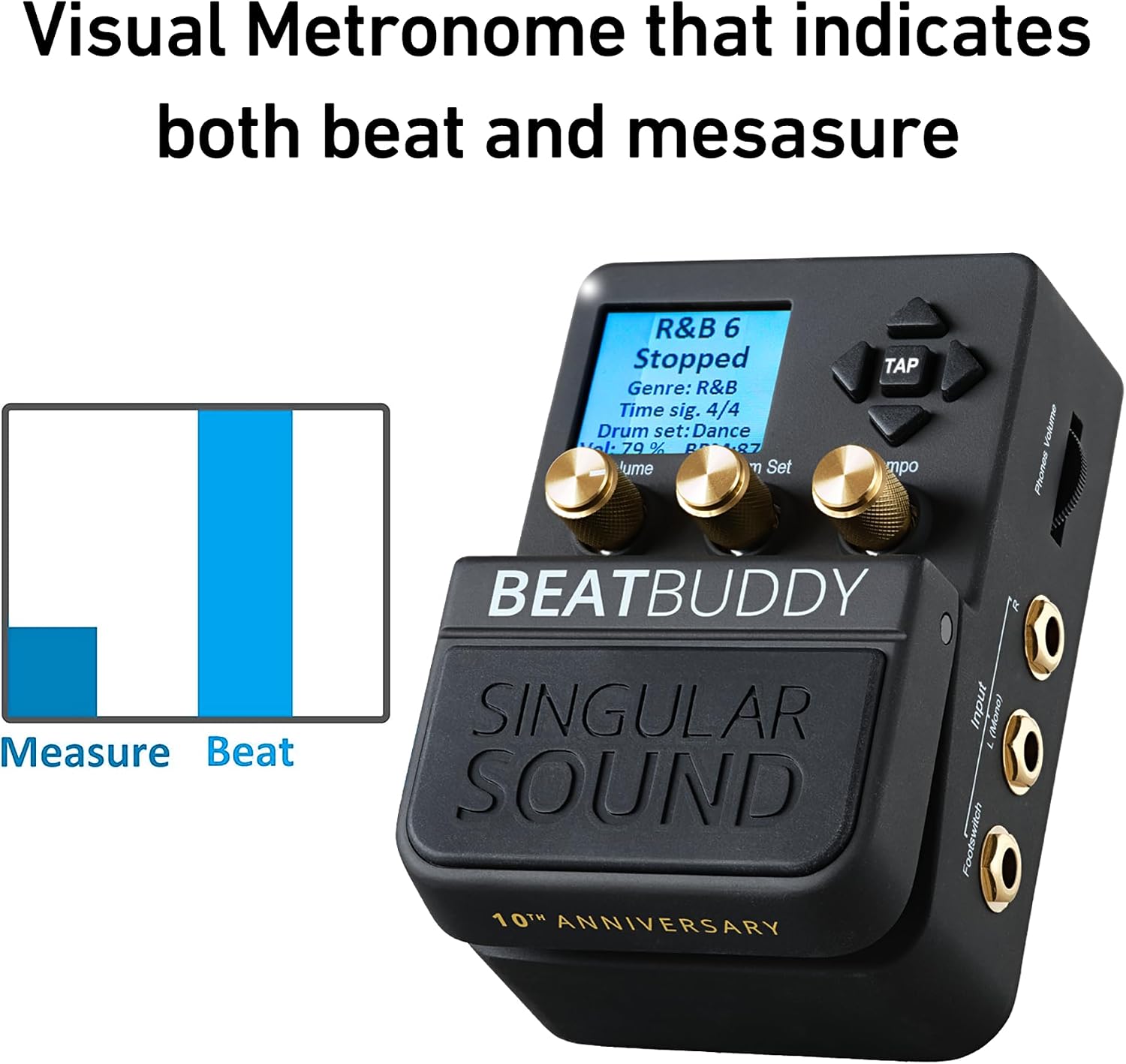
The BeatBuddy has a reputation that is genuinely unusual in the drum-pedal space. Reviewers and long-term owners consistently describe the drum feel as musical rather than mechanical—phrases like “finally a drum machine done right” appear in Sweetwater’s customer Q&A section for the Singular Sound BeatBuddy, particularly from acoustic singer-songwriters who find most drum machines too robotic for an intimate live set. That reputation is well-earned: Singular Sound built BeatBuddy around multi-layered, velocity-sensitive samples, which means a hi-hat at the start of a groove does not sound identical to the hi-hat at the end. The result is a feel that owners repeatedly contrast favorably against simpler groove boxes.
Synthtopia’s 2025 news coverage of the BeatBuddy 10th Anniversary edition notes the updated industrial design and expanded content library, but the core architecture—footswitch-triggered song sections, fills, transitions, and endings—remains the platform’s defining feature. For a performing musician, that architecture is natural: you are not programming a pattern; you are conducting a band with your feet.
One trust issue with the BeatBuddy 2 is worth addressing directly. Sweetwater’s customer Q&A for the unit includes at least one verified owner report flagging a significant discrepancy: the unit arrived with minimal content on the SD card despite the product description advertising 200 songs. Based on Singular Sound’s published documentation, the songs ship as downloadable content delivered through the company’s desktop software manager rather than stored on the unit at the factory—meaning the “200 songs included” claim is accurate but requires a firmware setup step that is not always prominently communicated at the point of sale. If you unbox a BeatBuddy 2 at a gig and expect to play immediately, that setup step is a surprise. Download the software manager before the pedal arrives.
Native
$249.00
In stock on Amazon
Check price on AmazonBeatBuddy Mini 2: Compact Convenience with a Live Workflow Tax
The BeatBuddy Mini 2 brings the same human-feel sample engine to a smaller, less expensive form factor. Owners consistently praise the size and the price point. The complaint that surfaces repeatedly and specifically in Sweetwater’s customer Q&A and in coverage from MusicRadar’s rhythm-pedal feature roundups, however, is a tempo behavior that catches live performers off guard: the Mini 2 resets its tempo each time you change songs or genres. In a set where you are cycling through different grooves for different songs, that means manually re-dialing the BPM between songs—an interruption that the full-size BeatBuddy 2 handles more gracefully.
This is not a fatal flaw. Owners report two workable workarounds: organizing setlists so that songs in the same tempo range sit adjacent, or entering BPM manually at each song change. But it is a live workflow tax that players with varied setlists should price in before buying. Singular Sound’s BeatBuddy community forum, referenced in Sweetwater Q&A contributor discussions, has documented this behavior since the Mini 2’s release; as of mid-2026 it has not been addressed by a firmware update.
teenage
$89.00
In stock on Amazon
Check price on AmazonMOOER D7 X2 and Micro Drummer II: Value and Its Limits
MOOER D7 X2: Best Budget Groove Variety
MOOER occupies a practical niche—compact, affordable, and genre-varied. The D7 X2 is the more capable of the two MOOER units covered here. Thomann’s aggregated customer reviews for the D7 X2 praise the groove variety and value-per-dollar. The pattern library leans wider than the BeatBuddy’s default acoustic kits, with electronic and genre-specific grooves that suit players who move between styles. MusicRadar’s feature coverage on budget rhythm pedals for live performance positions MOOER as the right answer when the budget ceiling is the primary constraint, and that editorial position reflects community experience accurately.
The D7 X2’s basic groove playback and tempo functions are accessible without consulting documentation—owners generally report core operation as intuitive. Advanced features like editing grooves or navigating the full preset library benefit from the manual, but a guitarist who wants to start a groove and adjust tempo can do that from the front panel without prior study. For a pedalboard addition that delivers rhythmic variety at a modest outlay, the D7 X2 has genuine community support.
The broader MOOER tradeoff is build quality versus price. MusicRadar’s rhythm-pedal coverage consistently notes that MOOER hardware is not built to the same standard as Singular Sound or BOSS, and that gap becomes more significant in long-term gigging situations. If you are rotating through different venues weekly, durability matters more than if you are a home player who takes the pedal to occasional open mics.
teenage
$89.00
In stock on Amazon
Check price on AmazonMOOER Micro Drummer II: Budget Compact with a Documentation Problem
The Micro Drummer II is where documentation becomes the deciding factor. Thomann’s aggregated customer reviews for the unit surface a recurring and specific complaint: owners report that the unit ships with documentation insufficient to understand what each preset or parameter does. One owner described the situation as “absolutely no explanation about what each one is or how to change it.” For a practitioner who is comfortable doing self-directed video research and cross-referencing third-party guides, this is a manageable obstacle. For anyone who needs a pedal that is functional out of the box at a gig or teaching session, it is a genuine liability. The Micro Drummer II rewards patience; it punishes urgency.
The MOOER units are also more limited when it comes to odd time signatures. Their groove libraries lean toward standard 4/4 and 8-bar patterns, and owner reports on Thomann suggest that creating custom odd-time content requires workarounds that are poorly documented. If your repertoire regularly involves non-4/4 material, this is not the right tool.
teenage
$89.00
In stock on Amazon
Check price on AmazonBOSS RC-10R: The Looper with a Built-In Rhythm Section
RC-10R: Premium Integration for the Loop-Oriented Performer
The BOSS RC-10R is a fundamentally different kind of product than the BeatBuddy or the MOOER units, and that distinction matters before you buy. Where those pedals are primarily drum playback devices—you trigger pre-built grooves and conduct their arrangement with your foot—the RC-10R is a looper with a built-in rhythm engine. A looper is a pedal that records and plays back audio in real time. The RC-10R workflow is: you set a groove, record a loop of your playing over it, and the pedal holds both the loop and the rhythm together in sync. Sound On Sound’s review of the BOSS RC-10R Rhythm Loop Station identifies this integration as the unit’s central value proposition for solo performers who want to build layered, live arrangements rather than simply triggering a backing beat.
That power comes with a learning curve that Sound On Sound and MusicRadar’s live-performance feature coverage both describe consistently: the RC-10R is not an unbox-and-play device. The interaction model between the rhythm engine, the looper, and the footswitch controls requires deliberate study. Plan for three to five structured tutorial sessions before your first live use. For a guitarist who has never owned a looper before, the RC-10R is not the gentlest entry point. If your primary goal is rhythm accompaniment and looping is secondary, a BeatBuddy paired with a simpler dedicated looper may be a less stressful introduction.
The RC-10R’s rhythm engine, per BOSS’s published specifications, supports a wide range of time signatures, making it relevant for players working in folk, Celtic, prog, or any non-4/4 material—a genuine differentiator from the MOOER units. MusicRadar’s feature coverage on rhythm pedals for live performance identifies the RC-10R’s odd-time support as one of the strongest in the pedalboard format.
Singular
$379.00
In stock on Amazon
Check price on AmazonComparison at a Glance
| Pedal | Primary Use Case | Learning Curve | Live Tempo Control | Odd-Time Support |
|---|---|---|---|---|
| BeatBuddy 2 | Acoustic/live performance | Low–moderate | Stable across songs | Good (community library) |
| BeatBuddy Mini 2 | Compact live use | Low | Resets on song change | Limited |
| MOOER D7 X2 | Budget pedalboard groove | Low–moderate | Manual | Limited |
| MOOER Micro Drummer II | Ultra-compact budget | High (poor docs) | Manual | Very limited |
| BOSS RC-10R | Looper + rhythm, full sets | High | Integrated | Excellent |
Frequently Asked Questions
Does the BeatBuddy Mini 2 let you lock tempo across song changes?
Based on Sweetwater’s customer Q&A documentation and MusicRadar’s rhythm-pedal feature coverage through mid-2026, the Mini 2 does not retain tempo when you switch songs or genres—it resets to each song’s default BPM. This is the most commonly cited live-performance friction point with the unit. If consistent tempo-locking across a diverse setlist is non-negotiable for your live workflow, the full-size BeatBuddy 2 handles this more reliably.
Does the BeatBuddy 2 come pre-loaded with songs out of the box?
Technically yes, but not in the way the product listing implies. Sweetwater’s customer Q&A for the BeatBuddy 2 includes owner reports that the unit may arrive with minimal content on the SD card, with the advertised song library delivered via Singular Sound’s desktop software manager as downloadable content. Allow time for this setup step, and download the software manager before the pedal arrives so you are not troubleshooting at a gig.
Can the MOOER D7 X2 be used without reading the manual?
Yes, for basic functions. Thomann’s aggregated customer reviews and owner reports indicate that groove playback and tempo adjustment are accessible from the front panel without documentation. Advanced preset navigation and groove editing benefit from the manual, but a guitarist who wants to start a groove immediately can do so. This contrasts sharply with the Micro Drummer II, where even basic operation draws complaints about inadequate guidance.
Is the BOSS RC-10R usable for a guitarist who has never owned a looper?
It can be, but Sound On Sound’s review of the RC-10R and MusicRadar’s live-performance pedal coverage are consistent on this point: plan for a structured learning period. The RC-10R is not the simplest first looper on the market. If your primary goal is rhythm accompaniment rather than live arrangement building, a BeatBuddy paired with a simpler looper is a gentler entry path.
How do these pedals handle odd time signatures for folk or prog players?
This is a genuine differentiator. The BOSS RC-10R has the most robust odd-time support, per BOSS’s published specifications and MusicRadar’s live-performance feature coverage. The full-size BeatBuddy 2 supports odd time signatures within its song file format and has a community-created content library—referenced in Sweetwater’s Q&A section by multiple contributors—that includes 3/4, 5/4, 6/8, and 7/8 patterns. The MOOER units are more limited; their libraries lean toward standard 4/4 patterns, and custom odd-time content requires poorly documented workarounds. For repertoire that regularly involves non-4/4 material, the BeatBuddy 2 or RC-10R are the appropriate options.
The Decision Rule
If you are a solo acoustic performer or singer-songwriter who needs realistic, musical-feeling drums and can spend setup time before your first gig: the BeatBuddy 2 is the community consensus pick, supported by Sweetwater’s customer Q&A record and Synthtopia’s product coverage. Budget the setup time, download the software manager before the pedal arrives, and you get the most widely respected drum feel in this pedalboard category.
If you need the BeatBuddy form factor at a lower price and your setlists stay within a narrow tempo range: the BeatBuddy Mini 2 works, with the explicit understanding that tempo resets on song changes and you will need a workaround for varied setlists.
If budget is the primary constraint and you are comfortable with self-directed research: the MOOER D7 X2 delivers genuine value and groove variety, per Thomann’s customer review aggregation and MusicRadar’s budget-pedal coverage. Avoid the Micro Drummer II unless you enjoy undocumented exploration as part of the process.
If you are building a live performance rig around looping—layering parts, building arrangements in real time, not just triggering a backing beat—and you are willing to invest in learning the tool: the BOSS RC-10R is the most powerful integration available in this pedal format, as documented in Sound On Sound’s review of the unit. That power becomes accessible once you have done the tutorial work.
The category is mature enough in 2026 that there are no bad options here, only mismatches between a pedal’s workflow and a player’s live reality. Name your workflow first; the right pedal follows directly from that.