If you play guitar or bass and perform live, you’ve probably felt the tension between wanting a real rhythmic backbone and not wanting to hire a drummer or haul a laptop onstage. That’s exactly the gap that drum machine guitar pedals—compact, floor-mountable devices that generate drum patterns you control with your feet—were designed to fill. Unlike a full drum machine sitting on a table, these units are built to live on a pedalboard (the flat board guitarists use to organize their effects pedals) and respond to footswitch presses mid-song. The key features that matter most in a live context are tap tempo (tapping a button with your foot to set the beat speed in real time), fill triggers (dedicated footswitches that fire a short drum fill to signal a song transition), and groove feel (how human or stiff the rhythmic timing sounds). This guide breaks down how those three features work across the main options available in 2025–2026, names the tradeoffs explicitly, and ends with a clear decision framework so you can stop researching and start playing.
| EDITOR'S PICKSingular Sound BeatBuddy 10th A… | Mid-tierSingular Sound BeatBuddy MINI 2… | Budget pickMOOER Drum Machine Guitar Pedal… | |
|---|---|---|---|
| Drum Grooves | — | — | 121 |
| Music Styles | — | — | 11 |
| Rhythm Slots | — | — | 7 |
| Hands-Free | — | ✓ | — |
| Tap Tempo | — | — | ✓ |
| Fill Function | — | — | ✓ |
| Price | $379.00 | $149.00 | $110.99 |
| See on Amazon → | See on Amazon → | See on Amazon → |
What “Groove Feel” Actually Means in a Stompbox Context
The term groove feel gets thrown around loosely, so it’s worth pinning down what it means in hardware terms before comparing products.
When a drum machine plays a pattern with perfect quantization—every hit landing exactly on the mathematical grid—it can sound mechanical or rigid, especially at slower tempos. Real drummers introduce tiny timing deviations (a snare that lands 8 milliseconds late, a hi-hat that rushes slightly) that create the sensation of a groove pulling you forward or sitting back in the pocket. Attack Magazine’s 2024 feature on groove quantization and humanization in hardware describes this as “micro-timing offset data embedded in the pattern,” and notes that the difference between a stiff loop and a convincing one is often a matter of single-digit millisecond shifts.
In stompbox drum machines, groove feel is delivered through one of three mechanisms:
- Pre-programmed humanized patterns — The manufacturer has already baked timing and velocity variation into the factory beats. You’re playing back their feel, not generating your own.
- Adjustable humanize controls — A knob or parameter lets you dial in a percentage of randomized timing offset. More flexible, but can sound inconsistent at extreme settings.
- MIDI-imported grooves — Some units accept MIDI pattern files, letting you load grooves recorded from real drummers or programmed in a DAW (digital audio workstation—software used to record and produce music).
Understanding which approach a device uses matters because it determines how much control you have at the gig when the feel isn’t landing.
Tap Tempo and Fill Triggers: The Live-Performance Essentials
Tap Tempo
Tap tempo seems simple—press a button four times to the beat and the device locks to your tempo—but implementation varies significantly across products, and the variance matters onstage.
The core questions to ask about any unit’s tap tempo:
- How many taps does it average? Most devices average 2–4 taps. Units that average more taps take longer to lock but are more stable once set.
- Does it chase tap tempo smoothly or jump? Jumping to a new tempo abruptly mid-pattern can create a jarring stutter. Smooth interpolation is preferable when you’re correcting tempo on the fly.
- Can you lock tap tempo to a subdivided beat? Some units let you tap on eighth notes or quarter notes and set the parameter separately—useful when you’re playing a fast passage and can only tap eighths.
MusicRadar’s roundup of drum machines for guitarists (2024) consistently flags tap tempo latency as one of the top live-complaint categories in user reviews, with several players noting that certain budget units take up to eight taps before the tempo stabilizes.
Fill Triggers
A fill trigger is a dedicated footswitch (or footswitch mode) that, when pressed, breaks out of the main loop to play a one- or two-bar fill, then returns to the main pattern. This is the feature that separates a glorified loop pedal from something that genuinely responds to song structure.
Key tradeoffs in fill implementation:
- One fill vs. multiple fill banks — Entry-level units typically offer one fill per pattern. Mid-range units like the BeatBuddy (see below) offer multiple fills per song part, accessible by press duration (short press = accent, long press = transition fill).
- Quantized exit vs. immediate exit — Does the fill wait for the downbeat to start, or does it fire immediately? Quantized entry sounds more musical; immediate entry gives you more expressive control but requires precise timing from the player.
- Outro/ending triggers — Some units have a separate footswitch for song endings, which plays a final fill and stops. This is a small feature that makes a large difference in live presentation.
The Main Contenders: Where the Market Sits in 2026
BeatBuddy (Singular Sound) — ~$299 street
The BeatBuddy remains the most discussed dedicated drum-pedal platform in its category. Sweetwater’s editorial notes describe it as “the closest thing to a real drummer in a stompbox,” and that assessment reflects the consensus across long-run user reviews. The unit runs patterns from an SD card, giving it access to thousands of community-created and officially licensed drum sets and songs. Its fill implementation is notably deep for the price point: a short tap plays a fill accent while the pattern continues; a longer hold triggers a transition fill that resolves to the next song section on the downbeat.
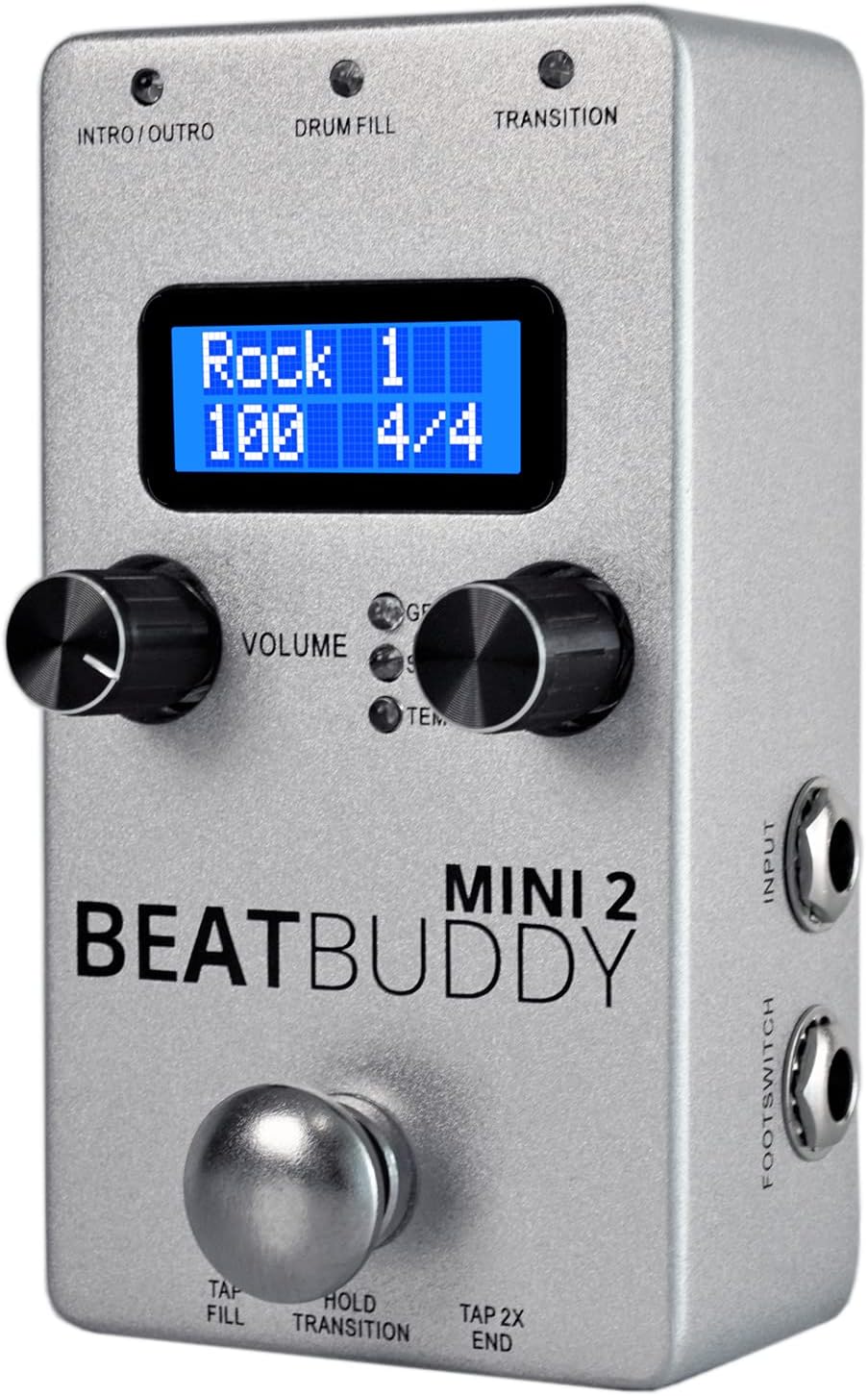
The BeatBuddy Mini 2 (~$129) strips the feature set down to a simpler three-button interface but retains the core fill-and-transition logic. Sweetwater’s product page notes it as the entry recommendation for guitarists who want convincing fills without the overhead of the full BeatBuddy’s song management system.
Groove feel: The BeatBuddy ships with humanized patterns from real drummers, which puts it solidly in the “pre-programmed feel” camp. Owners consistently report that the stock kits sound convincingly live at most genre tempos; the constraint is that you’re choosing from the library rather than sculpting the feel yourself.
Boss DR-01S Rhythm Partner — ~$200 street
The DR-01S is built primarily for acoustic guitarists—its internal speaker and battery option make it gig-ready without a PA—but its footswitch connectivity and tap tempo implementation have earned attention from the broader live-performance community. Sound On Sound’s 2023 coverage of Boss’s floor unit lineup noted the DR-01S’s tempo-matching algorithm as particularly stable compared to earlier Boss floor percussion units.
Groove feel: Boss’s pattern library leans toward relatively clean, quantized patterns with light humanization. Players who want a looser, jazzier feel frequently note in reviews that the DR-01S sounds more “produced” than “live.” That’s not a flaw in every context, but it’s a meaningful tradeoff.
Singular Sound BeatBuddy + MIDI Out — Hybrid Approach (~$299 + MIDI footcontroller)
Intermediate and advanced players frequently pair the BeatBuddy with a MIDI footcontroller to expand scene-switching and fill-triggering options. Perfect Circuit’s buyer notes flag this as a popular upgrade path: the BeatBuddy accepts MIDI program change and note-on messages, so an external controller can trigger fills, change song parts, and start/stop patterns via MIDI without touching the unit itself. This is effectively how working live performers build a stage-viable drum rig around a stompbox form factor.
Eurorack and Modular Approaches (Advanced Segment)
For the modular segment of the audience, “drum machine guitar pedal” starts to dissolve as a category. A Moog DFAM (Drummer From Another Mother, $679 street) in a small skiff can be clocked from a tap-tempo module such as the 4ms Tempi ($229), with fill-like variation achieved through CV-controllable probability gates. This architecture offers the most expressive groove control of any available approach—but it requires per-gig patching and offers no song-structure management. The Perfect Circuit editorial blog’s 2025 notes on live modular percussion setups describe this as “a high-ceiling, high-maintenance proposition” that rewards players who have already solved their basic live workflow.
By the Numbers
| Unit | Street Price | Fill Banks | Tap Tempo | Groove Method |
|---|---|---|---|---|
| BeatBuddy | ~$299 | Multiple per part | Yes (stable) | Pre-humanized library |
| BeatBuddy Mini 2 | ~$129 | 1 fill per pattern | Yes | Pre-humanized library |
| Boss DR-01S | ~$200 | Limited | Yes | Light humanization |
| DFAM + Tempi (modular) | ~$900+ | CV-probabilistic | Via module | Fully sculptable |
The Tradeoffs Nobody Talks About Enough
Tempo stability vs. fill expressiveness is the core tension in this product category. Units with the most convincing fills (BeatBuddy’s long-press transition system) require precise foot timing from the player to execute cleanly. Units with simpler fill logic (one press, one fill) are more forgiving under pressure but sound less dynamic.
Library depth vs. customization is the second major axis. The BeatBuddy’s SD card system gives access to hundreds of community-built packs—Attack Magazine’s 2024 humanization feature specifically called out third-party BeatBuddy packs as among the best-humanized patterns available in any stompbox format. But you’re still selecting from a menu. The DFAM-plus-Tempi path gives you a blank canvas, at the cost of setup time and onstage complexity.
Mono output vs. stereo/aux output matters for players routing into a PA. Some units split kick and snare/overhead to separate outputs, giving the FOH (front-of-house, the main sound engineer at a live venue) more mix control. The standard BeatBuddy has stereo output with optional headphone/aux splits; the Mini 2 is mono only.
The Decision Rule
Here’s the if/then framework based on the patterns in community consensus and published spec comparisons:
- If you’re a solo gigging guitarist who needs reliable fills and fast setup, the BeatBuddy at ~$299 is the consensus recommendation. Its song-management system, multiple fill banks, and humanized library cover 90% of live genre situations.
- If you’re budget-constrained and primarily play straightforward song structures, the BeatBuddy Mini 2 at ~$129 delivers the same core fill logic with a simpler interface. Give up multi-part song management, gain simplicity.
- If your genre skews acoustic or you need built-in speaker/battery option, the Boss DR-01S at ~$200 is the better-suited unit, with the caveat that its groove feel reads as more produced.
- If you’re already running a MIDI-capable footcontroller (such as a Boss ES-5 or Morningstar MC8) and want to expand your drum rig without adding a dedicated controller, the BeatBuddy’s MIDI implementation makes it the strongest integration target in the stompbox category.
- If you’re in the modular segment and treating live percussion as a synthesis problem, the DFAM-plus-tap-tempo-module architecture is the expressive ceiling—but budget at least $900 and factor in the patching overhead before committing to it as your primary live solution.
The drum machine pedal market in 2026 is narrower than it probably should be given how many solo and duo acts play live, which means most players are choosing between a small set of well-understood tools. That’s actually useful: the community consensus on these units is deep, the edge cases are well-documented, and the tradeoffs described above are stable. Pick the unit that matches your fill complexity needs and your tolerance for onstage system management—those two variables will predict your satisfaction more reliably than any single spec.