Going “DAWless” means making music without a computer running a digital audio workstation (DAW)—software like Ableton Live or Logic Pro. Instead, you use standalone hardware: physical boxes that sequence, synthesize, and play back drum patterns entirely on their own. For producers who want to work on planes, in rehearsal rooms, or just away from a screen, compact standalone drum machines have become a genuine creative tool, not just a compromise. This guide breaks down the most talked-about budget options—the Roland T-8, Korg Volca Beats, Korg Volca Drum, Behringer RD-6, and Korg drumlogue—so you can make a clear-eyed decision about which one belongs in your rig.
If you’re already familiar with step sequencers and analog synthesis basics, good—this piece assumes that vocabulary. But the core question here is a practical one: at price points under $300, which of these boxes is actually worth carrying around, and which will frustrate you into a drawer within a month?
| EDITOR'S PICKKORG drumlogue Hybrid Drum Mach… | Mid-tierKorg Volca Drum Digital Percuss… | Budget pickKorg Volca Beats Analog Rythem… | |
|---|---|---|---|
| Synthesis | Hybrid | Digital | Analog |
| Sequencer | — | 16-step | 16-step |
| Active Step | — | ✓ | — |
| Sound Engine | — | — | Real analog |
| Price | $449.99 | $149.80 | $129.98 |
| See on Amazon → | See on Amazon → | See on Amazon → |
The Roland T-8: Battery Power Meets the TR Legacy
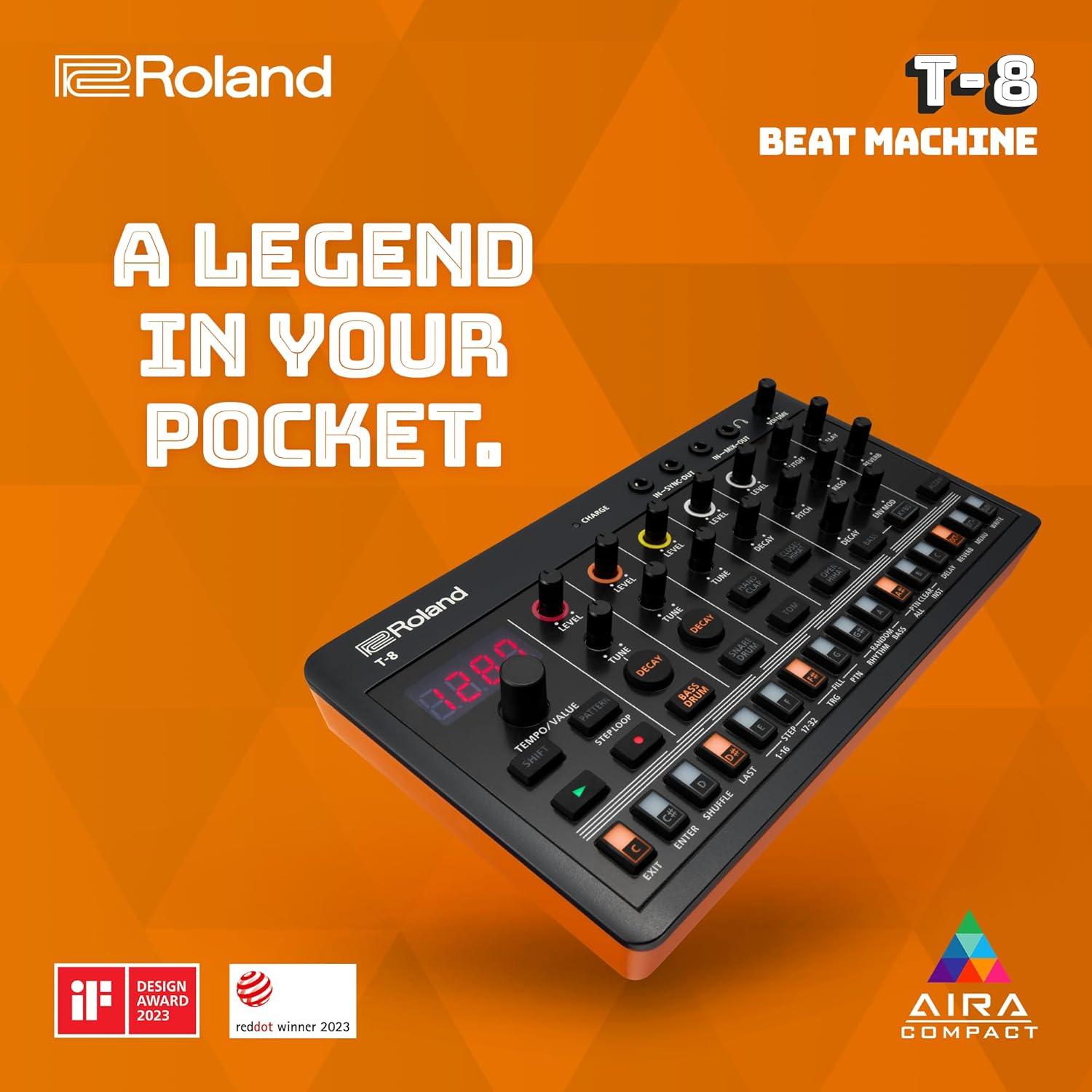
The Roland T-8 is Roland’s entry-level standalone box that combines a beat step sequencer with a bass synthesizer in one compact, battery-powered package. It draws heavily on Roland’s TR (Transistor Rhythm) lineage—the TR-808 and TR-909 are among the most historically significant drum machines ever made, responsible for the sound of hip-hop, techno, and house music at a foundational level. The T-8 does not replicate any single machine in that family wholesale, and that distinction matters.
Sound On Sound’s coverage of the Roland T-8 makes clear that the instrument pulls sounds from multiple TR machines rather than faithfully cloning one complete kit. Owners consistently describe the result as “piecemeal”—you get the TR-808 kick character alongside elements from the TR-606 and TR-707, assembled into a single playable kit. For some producers this is actually a feature: you’re getting a curated cross-section of Roland’s rhythm legacy. For anyone expecting the full 808 palette—all sixteen instruments, true Accent behavior, full decay control on the open hi-hat—this is the wrong box.
What the T-8 does exceptionally well is portability. Owners across forum communities and long-form review threads describe using it on international flights and train journeys, making patterns during commutes and finishing them at the hotel. Battery-powered operation is genuinely functional here, not an afterthought. The built-in speaker is thin, as you’d expect, but the headphone output is clean enough for serious pattern work on the go.
One consistent note from the owner community: YouTube tutorials are close to mandatory for getting the most from the T-8’s interface. The workflow is not immediately intuitive—pattern chaining, parameter locking, and the bass synth integration all benefit from visual walkthroughs. Budget learning time alongside the learning curve. If you’re the type who reads a manual once and moves on, the T-8 will pay off. If you need tactile immediacy out of the box, it can feel opaque in the first sessions.
By the numbers — T-8 vs. Volca Beats quick compare:
| Feature | Roland T-8 | Korg Volca Beats |
|---|---|---|
| Battery powered | Yes (AA) | Yes (AA) |
| Built-in speaker | Yes | Yes |
| Onboard bass synth | Yes | No |
| Pattern recall (live) | Yes | Yes |
| Approximate street price (2026) | ~$199 | ~$149 |
Korg Volca Beats: The One That Started the Conversation
Korg’s Volca series democratized analog drum synthesis in a way few products have. The Volca Beats is the percussion-focused entry in that line—a genuine analog drum machine with a 16-step sequencer, stutter effects, and MIDI in for external sync and triggering. It runs on six AA batteries, has a built-in speaker, and has a street price that makes it one of the most accessible analog drum machines ever made.
MusicRadar’s Korg Volca Beats review describes it as “as close to perfect as you can get for the price,” with particular praise for live pattern recall—the ability to switch between patterns smoothly during performance without dropout or glitch. That’s not a small thing. Many budget sequencers stumble on this, and the Volca Beats handles it with enough grace that live performers have built real sets around it.
The honest friction point: pattern entry. The interface uses a 16-button grid and a small LCD, and programming rhythms is slower and more fiddly than on machines with dedicated pad grids or knob-per-function layouts. If you’re used to the immediacy of a Roland TR-style step entry—where each button maps directly to a step—the Volca’s workflow asks more of you. Owners consistently flag this as the adaptation cost. It’s learnable, but it is a cost.
The analog circuitry does deliver. The kick has real low-end weight. The snare and hi-hats have character that digital emulations at this price point still struggle to match.
Korg Volca Drum: Sequencer Depth at a Price
The Volca Drum is a different animal from the Volca Beats. Where the Beats is a classic analog drum machine, the Volca Drum is a digital percussion synthesizer built around layered oscillators and waveguide resonance—it can create sounds that range from organic percussion to deeply alien textures.
The sequencer is where reviewers go wide-eyed. MusicRadar’s Volca Drum coverage describes the sequencer depth as “pretty ridiculous”: up to 16 hits per step, probability controls per instrument, and parameter locks (the ability to record per-step changes to any parameter, so a single step can have a different pitch, decay, or filter setting than the steps around it). For producers interested in polyrhythm, generative pattern behavior, or detailed sound evolution across a loop, this is an unusually deep toolkit for the price.
The real cost is workflow. Sound design on the Volca Drum is slow. Because most parameters are accessed through menu navigation rather than dedicated knobs, adjusting individual sounds requires multiple button presses and visual reference to the display. Reviewers and owners consistently describe this as the tradeoff: remarkable capability, frustrating to dial in quickly. If you’re a sound designer who works methodically and saves patches carefully, this friction becomes manageable. If you want to turn a knob and hear immediate results, the Volca Drum will test your patience.
Behringer RD-6: The 606 Clone With a Hot Output Problem
The Behringer RD-6 is an analog drum machine modeled on Roland’s TR-606—a compact, battery-powered machine from 1981 that found its audience decades later as a staple of acid techno. The RD-6 reproduces the 606’s character instruments at a price point well below vintage hardware, and its sound quality consistently earns positive owner assessments.
The practical warning that Sweetwater’s product documentation and owner communities both surface: the RD-6’s outputs run hot. Hot outputs mean the signal level is higher than most consumer or prosumer mixers and audio interfaces expect on their standard line inputs. In practice, beginners plugging the RD-6 into a typical audio interface are likely to hit the input ceiling and get distortion before they’ve turned the master volume past halfway. The fix is straightforward—use a pad switch on your interface input if available, or attenuate the signal—but it is a real friction point that catches people off guard.
This is not a dealbreaker for experienced producers who understand gain staging (managing signal levels through a signal chain). It is a meaningful gotcha for newcomers who expect to plug in and play. Know before you buy: the RD-6 requires some signal chain literacy to use comfortably.
Korg drumlogue: Honest Assessment of a Reliability Concern
The Korg drumlogue is the most ambitious machine in this price tier—a hybrid drum synthesizer that combines analog voices with digital plugin slots, allowing users to load custom synthesis algorithms written by third-party developers. On paper, this is an exciting architecture. In practice, the community conversation in 2024 and 2025 shifted significantly around a specific hardware defect.
Synthtopia’s coverage of the drumlogue and owner threads that have circulated through production communities document a recurring issue: instruments randomly dropping steps in patterns. This is not a minor sonic glitch—dropped steps mean your rhythm is actively changing in ways you didn’t program. One owner account that received significant attention documented a hardware defect of this kind, and noted that Korg’s support response was slow enough that the return window closed before the issue was resolved. That outcome—a defective unit, slow manufacturer support, missed return window—is a real risk that belongs in any honest buying guide.
This does not mean every drumlogue unit has this problem. Hardware defects are rarely universal. But for a machine being considered for live performance, where reliability is non-negotiable, the risk calculus looks different than for a studio-only instrument where a crash pauses a session rather than ending a gig. The community consensus heading into 2026 is cautious: the drumlogue’s concept is compelling, but verify your unit thoroughly during the return window, and document any issues immediately.
If X, Then Y: The Decision Framework
Here’s where the tradeoffs resolve into a clear structure:
If you need maximum portability and an all-in-one creative tool for travel: The Roland T-8’s battery power, built-in bass synth, and TR-derived sounds make it the most complete standalone package in this tier. Accept the learning curve and invest time in tutorials.
If you want genuine analog character and live performance reliability at the lowest price: The Korg Volca Beats is the cleaner choice—its live pattern recall is solid, its sound is the real thing, and its limitations (slow pattern entry) are workable once you’re past the adaptation phase.
If you’re a methodical sound designer who wants generative sequencing depth: The Korg Volca Drum’s 16-hits-per-step sequencer and probability controls offer genuinely unusual capability. Accept that sound adjustment will be slow and plan your sessions accordingly.
If you have interface experience and want a classic 606 character: The Behringer RD-6 delivers, but understand gain staging before you buy. Hot outputs are not a flaw you can ignore—they require active management.
If you’re considering the Korg drumlogue for live use: Hold off, or buy from a retailer with a generous return window and test the unit rigorously in the first week. The hybrid architecture is genuinely interesting; the reliability concerns are genuinely real.
The DAWless path at this price tier is more viable than it’s ever been, but the right box depends entirely on whether you’re optimizing for portability, sonic character, sequencing depth, or live reliability. None of these machines does everything—pick the one whose strengths match your actual workflow.
Frequently Asked Questions
Is the Roland T-8 a real TR-808 or TR-909 sound?
Not exactly. Sound On Sound’s coverage confirms that the T-8 draws from multiple TR machines—including the 808, 606, and 707—rather than fully cloning any single one. You’ll recognize the character and heritage, but owners consistently describe the kit as a curated selection rather than a faithful one-machine reproduction. If you need a complete authentic 808 kit, the T-8 is not that instrument.
Does the Korg Volca Beats run on batteries?
Yes. The Volca Beats runs on six AA batteries and includes a built-in speaker, making it a genuinely self-contained portable instrument. Battery life is reasonable for practice and travel sessions, though owners recommend rechargeable AAs for regular use.
What does the Volca Drum’s 16-hits-per-step actually sound like in practice?
Think of it as polyrhythmic density within a single step. Rather than one hit per step, you can pack multiple timed micro-hits—with independent probability settings—creating rolls, flamming effects, and evolving rhythmic textures that a standard step sequencer can’t produce. Combined with parameter locks, a single pattern can generate rhythms that feel alive and variable rather than mechanically repeating. MusicRadar’s Volca Drum coverage describes it as a sequencer that rewards patience and experimentation.
Will the Behringer RD-6 overdrive my mixer or audio interface?
It can, yes. The RD-6’s outputs run at a higher signal level than many interfaces and mixers expect on standard line inputs. Beginners frequently report distortion before reaching moderate volume levels. Using an input pad switch (available on many interfaces) or reducing output level at the source addresses this, but it requires knowing that the problem exists. Check your interface’s input specifications before connecting.
Is the Korg drumlogue reliable for live performance given reported hardware issues?
Community consensus heading into 2026 is cautious. A documented hardware defect—instruments randomly dropping programmed steps—has surfaced in owner accounts, and at least one owner reported that slow support response from Korg caused them to miss the return window. Synthtopia’s drumlogue coverage and owner communities suggest the drumlogue’s architecture is genuinely interesting, but for live performance where reliability is critical, thorough pre-gig testing and a clear return policy are essential before committing.