Behringer has spent the last several years releasing affordable analog drum machines — hardware boxes that generate percussion sounds using real electronic circuits rather than digital audio samples — that take direct inspiration from some of the most iconic rhythm machines ever built. The RD-6, RD-8, RD-9, and RD-78 are circuit-level tributes to the Roland TR-606, TR-808, TR-909, and CR-78 respectively. If those model numbers mean nothing to you yet: those four Roland machines defined the sound of hip-hop, house, techno, and disco across four decades, and original units now sell for thousands of dollars on the used market. Behringer’s versions land between roughly $150 and $350 new, which is why they attract serious attention. This article breaks down what each machine actually delivers, where each one falls short, and which one belongs in your rig — with the math and the tradeoffs named explicitly so you can make the call.
| EDITOR'S PICKSonicware CyDrums [Expressive D… | Mid-tierBehringer RHYTHM DESIGNER RD-8… | Budget pickBehringer Rhythm Designer RD-6-… | |
|---|---|---|---|
| Drum Sounds | — | 16 | 8 |
| Sequencer Steps | — | 64 | 64 |
| Synth Engine | Wavetable | Analog | Analog |
| Battery Power | ✓ | — | — |
| Built-in Speaker | ✓ | — | — |
| Velocity/Pressure | ✓ | — | — |
| Price | $499.00 | $319.00 | $149.00 |
| See on Amazon → | See on Amazon → | See on Amazon → |
The Baseline You Need to Set Before You Buy Any of These
The single most useful framing for this entire lineup comes from reviewers who own both the Behringer versions and the original Roland hardware. The consistent verdict across coverage at Sound On Sound and MusicRadar is a version of the same sentence: surprisingly close for the price, but not a 100% replica. Synthtopia’s RD-78 hands-on preview coverage is especially instructive — it quotes an owner with a vintage CR-78 describing the Behringer as “not a 100% clone but gets you so close.” That phrasing matters. These are not forensic replicas. They are analog machines built around similar circuit topologies — the basic electronic architecture — that produce sounds in the same family as the originals. For most production contexts, that’s more than enough. For mastering engineers or sample-library purists comparing waveforms, it probably isn’t. Know which camp you’re in before you read a single spec.
The second baseline: every machine in this lineup uses a step sequencer workflow inherited from the late 1970s and early 1980s. A step sequencer programs rhythms by turning on or off a series of buttons (typically 16) that represent subdivisions of a bar. There is no piano roll, no drag-and-drop, no touch screen. Attack Magazine’s buyer guidance for budget analog drum machines consistently notes that this workflow is simultaneously what makes these machines authentic and what creates the steepest learning curve for producers who have only worked inside modern DAWs (digital audio workstations — software like Ableton Live or Logic Pro). If you are comfortable with step sequencing, these machines will feel natural within an hour. If you are not, budget a weekend.
How the Four Machines Stack Up
The table below shows the essential specs at a glance. The sections that follow examine each machine in depth.
| Machine | Roland Inspiration | Voices | Street Price (approx. 2026) |
|---|---|---|---|
| RD-6 | TR-606 | 7 | ~$150 |
| RD-8 | TR-808 | 11 | ~$299 |
| RD-9 | TR-909 | 11 | ~$299 |
| RD-78 | CR-78 | 14 | ~$349 |
RD-6 — The Entry Point
The RD-6 is a seven-voice analog drum machine covering the essential TR-606 palette: bass drum, snare, two toms, open and closed hi-hat, and cymbal. Sweetwater’s RD-6 product listing and buyer Q&A section consistently flags it as the most approachable unit in the family for someone new to hardware sequencing, largely because the voice count is low enough that the front panel doesn’t feel overwhelming. The tradeoff is that the 606 source material was always the thinner, higher-pitched sibling to the 808, which means the RD-6 sits better in punk, EBM (electronic body music — a hard-edged industrial dance genre), and lo-fi contexts than in bass-heavy trap or house where you need a commanding kick.
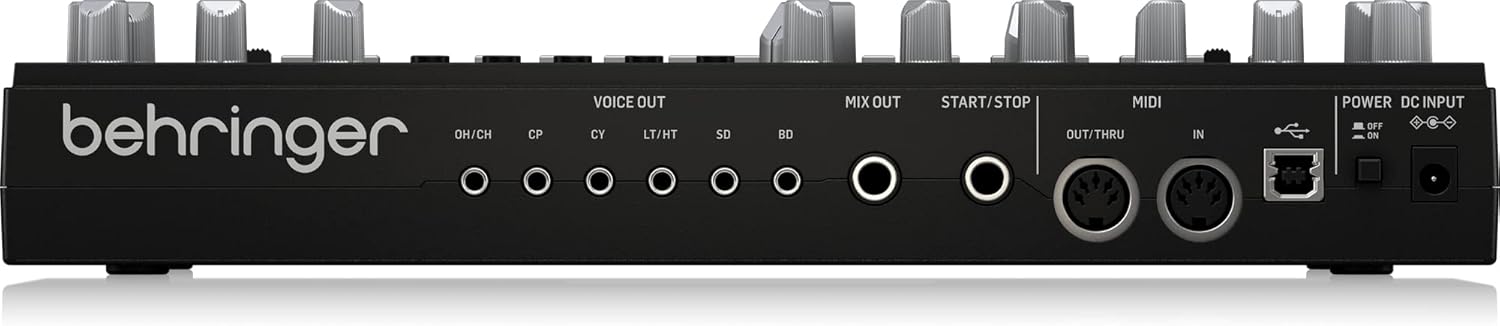
The hot output issue: Across owner feedback aggregated at Sweetwater, the single most common technical complaint for the RD-6 is that the audio output is hot — meaning the signal level coming out of the machine is higher than what most consumer-grade or prosumer audio interfaces and mixers expect. Plugging the RD-6 directly into a standard interface input at full volume will almost certainly overdrive the input (adding unwanted distortion at the preamp stage). The fix is straightforward: pad the input on your interface if it has a -20 dB pad switch, use a DI box with attenuation, or simply bring the machine’s master volume down before routing.
Behringer
$149.00
In stock on Amazon
Check price on AmazonRD-8 — The 808 Clone
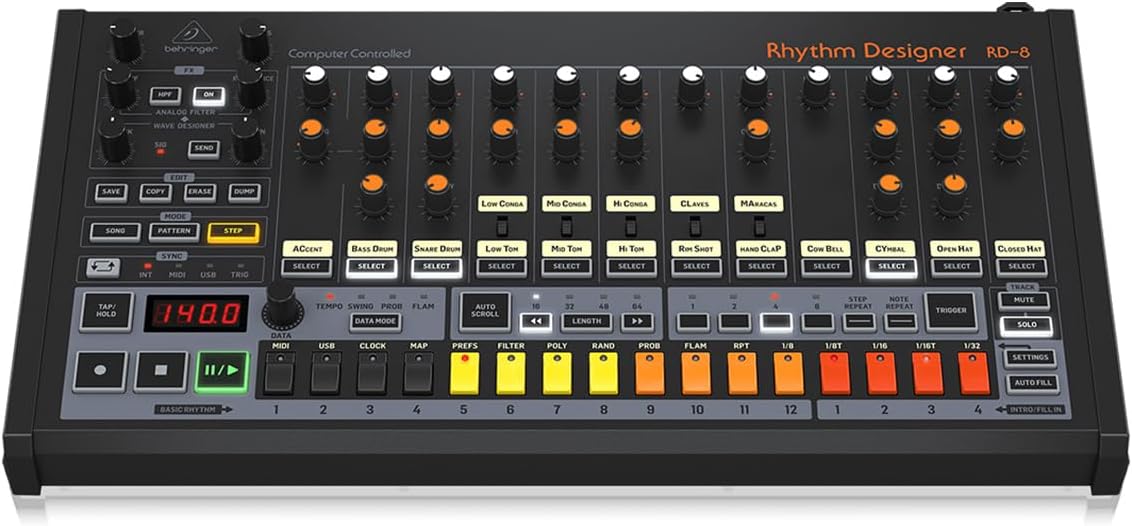
The RD-8 covers the full TR-808 voice set — bass drum, snare, low/mid/high conga, low/mid/high tom, rimshot, cowbell, hand clap, and maracas — with per-voice pitch and decay controls that closely mirror the original panel layout. Sound On Sound’s RD-8 review acknowledges that the machine gets the essential character of the 808 right at a price point that was unthinkable five years prior.
There is one compositional limitation in the RD-8 that experienced buyers flag consistently enough to treat as a known constraint rather than a complaint: the maracas and hand clap cannot be triggered simultaneously, even over MIDI. This is a hardware-level limitation inherited from the original TR-808’s architecture. If your production style leans on layered percussion hits — stacking the clap and maracas on the same beat for a thicker transient — you will work around this by resampling, layering in your DAW, or triggering a second sound source in parallel. It is not a dealbreaker, but it is a real compositional boundary you should know before you build a live set around it.
The hot output issue documented at Sweetwater for the RD-6 applies equally to the RD-8. Pad the input or attenuate before routing to your interface.
Behringer
$319.00
In stock on Amazon
Check price on AmazonRD-9 — The Machine That Rewards the Right Expectations
The RD-9 generates more polarized reviews than anything else in the Behringer drum lineup, and the reason is entirely about expectations management. MusicRadar’s RD-9 review captures the pattern clearly: buyers who expected a processed, radio-ready version of the TR-909 — the punchy, reverb-soaked kick and snare that appears on thousands of house and techno records — are disappointed. Buyers who understand that the original TR-909 was designed to be a dry, somewhat dark-sounding machine that engineers and producers then processed heavily in the studio love it immediately.
The TR-909 was never a finished sound. It was raw material. The polished 909 sounds you know from classic Detroit techno and Chicago house records came from external compression, reverb, and EQ applied in the mix — not from the machine itself. Owners who approach the RD-9 that way, running the kick and snare through a compressor and a room reverb, consistently report that it drops right into the genre context they were aiming for. Owners who expect it to sound like a finished record out of the box reliably feel shortchanged. Attack Magazine’s analog drum machine buyer guidance reinforces this: the RD-9 is correctly understood as a signal source, not a polished end product.
The hot output issue applies here as well, per owner reports documented at MusicRadar. Pad the input or attenuate before routing to your interface.
Behringer
$319.00
In stock on Amazon
Check price on AmazonRD-78 — The Outlier in the Lineup
The RD-78 draws from the Roland CR-78 — an older, more esoteric machine from 1978 that predates the 808 and was originally marketed as a home entertainment device before producers discovered its distinctive metallic percussion sounds on records by Phil Collins and Blondie. The CR-78 has a cult following that is smaller but intensely committed, and the RD-78 serves that specific audience.
Synthtopia’s RD-78 hands-on preview coverage quotes owners with vintage CR-78 units as consistently impressed by how close the Behringer gets — but equally consistent in noting it is not a perfect match. The RD-78 offers 14 voices and adds programmability that the original CR-78 lacked in its preset-only form, which makes it genuinely more flexible as a studio tool while being a less forensically accurate replica. For producers who want the CR-78 sound palette (rimshot, guiro, maracas, tambourine, and a distinctive bass drum with a slow attack) without spending $1,500–$2,500 for a vintage unit in working condition, the RD-78 is the only realistic option in the current market.
Sonicware
$499.00
In stock on Amazon
Check price on AmazonAre These Machines Beginner-Friendly?
The honest answer is: they are beginner-friendly in terms of sound design — the knobs are labeled, the voices are discrete, and there is nothing abstract about turning a decay knob to shape a kick drum. The step sequencer workflow is not beginner-friendly if your reference point is modern software. Attack Magazine’s buyer guidance consistently frames this as the authentic vintage experience and a genuine usability barrier simultaneously — both things are true, and neither cancels the other out.
If you have never operated a hardware step sequencer, the RD-6 is the most forgiving starting point because the reduced voice count (seven voices versus eleven or fourteen) means fewer tracks to manage while you are learning the pattern entry logic. Once the workflow clicks, moving to the RD-8 or RD-9 is a straightforward step up rather than a restart.
Frequently Asked Questions
Why do Behringer drum machine outputs overdrive my mixer? The RD-6, RD-8, and RD-9 all output a hotter signal than the standard line level most modern interfaces expect. Use your interface’s -20 dB pad switch if available, or route through a DI box with attenuation. Reducing the machine’s master output level before hitting your interface input is the fastest fix. This issue is documented in owner Q&A at Sweetwater and in MusicRadar’s RD-9 review.
Is the RD-9 supposed to sound dry and dark out of the box? Yes — and this is by design, not a defect. The original TR-909 was a dry machine intended to be processed in the mix. The polished, punchy 909 sounds on classic house and techno records came from compression, reverb, and EQ applied externally. Attack Magazine’s analog drum machine buyer guidance and MusicRadar’s RD-9 review both reinforce this framing: treat the RD-9 as raw source material, process it, and it delivers.
Can the RD-8 trigger maracas and clap at the same time? No. This is a hardware-level limitation that mirrors the original TR-808. The maracas and hand clap voices share a circuit path that prevents simultaneous triggering, even via MIDI. The workaround is to layer one of the sounds from a second source or resample both voices and combine them in your DAW.
How close is the RD-78 to an original Roland CR-78? Owners with vintage CR-78 units consistently describe the RD-78 as very close — close enough to serve the same genre and tonal role — while being careful to note it is not a 100% match. Synthtopia’s RD-78 hands-on preview coverage captures this as “not a 100% clone but gets you so close.” For most production contexts the gap is academic. For archivists or sample-library work, it will matter.
Are these machines beginner-friendly or do they require experience with vintage workflows? The sound design side is accessible. The step sequencer workflow requires time to learn if you are coming from a DAW-only background. Budget a weekend of focused practice before expecting to move fast.
Which Behringer analog drum machine is the best starting point for someone new to hardware sequencing? The RD-6. The lower voice count reduces the front-panel complexity while you are learning the sequencer. Once the workflow clicks, moving to the RD-8 or RD-9 is a natural next step.
The Decision Rule
If you want the 808 palette and you are comfortable with a known hardware limitation around simultaneous voice triggering: RD-8. If you produce techno or house and you understand that you are buying a signal source to process — not a finished sound: RD-9. If you are entry-level on hardware sequencing and want to build the muscle memory without the complexity overhead: RD-6. If you are chasing the CR-78 sound palette specifically and vintage units are out of budget: RD-78 is the only current option that gets you into that territory. None of these machines are wrong. They are calibrated differently, and the right one is the one that matches what you already know about how you work.