If you perform solo — just you, your guitar or keyboard, and a live audience — one of the most practical problems you’ll ever solve is the drummer question. A drum machine pedal (a compact, floor-mounted device that plays pre-programmed beats you can trigger with your foot while your hands stay free to play) is the solution thousands of solo performers have landed on. Unlike a full drum machine that sits on a table and demands your eyes and hands, these pedals are designed to be controlled without breaking your flow onstage. The two names that come up most consistently in this search are the Singular Sound BeatBuddy and the MOOER D7 X2, with the smaller MOOER Micro Drummer II worth a serious look at the value end of the market. This article maps the real-world tradeoffs between them so you can make a clean decision — not a hopeful one.
One note on framing before we dive in: the Arturia DrumBrute is a genuinely excellent drum synthesizer, but it is a tabletop instrument that requires hands-on programming. It is built for studio composition and hands-on performance, not for a solo guitarist who needs to stomp through a two-hour set while keeping both hands on the instrument. Keeping that distinction clear shapes everything that follows.
What You’re Actually Choosing Between
These pedals solve the same surface-level problem but reflect meaningfully different philosophies about how a solo performer should interact with their rhythm section.
The BeatBuddy: A Virtual Drummer, Not a Loop Player
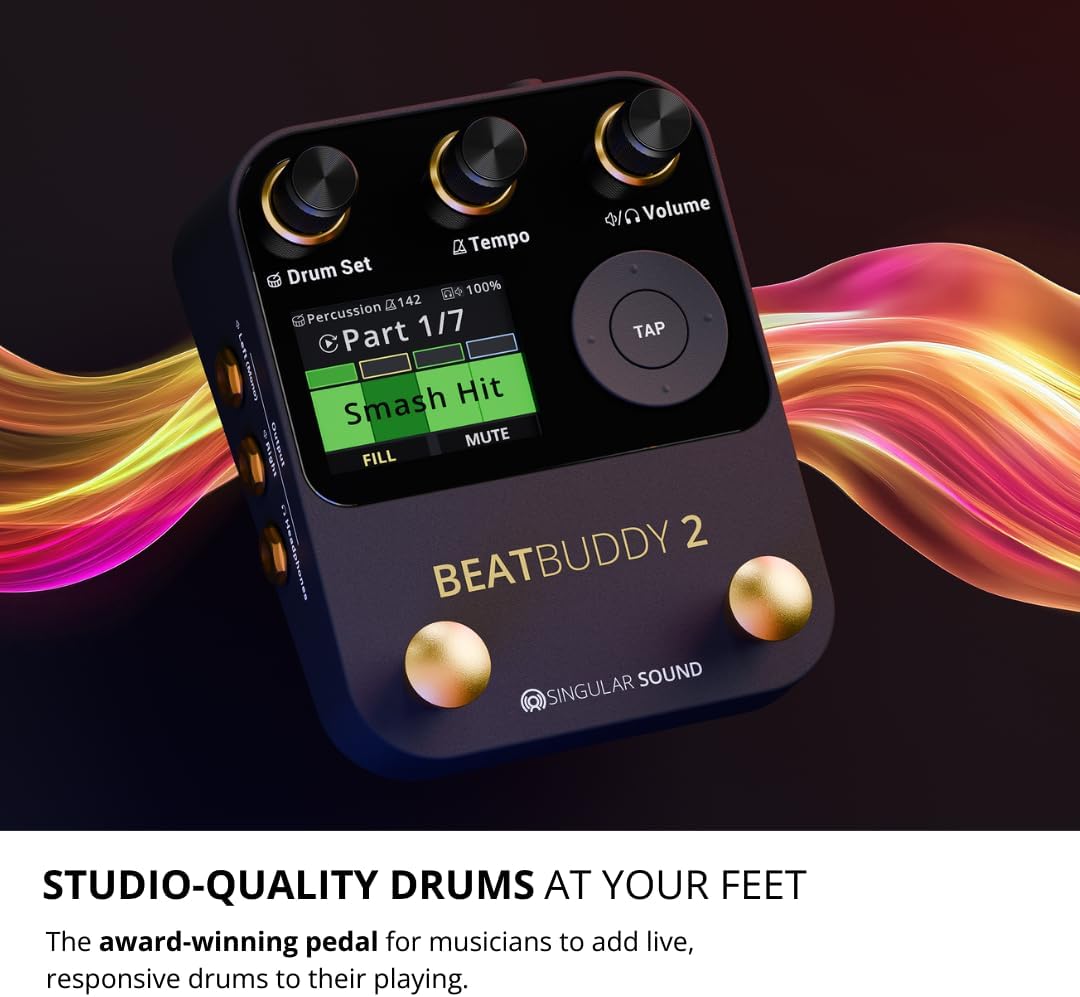
The BeatBuddy — and its more affordable variant, the BeatBuddy Mini 2 — is built around the concept of a virtual drummer with genuine musical dynamics. The audio engine plays multi-layered, velocity-sensitive drum kit samples, not one-shot loops, which is why so many owners describe the result as having a “human feel” that flat loop-based competitors miss. Sound On Sound’s review of the Singular Sound BeatBuddy noted the approach of using actual drumming performances segmented into intro, main groove, fill, and outro sections — an architecture that is closer to how a real drummer thinks about song structure than how most beat machines work. Sweetwater’s product overview for the BeatBuddy confirms the SD card expandability that allows users to load custom WAV-based drum kits, which distinguishes it from every other option in this comparison.
Singular
$499.00
In stock on Amazon
Check price on AmazonThe MOOER D7 X2: Speed and Simplicity Above All
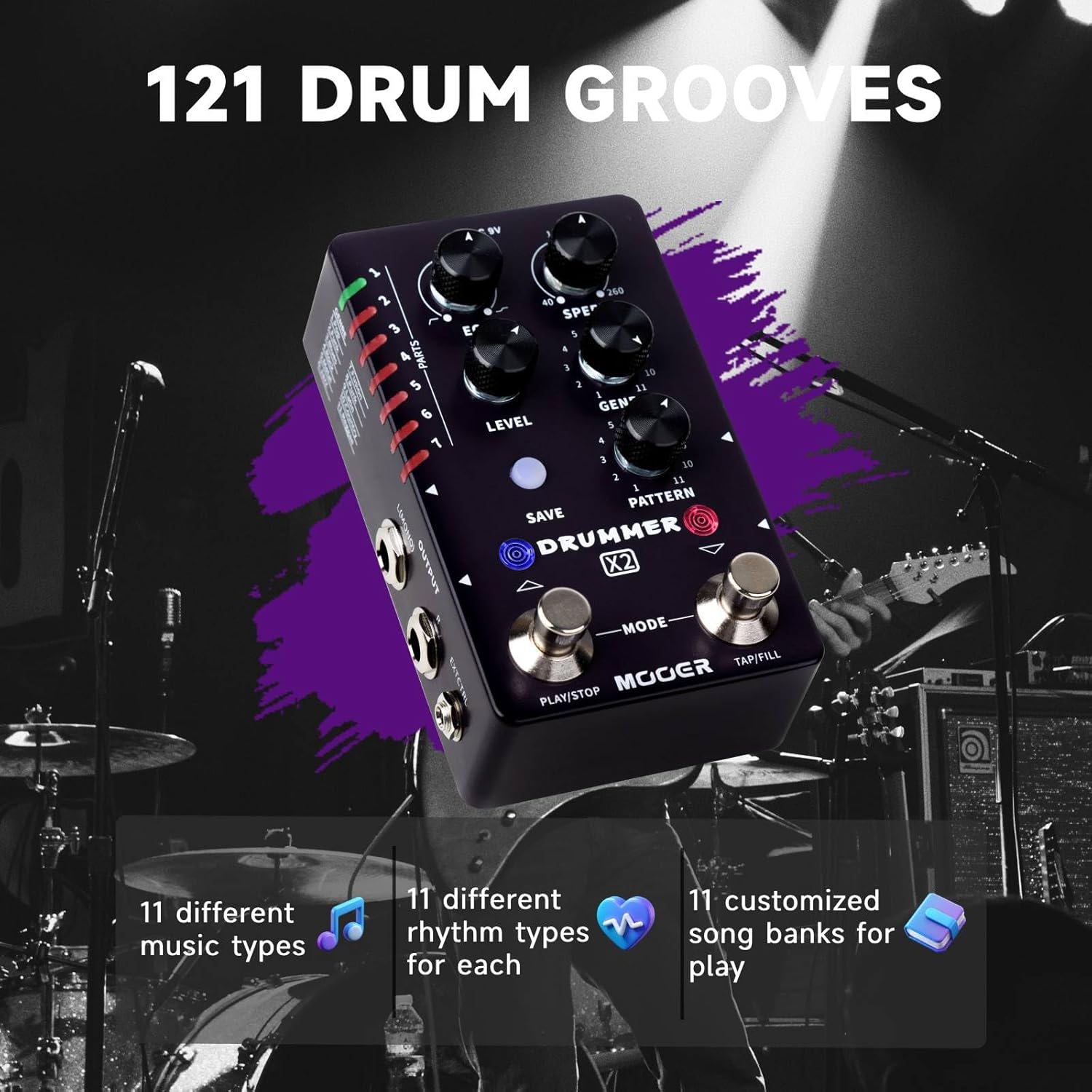
The MOOER D7 X2 is built around immediacy and knob-per-function control. Synthtopia’s coverage of the D7 X2’s announcement highlighted the all-hardware interface — no screen navigation, no menu diving — as the headline design philosophy. Every core parameter has a dedicated knob or button. For performers who want to dial tempo and pattern in under three seconds without looking down, that operational speed matters enormously in a live context. The D7 X2 ships with 48 rhythm patterns spanning rock, blues, funk, country, and pop, and owner accounts confirm the patterns are professional and performance-ready. The constraint is that what ships is what you get — there is no sample import, no custom kit loading, and no SD card expansion slot.
Korg
$129.98
In stock on Amazon
Check price on AmazonThe MOOER Micro Drummer II: The Overlooked Entry
The MOOER Micro Drummer II is the compact entry in this conversation: a smaller, simpler device that earns a separate mention because it over-delivers in specific use cases. Perfect Circuit’s product listing for the Micro Drummer II confirms non-standard time signatures including 5/4 and 7/8 among its 70-plus onboard rhythms — an unexpected creative bonus that is genuinely rare at this price tier. Reviewers have also consistently praised the headphone output as clean and loud enough for genuine practice use, making the Micro Drummer II function as a standalone headphone amp for late-night practice sessions. For odd-meter songwriters and players who want a two-in-one device, this matters.
MOOER X2
$110.99
In stock on Amazon
Check price on AmazonBy the Numbers
| Feature | BeatBuddy | BeatBuddy Mini 2 | MOOER D7 X2 | MOOER Micro Drummer II |
|---|---|---|---|---|
| Onboard patterns | 200+ songs, expandable via SD | ~100 songs | 48 rhythm patterns | 70+ rhythms |
| Interface | Small screen + footswitches | Simplified screen + footswitches | All-knob, no screen | Knob-based, minimal |
| Time sig options | Primarily 4/4, some extended | Primarily 4/4 | Standard (primarily 4/4) | Includes 5/4, 7/8 |
| Expandability | Yes — SD card, import WAVs | Limited | No | No |
| Headphone output | Yes | Yes | Yes | Yes — praised for practice use |
Where Each Pedal Earns Its Place
BeatBuddy: Genre Fluidity and Sample Depth
The case for BeatBuddy is strongest when your set list spans multiple genres and you need the drums to feel like a real bandmate rather than a click track. The velocity-sensitive sample engine — described in detail in Sound On Sound’s BeatBuddy review — produces a groove that audiences do not immediately recognize as a machine, which is a high bar for a floor pedal.
The expandability story is genuinely compelling. The SD card slot accepts custom drum kits built from your own WAV samples, and Sweetwater’s product overview confirms this functionality as a core hardware feature rather than a firmware add-on. For producers who have strong opinions about their snare samples, this is the only pedal in this comparison that lets you act on those opinions with your own audio files.
That said, the frustration points are real and recurring, and you should go in with eyes open.
Tempo does not lock between songs. This is the most consistently cited complaint from working solo performers: when you switch songs on the BeatBuddy, the tempo resets to whatever that preset’s stored default is, requiring a manual adjustment. There is no global tempo lock that persists across song changes. For a structured set where every song runs at the same tempo, this is a non-issue. For anyone moving between a slow blues at 72 BPM and an upbeat pop number at 130 BPM, you will be tapping tempo or scrolling numbers between songs unless you carefully pre-program your set in advance using the BeatBuddy Manager desktop software.
The outro cannot be disabled globally. When you double-tap the footswitch to end a song, the BeatBuddy plays an outro fill before stopping. Performers who need a clean, immediate stop on demand — to cut the drums exactly on a lyric or a chord — report this as a genuine workflow problem. The workaround most performers land on is using the pause function instead of a full stop, or pre-programming sets so that the outro duration is tolerable. It is a workaround, not a solution.
MOOER D7 X2: Fast, Reliable, Fixed
The MOOER D7 X2’s all-knob interface is faster in a live context for performers who know their set’s tempo and pattern requirements ahead of time. Synthtopia’s coverage of the D7 X2’s release specifically highlighted the knob-per-function design as the defining differentiator from screen-based competitors: dialing tempo on the D7 X2 takes one hand gesture with no menu navigation required.
MusicRadar’s roundup of drum machines — “Best drum machines 2025: the best beat-making devices for every budget” — notes that pattern count is often less predictive of live usefulness than pattern quality and tempoability. The D7 X2’s 48 patterns score well on quality; the limitation is breadth. If your genre is covered in the factory library, you will likely find what you need. If you need jazz brushes, flamenco, or Afrobeat grooves, there is no expansion path.
MOOER Micro Drummer II: Practice Tool That Doubles as a Gig Pedal
The Micro Drummer II earns its place in this comparison not by competing directly with the D7 X2 or BeatBuddy on stage features, but by solving a different problem more completely than either of them. Perfect Circuit’s listing confirms the non-4/4 time signatures — 5/4 and 7/8 among others — and the headphone output that reviewers consistently praise as genuinely usable for late-night practice without a speaker. At its price point, having a device that functions as both a practice drum machine and a headphone amp is a meaningful value argument for solo players who rehearse privately as often as they perform publicly.
The odd-meter rhythm selection also makes the Micro Drummer II the most creatively interesting option in this comparison for progressive, folk, and jazz-influenced players — a distinction that the full D7 X2 does not address.
The Decision Frame
The comparison maps cleanly onto three performer profiles:
If your priority is musical authenticity and your set spans multiple styles: The BeatBuddy is the stronger instrument. The human-feel sample engine is genuinely differentiated, the expandability via SD card and custom WAV kits is real, and the genre coverage is the widest of any pedal here. Budget time to pre-program your set in the BeatBuddy Manager desktop software — working around the tempo-reset and outro issues requires front-loading that prep work rather than fighting the hardware mid-show.
If your priority is speed and simplicity and your set is stylistically focused: The MOOER D7 X2 is the leaner, faster tool. No screen, no menus, no SD card management. You lose sample customization and gain operational simplicity. If you play blues, country, or rock-oriented sets with consistent tempo ranges and want to spend zero time in a desktop editor, the D7 X2’s interface philosophy fits that workflow better.
If you’re practicing solo, playing intimate acoustic sets, or working with odd meters on a tight budget: The MOOER Micro Drummer II is the overlooked option worth considering seriously. The headphone amp functionality alone justifies the price for many buyers, and the non-4/4 rhythms make it more creatively interesting than its entry-level positioning suggests.
One last note on the BeatBuddy Mini 2: for most intermediate performers, the full BeatBuddy is worth the upgrade. The Mini 2’s simplified interface and reduced song library suit beginners, but the limited SD expandability is a real ceiling for anyone planning to build a custom kit library. The consistent owner sentiment is “buy the full BeatBuddy once” rather than starting with the Mini 2 and upgrading later.
Frequently Asked Questions
Can you lock the tempo on the BeatBuddy so it doesn’t reset between songs? Not globally, as of mid-2026. Tempo is stored per-song, so switching songs resets tempo to that song’s preset. The practical workaround is pre-programming your entire set in the BeatBuddy Manager software with all tempos manually adjusted so the reset lands on your correct tempo by design.
Is the BeatBuddy Mini 2 good enough, or is the full BeatBuddy worth the upgrade? For live performance and anyone planning to expand their drum kit library with custom WAV samples, the full BeatBuddy is the better long-term purchase. The Mini 2’s limited expandability caps your customization options. If budget is the constraint and your set is simple and single-genre, the Mini 2 gets the job done — but performers who started there and upgraded consistently report wishing they had bought the full version first.
How many beats does the MOOER D7 X2 have, and are they usable live? The D7 X2 ships with 48 rhythm patterns. As noted in Synthtopia’s coverage of the pedal’s announcement, the patterns span rock, blues, funk, country, and pop. Community consensus is that quality is high and patterns are performance-ready. The limitation is breadth, not quality.
Can the BeatBuddy outro be disabled? Not as a global toggle, as of mid-2026. The outro fires automatically on the standard double-tap stop command. Common live workarounds include using the pause function instead of a full stop, or managing the signal at the mixer level. It remains one of the most consistently requested firmware features from working solo performers.
Does the MOOER Micro Drummer II work as a headphone amp as well as a drum pedal? Yes, and this is one of its most praised practical features. Perfect Circuit’s product listing confirms the headphone output, and owner accounts validate it as a real-world feature clean and loud enough for genuine practice use — making the Micro Drummer II useful as a standalone headphone amp for guitar or bass when you want drum backing in your ears without powering a speaker.